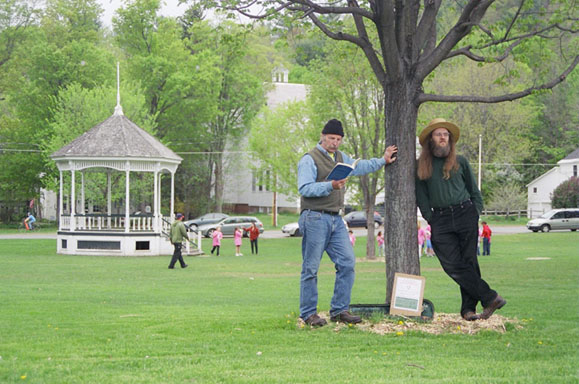
New from Woodburners December 17, 2006 ~ OFF THE TOP OF MY HEAD

Link to our Bookshop
 From Woodburners (link
to this for the complete webpage anthology): The Stories of the Street, An Anthology
From Woodburners (link
to this for the complete webpage anthology): The Stories of the Street, An Anthology
Cid Corman — The
Next One Thousand Years
Home / About Longhouse / Books for Sale / Friends & Links / Contact Us/To Order / Write Us
Earlier 2006 Woodburners Little Leaves, King Harvest / Patricia Smith / HIS MUSIC BENT, JAMES L. WEIL (1929 — 2006) / !MPEACH / JF I R E W O R K S / A Barn, Some Books, The Birds / June Coda / June Bug Rattle Screen / Called Back / Remembering Hui-Ming Wang / A Gary Snyder Visit / Remembering Ian Hamilton Finlay / April Showers / Dennis Weaver / Woodburners Celerates A Few Recent Films & March In Like A Lion / Together Forever / Farewells / Valentine / What You Will Not Hear / Winter News
WOODBURNERS WE RECOMMEND : OFF THE TOP OF MY HEAD ! We celebrate in solidarity the street cry hurrah for the end of Pinochet ! So many fine and wholesome and good to share things in the mail recently, or off the street, or given. The eternal given. The more I look at this degenerate government, leadership, and role playing of the greater artist - I'd rather fly away. I once met a phantom up in the dark November backwoods of Vermont, near ski country, where deaths are becoming a usual thing. Another shot dead on a back road just the other day. Along a river washing cold mountain water from some unknown place, from a drop. But once upon a time out in the woods looking for someone, I came upon this phantom. And this hooded smelly one, varmint sprayed, peered out of his cave clothing when I queried and spoke back with simple truths: "Nope" and "Yup". Then he flew down through the trees, blackened as they were in the heavy rain, and was gone. Not bad for a guy I later found out was well over 70 years old.
Anne Waldman has a new and pretty interesting book out, and it's all Anne. High spirit and gifting photographs of old gone pals and poets and retaining the whole: Outrider (La Alameda), poems, essays and interviews you won't get out of the poetry community without knowing sometime in your life. May as well begin. And how did this poem epitomize what I've termed the "Outrider" tradition since 1974 when Allen Ginsberg and I founded the Jack Kerouac School of Disembodied Poetics at Naropa University? The Outrider holds a premise of imaginative consciousness. The Outrider rides the edge - parallel to the mainstream, is the shadow to the mainstream, is the consciousness or soul of the mainstream, whether it recognizes its existence or not. It cannot be co-opted, it cannot be bought. Or rides through the chaos, maintaining a stance of "negative capability", but also does not give up that projective drive, or its original identity that demands that it intervene on the culture. This not about being an Outsider. The Outrider might be an outlaw, but not an outsider. Rather, the Outrider is a kind of shaman, the true spiritual "insider". The shaman travels to zones of light and shadow. The shaman travels to edges of madness and death and comes back to tell the stories.
After the above, the poet I would then go to seek immediately and immerse, and there is the book coming forth to follow, Joanne Kyger, About Now. I haven't held the book yet, but at 800 pages, and Collected, and that means at least 40 years of poetry and living, and I have certainly read all the separate books over those 40 years...there will be meaning. Find and read, give away as gift, counsel all booksellers, teachers and readers. Copy a poem from the book and pin up on a tree, post, laundromat wall where all best readers still congregate.
Fresh in, I have to reach for the morning mail: Banana Baby, Louise Landes Levi (Supernova [email protected]) in Italian & English. Louise, vagabond poet/minstrel/seeker in full glory expressionist as painting and words long poem song. From America to Europe and a world called home this poet opens the greatest of hearts vulnerable street fighter and humbled visitor all at one embrace. Stylist par excellence. I dream I exist.
Ah, shoulda and coulda been better Chicago Review/Kenneth Rexroth/sixtieth anniversary issue : meant as a celebration of the celebratory one - anarchist/Chicago/San Francisco/Beat/wunderkind literary man, and it all somehow comes up tired. The best of the gathering is the springfed clutch of Rexroth's correspondence with Zukofsky, Yvor Winters, Jonathan Williams and others. All pertinent and so enriched, as always. The rest of the bunch is satisfactory enough, or else just sapped by the customary inclusion and certainly none lacking with sincerity. Jack Spicer is primo Spicer announcing Rexroth's "death" decades before it happened. Robert Bly comes in with a little more of his tweaked magic in essay form. But where's the ground breakers, where's the physical and unified literary and political dangerous mind, where's the beef? A dead man, buried in Santa Barbara, with an eye to see the Pacific (I went to Rexroth's grave once, the Pacific can be seen if you stand on tip-toes) is the life of the party here! Where is the lust of the young poets and thinkers? Jeezus, Sam Hamill and Bradford Morrow are just about tapped out dancing across the stage in a one-two Rexrothian shuffle. I'm sick of listening and watching these two beat an old drum with bleeding fingers for their own pal. Didn't anyone else love this guy? Isn't there anyone out there 25 years old with a hardon for something other than themselves? The cover to the issue is pretty ugly even though the poet drew it of himself. Rexroth couldn't have been more wrong about Gertrude Stein (and time has proven him wrong) but it is about the one and only time he was so flat wrong since almost everything else he wrote and said and spoke and scripted into poetry and translation could be massaged or taken apart and used elsewhere and serviced. Listen to him for a moment here. It's raw and sensational and garnished with a disappearing expertise, as shared with Jonathan Williams by letter in 1951: Like a pianist or violinist - you can't be an artist without long hours of constant practice. This is the training - then you've got to get out & put it to use. Work as a gandy dancer or harvest hand or longshoreman - go to sea - get locked up often - jive your affairs with waitresses and cannery girls & whores - work for a bookie - etc. etc. See it all, get your nose in the sweaty armpits of real people. And keep away from dilettantes - potters, weavers, and [ ] dancers. I don't wish you any hard luck, but Danbury will do you a lot more good than Black Mountain - if you throw your lot in with the cons and avoid the martyred do-gooders.
Almost all poets today were kids who couldn't climb trees, swim, or wrassle and were afraid of rough games - so they read Edgar Rice Burroughs, played with themselves, and eventually took to Art. They are poets because they are incompetents. Nobody gives a damn about poetry except a few other malformed freaks like themselves who know less than they do - so they can get away with anything & anything at all. Read Glass Hill, Inferno, Golden Goose, etc, etc. It's not a question. Anybody could do it. Almost anybody could do it better. If you could run a lathe, rope a cow, dig a ditch, fix a car, or fuck a woman, you could do better than anybody in the little poetry magazines after about two hours coaching.
Rough stuff. And amen. I read this aloud to my wife Susan who studied with Kenneth Rexroth in Santa Barbara 1969 and she nodded her head with glee. She also said the don of 'poetry & song' (the name of his class) seemed a bit smug and self-contained when seen walking the campus all alone. Drab, baggy clothing. And a face of radiance. It's not an easy chore gathering these special issues of kings, and the Chicago Review has recently gone wonderfully overboard with galas for Louise Zukofsky, Edward Dorn and now Rexroth. Long ago I would have thought one to Lorine Niedecker would have been absolute - even before Zukofsky - but let's wait and watch, there's always hope a new day may be dawning.
For a new journal exciting each issue, colossal to hold and just begin to wade into, packed with surprise and even much of the same gimmie (same poets all the time all issues everywhere else, blah blah blah) but done with a splendor all its own and with massive appetite for showcasing past/present poets: in this issue it's Dallas Wiebe's "The Kansas Poems" just for starters. Man, I do love their gusto! Edited by Deb Klowden & Ben Lerner - NO: a journal of the arts (www.nojournal.com)
Meanwhile, don't be silly, it's now on the bookshelves staring out at us with the best poetic glare ever: The Complete Poetry, Cesar Vallejo (U/Cal Press) edited & translated by Clayton Eshleman and decades of work and persistence and belief to see this come, and be made from the hands who know quite exactly how to design a book per poet. See their press work on Olson, Creeley, Berrigan, Niedecker collections just for starters. Like naming a sail boat or a race horse, this press stamps a quality from head to toe. The photograph of Vallejo is magnificent. Just look at the size of the tiny book he holds in his hungry hands. Remove the book jacket and it's night time, death time, solace. Whether they are the best translations the poet ever wrote no longer matters. These are the poems at the present moment, in quantity, in flush, maximus and finally. Spend all your rent and own it for the rest of your life. And female is the soul of the absent-she / And female is my own soul.
While reading Vallejo/Eshleman think a moment of Virginia Woolf. Sure, it's possible. Wood is a pleasant thing to think about. It comes from a tree; and trees grow, and we don't know how they grow. What Mary Ann Caws will sum up so elegantly in her equally elegant and delicate book on translation (perfect to go head to head with the Vallejo, so own both) Surprised In Translation (Chicago) Caw's has this to offer about Woolf : It is clear right here, in this moment, that delight is associated with thought, and with the lack of knowledge. We think about, we delight in thinking about, that which we do not yet know, like this wood and this tree. Thought radiates out from the center, not in a straight line: this is modernism, the nonlinear. See what grows and permits growth, and what does not.
----------
TUBA
The dance of differing
orthographies is all
but forgotten now.
Her stomach spoke
an ancient fish language
of the Cui ui ticutta.
His stomach chattered
ancient squirrel words
of the Koop ticutta.
Now their grown kids eat
tuba once in a red moon
and talk only by e-mail.
He dares not boss her around
anymore-Lord, if he did, she
might inhale Jim Beam and
race to the Indian cemetery
and piss on the grave
he so foolishly keeps
crawling out of.-Adrian C. Louis
Logorrhea (Triquarterly. 2006)------------
I have always enjoyed coming upon an essay or even letter from E.L. Doctorow in an issue of "The Nation". In a slim book collection of essays - not as exciting. Creationists, selected essays 1993-2006 (Random House) does have some sharp thinking about Mark Twain and Melville composing Moby-Dick, and even more on Harpo Marx and Albert Einstein, and an exceptional last chapter on "The Bomb". If Doctorow has anything, and he has much, it's his one or two line skill at distilling a whole chapter. Plus his fine eye character to Americana, now a very old and fussy word. Civilization is buying and selling people, and working them to death. Civilization is a vicious, confidence game played on a field of provincial ignorance.
I about died (in love) when I saw how fine this book looked - a royal original jim dandy of a book with gatefold covers and a photograph of the author James Laughlin as done up like a snapshot on the cover. Inside The Way It Wasn't (New Directions 2006), the author's quasi-autobiography since he was still penning all about his life when he passed away at 83. So this is the decorative and colorful files from the work in progress, and being mostly about others from a man who cared a great deal about others. It makes a very attractive story - from ancestors to Ezra Pound to Louis Zukofsky - with the author's alter ego Hiram Handspring, and Handspring's - well, blond pussy glossy - smack in the middle of the book. Long before Nixon, Reagan and the Bushes gave being an American a very bad name, we had the likes of Emerson, Twain, Stein, Ives, Miller, Robeson, Partch, Fuller, Patchen, Cage, X, Dorothy Day, Merton, Kerouac, Pynchon, Dylan, and rich guys like steel mill heir James Laughlin, who made books for ever single poet I've ever met to have in their libraries. And he wrote some great poems himself. A chip off the old Huck Finn.
Speaking of Huck Finn, Neal Cassady, the fast life of a Beat hero, David Sandison and Graham Vickers (Chicago) has the very best photograph of the mysterious LuAnne Henderson in it - probably shot by Cassady. It also may be the best portrait yet of the angel-headed hipster since it pays proper attention to Carolyn Cassady's side of the story, and less on rumor and grandstanding. But I'm taking my time reading and so are the writers etching this story. With few than 100 pages left it is only 1951, Cassady is 25 years old, been married three times and has two kids and Jack Kerouac and he have already lived on the road. In fact Kerouac has just finished writing his masterpiece that year in a three week pill-popped marathon. It will be six more long years before Cassady is even a blip on the screen for the rest of the world to know of his whereabouts in the published On the Road, as Dean Moriarty. There is only so much that can be retouched about a legend.
Quite suddenly everything is coming up comic books, comic artists, major collections (like S. Clay Wilson, don't go without it) and one of the finest has to be In the Studio, visits with contemporary cartoonists (Yale) - brilliantly focused and designed, with length interviews with the likes of these characters - Ivan Brunetti, Charles Burns, Daniel Clowes, Robert Crumb, Jaime Hernandez, Gary Panter, Seth, Art Spiegelman, Chris Ware...how can it go wrong? It don't.
Now for some common sense, for a closer, from the late David Schubert - 1941, his introduction to Five Young American Poets (New Directions):
A SHORT ESSAY ON POETRY
A poet who observes his own poetry ends up, in spite of it, by finding nothing to observe, just as a man who pays too much attention to the way he walks, finds his legs walking off from under him. Nevertheless, poets must sometimes look at themselves in order to remember what they are risking. What I see as poetry is a sample of the human sense, its incurably acute melancholia redeemed only by affection. This sample of endurance is innocent and gay: the music of the vowel and consonant is the happy-go-lucky echo of time itself. Without this music there is simply no poem. It borrows further gayety by contrast with the burden it carries - for this exquisite lilt, this dance of sound, must be married to a responsible intelligence before there can occur the poem. Naturally, they are one: meanings and music, metaphor and thought. In the course of poetry's career, perhaps new awarenesses are discovered, really new awarenesses and not verbal combinations brought together in any old way. This rather unimportant novelty is sometimes a play of possibility and sometimes a genuinely new insight: like Tristram Shandy, they add something to this Fragment of Life.
Music on while I wrote: Eric Anderson "The Street Was Always There", Wes Montgomery "Smokin' at the Half Note" (with some of the finest Wynton Kelly), Tengir-Too "Mountain Music of Kyrgyzstan", Michael Cooney, "Singer of Old Songs" ....various Dylan bootlegs, Billie Holiday on the hallway turntable, The Beatles "Love" (George Martin's orgy), Woods Hole Oceanographic Institution "Whale and Porpoise Voices","Baila! a Latin Dance Party", Jeff Beck, "You Had It Coming", Ann-Margret "Let Me Entertain You", Bo Carter "Bo Carter's Advice"
- Bob Arnold
17 Dec 06
CHEERS! CHEERS! CHEERS! CHEERS! CHEERS! CHEERS! CHEERS!
At the foot of a hill where children are playing
a dainty stream babbles
It does not realize that very soon
it will be the sea
- Ko Un
FULL MOON OVER FALLUJA
Well, now we know they are lighting up the night sky with white phosphorus,
better able to see midnight skin melting into bone. What country is it
that would send such harsh chemical fire into a neighborhood?
In occupied territories of Palestine, a father has donated organs of his son,
murdered by Israeli army, to a congregation of six, both Jewish and
Muslim. If this doesn't shame the violent of all nations into melting
their weapons, what will? Tonight, let children of earth sleep in peace
under a full moon, let skin remain the body's best organic protection,
let bones stay cool and covered--in a thousand years there will be
plenty of time for our skulls to rest in warm earth & give thanks.- Eliot Katz (When the Skyline Crumbles, poems for the Bush years / Cosmological Knot Press: [email protected] )
Eliot Katz is a poet and activist and such a warm-hearted soul as he so clearly comes across in each one of his books. A poet who can function most anywhere: urban blight, needs of the homeless and community action, at the barricade long against injustices, out in the Canadian Rockies with the love of his life. What in the world's not to like! The above poem comes from one of Eliot's latest chapbooks rummied with power. This book and his Unlocking the Exits (Coffee House) is a must for any poetry library. I mean must, folks.
Like a bird on a wire: say three birds on a wire one may have if looking for a fine evening at home with an old film, don't hesitate with Michelangelo Antonioni's (bird one), mid70s film The Passenger (bird two) or with Jack Nicholson (bird three) starring and offering commentary throughout the film in present day cracking elder voice and conversational ease, sincere 'Jack' personal reflection and dramatic science.
Here's a new book legacy in the making: I recently caught up with Cormac McCarthy by scooping out of a book sale drips and drabs his novel No Country for Old Men (Knopf). The book sat for a few weeks staring at me each time I walked through a particular room at home. I left it that way as a reminder to read. I'd gone through my grassfire phase of reading all McCarthy's books in one fell swoop and probably needed a few years respite, and so sold more of him from our bookshop than I was reading. The flaring red dust jacket of the novel was beckoning. In the early Fall I picked up the novel for a long distance drive with Susan and figured to begin reading the book aloud, and lo and behold, ran 150 pages quickly into the book, aloud no less, and soon we we're deep into guys with guns in the southwest gamed with deadly drugs. It got to be too much male bang-bang for Susan, so later that day I curled up in my slippers and read the rest of the book long into the night; only to receive an email from Texas friend and poet Kim Dorman that he was just starting McCarthy's newest novel The Road, with its particularly stark dark cover and he couldn't put the blooming thing down. How heavenly to think I could now go from modern Texas town shootouts (cheap motels get zonked) in one McCarthy novel, to The Road where a father & young son & pistol traipse the post-paradise earth in ashen misery with everything vanquished and people eating people. I could hardly wait. I said so to Dale Smith who was just writing to me from his Austin school headquarters where Charles Whitman, famed sniper, smacked bullet chips into the limestone building where Dale was writing from. Dale and Kim are friends in town but I don't think Dale knew yet Kim had flashed through The Road, but he was on his way within seconds to get his own copy after I spilled my guts; and by email #2 within a day he was chompin' at the McCarthy bit, a writer who has situated quite a few of his recent novels in the no man's land of the greater southwest with no borders. A buzzard doesn't fly in proportion to borders. Tommy Lee Jones shot his film The Three Burials of Melquiades Estrada in this same Cormac McCarthy terra incognito. You think you know where you are -but, man there is a lot of space. In McCarthy, dialogue isn't enhanced by punctuation, rather by the reader's immersed involvement. "An American Beckett here", as John Martone just wrote to me a second ago; midwestern John also disappearing into McCarthy. Beckett meets Bradbury, it had to happen. You're with McCarthy, or your not. There is an evolution of knowing exactly how the novel is working that occurs alive in your hands. The book literally becomes threatening. I'm looking across the room at my copy of The Road waiting for me. It is.The starving father and son, the cache of canned fruit they have just discovered in one more abandoned home cellar.Two pages earlier the duo fell upon another cellar writhing with naked human beings lodged by cannibal survivalists stalking what is left of the planet Earth. Depending on your age, you side with the father or son or both in your interpretation. The power of the book is what is missing, which is almost everything you are familiar with...except your soul and defenses. I've another writer friend, David Giannini, living up east where I am who has been reading the book in deep drunk droughts as he picks the book up in expertise reading habits from various bookshop locations. There has to be a buzzard ability to read a buzzard. Shoot one down, cut it open, unbelievably, it also has a heart. Susan's staying clear of me when I'm holding The Road in my paws.
Huh? - while hanging a glass door I was listening to school marm Bob Dylan's "Theme Time Radio Hour" and I believe he just said that blues singer Etta James was the daughter of Minnesota Fats! Did I hear that right? I was running a drill at the moment, but I grew up on both these two, and even if it isn't true I'm believing in it from now on. A long time ago I read Fats' book on shooting pool the same week as Lenny Bruce's How to Talk Dirty and Influence People (a title that only gets finer). I also want to imagine Dylan is steering this whole radio program by himself - between tunes deep in vinyl record piles, thick-thumbed books, research volumes he is mumbling through and ready to spin us another nugget tidbit of music history. I know he has an armory of researchers at the helm, but he's chattering away with tap-dancing confidence.
While I was writing about Dylan's show, I was already thinking of what I might say about the late Rolf Dieter Brinkmann, a poet I almost forgot about from the early 70s until his translator and caregiver Mark Terrill sent me his excellent slim volume of Brinkmann poems Like A Pilot, selected poems 1963-1970 (SRLR Press, PO Box 19228, Austin, TX 78760-9228). There is no easy example to place before you of a Brinkmann poem. The whole guy is a high wire act, and the poems mingle like the Milky Way. He's right up there with Roland Barthes, Randall Jarrell and Frank O'Hara - meaning, all unfortunate victims of being run down dead by vehicles - and come to think of it, he joins their mind pantheon as well. A poet from near Brinkmann's same Europe and certainly ice skater's verve and swirl, would be Cralan Kelder. Both poets with such a tease at language and living. I'll try to put them both in a pullman coach for you here, though I already know it's impossible since they insist at spreading like scattershot. Brinkmann you can find via this exceptional book of poems. Cralan is newly wed and a sweet guy, already published by Erica Van Horn & Simon Cutts at Coracle, and Longhouse, so expect years ahead of more fine books. Plus John Martone and I are nitching-in Cralan for the forthcoming and very last blast of Origin. More on that in 2007. I imagine crooked mouth Ellen Barkin and Al Pacino from the film Sea of Love as the cinematic equivalents to many of Brinkmann's poems -
NOT HERE
It was
a room which
she slowly
filled
or it was
a movement that
she
made
or
just that she was there
and stayed.
Considering
the time of day
the opportunity
was to
his advantage. The
time she
stayed
and still more. The
movement, the
confusion.
How together they saw
through the confusion.
They almost
could have said
we're
happy.
-Rolf Dieter Brinkmann
(trans. Mark Terrill)
CALL FROM TOKYO
attic room
lying on a small bed
in southern Holland
end of "summer"
it's August, and she said
"no deal this year"
as far as I can tell.
All "summer"
clouds rolling in
like free samples of a new drink.
window open
listen to rain.
pretend we're camping.
girl calls on telephone.
somebody in Tokyo loves me.
I love somebody in Tokyo.
maybe that's the whole poem.
she's leaving Tokyo soon
in an hour or two,
but I'll still love her.
- Cralan Kelder
from Cralan Kelder . night falls and is slow to get up. Longhouse, 2005.
~
We didn't head into much of the annual Brattleboro Literary Festival this year, held the last five years around Columbus Day. It had more to do with the weather being just too woodcutting perfect, which is what we were doing, or even for eating picked apples out in the sun. And we did that too. In fact, the festival has gone from its first year apple- tasty to almost a bowl of waxed fruits. Not all of this can be blamed on the dedicated organizers who are, after all, working on volunteer time and genuine interest, along with the usual slumming with a most general MFA pursuit. For the most part, the writers drawn are academic, institutional, or rolling in the big time...and the audience these days hankers for that. Don't blame it on the organizers who are simply feeding the people crackers they want. Post a list of classic "Nobodys" to read in any festival and no one's coming. But man, have those been the best readings in my experience! I've got an imaginary public readers list 100-strong that no one's attending. Believe-you-me. I can't imagine anyone tolerating an unknown writer presenting the same drivel I heard a famed one reading at the festival - after she forewarned us she does not like to read her own work (which she was about to do) and usually only reads for money - but she was making an exception for us. Famous names have got us all stuck. And this in the same festival that over the years has had Ruth Stone in blinding antics with clarified sincerity, Saul Bellow in sit-down conversational tone like Augie March had just hit town, and William Gass sweeping the rafters of a church in storytelling heaven. It can happen. This year it was Martin Espada, stalwart, sweaty, and sleeves rolled up putting the make on the poems of Neruda, Vallejo, Lorca and even tenderhearted gone broken Miguel Hernandez with such an Orson Wellian ceremony, and switch-hitting between Spanish and English and never losing the luster betwixt translation. Masterful. Companionable. There was a sweetness in his body language and words. For these four dead freedom fighters, one should give thanks to Espada. And for dropping in, like a snowflake, a poem by Genevieve Taggard; who, whether Espada knows it or not (he made no mention), once lived around these Brattleboro hills.
Such exquisite color left in the Vermont back hills and we've been hiking and working in them every day. Midway through October and at 1000 feet the fern beds remain buoyant and happy green along the trail, under the yellow birch, dodging the frost that wiped out their kin lower down beside the river with us. We've been cutting wood, splitting up two to three truck loads a day and stacking the beech, ash, red oak and sugar maple into cord-size cairns since I'm away from stone work; so I may as well stack the wood to season as if stone. Solid mounds. Stay in practice. We stapled the "Bernie for US Senate" onto one of the cairns facing down the hill to the road. That's Bernie Sanders: Independent, the first live body I've ever endorsed for a government seat, even though I think he'd do more good as our governor - where he'd have better earth to hoe in. And my how the smallest maple leaves have fallen off those destitute trees that were stripped by caterpillars of first growth foliage in May, and returned by late July with at least a second leafing. These leaves the size of a baby's hand, candy orange and red, dreamy to come across brightening up through the trail. Overnight it could snow, smack a deadly frost, so don't blink.
"You get outta the fuckin car -
No! you get outta the fuckin car
No! you get outta the fuckin car.
No! you get outta the fuckin car.
No! you get outta the fuckin car..."{more choice moments from today's American cinema 101 - just punch into any film channel available and be sure to have brain-dead script masterpieces starring The Rock, Snoop Dogg and of course Bruce Willis. I reach, instead, for my copy of Kiss Me Deadly}
Sean Casey at The Chuckwagon (valleyarts.blogspot.com / [email protected]) continues to whack out of the park great little publications, stapled and simple as pie. Dave Newman's Midnight is the latest treat of poetry from the work place, complete with a young junkie ("Don") as your job supervisor. All I can say is I'm glad both my grandmothers have passed on to a better world. In the meantime we have worksite poets creamed in irony like Dave Newman, sharing why little works right anymore when you go to buy a fuel cap at your local hardware store (if you even have a hardware store in town. Home Depot is not a hardware store). The whole of this poetry collection can be read in ten minutes of a long poem salvo, plus it's got heart and edge -
Don hadn't had a driver's license
since his first bust at sixteen.
He lost his license, then got
busted driving drunk
down a one way street,
so they doubled his license
suspension, and so on, forever.I said, "How do you get to work?"
He said, "I drive."
- Dave Newman
Such a lovely book of poems - and his first, at age 80, after running with the ever famous Berkeley Renaissance dogs in the 40s - Duncan, Spicer, Blaser - and publishing sporadic gems from 1955-60, he let it all go elsewhere for the next 43 years. A gush returned from 2003-05 making the gist of Everything Preserved, Landis Everson (Graywolf). I'd pick any poem in the book as an excellent example of steering right. That's a sharp 100 pages with no mistakes. The first poem to turn my head -
FAMINE
In the middle of the night at least twenty deer
Came out upon my pillow to graze.
Gazing down at me with sad, round eyes,
Their pointed hooves quilting my pillow.
And I thrashed gently in sleeplessness,
Moving not to disturb them, wondering
At the famine this year that forces so many
To roam to poor, unfamiliar pastures.
The moon through the window throws cold light
Upon their curved backs, making a forest
Of crossed antler shadows on sheets
That until now have been flawless and starved.- Landis Everson
From about the late 1500's to the 18th century, many thousands of European men - and women - converted to Islam. Most of them lived and worked in Algiers, Tunis, Tripoli, and the Rabat-Sale area of Morocco - the so-called Barbary Coast States. Most of the women became Moslems when they married Moslem men. This much is easy enough to understand, although it would be fascinating if we could trace the lives of some of them in search of some 17th century Isabelle Eberhardt? But what about the men? What caused them to convert?
Christian Europeans had a special term for these men: Renegadoes, "renegades": apostates, turncoats, traitors. Christians had some reason for these sentiments, since Christian Europe was still at war with Islam. The Crusades had never really ended. The last Moorish kingdom in Spain, Grenada, was added to the Reconquista only in 1492, and the last Moorish uprising in Spain took place in 1610. The Ottoman Empire, vigorous, brilliant, and armed to the teeth (just like its contemporary Elizabethan/Jacobean England), pressed its offensive against Europe on two fronts, by land toward Vienna, and by sea westward through the Mediterranean.from, Pirate Utopias, Moorish corsairs & European renegadoes by Peter Lamborn Wilson (Autonomedia)
- the opening chapter to a fascinating book by a renegade chronicler mining the dark secrets from the 17th c. Pirate Republic of Sale in Morocco to old New York. Small world.
R. Crumb's Heroes of Blues, Jazz & Country (Abrams) introduction by Terry Zwigoff. Don't be confused - master artist R. Crumb didn't write the nifty text for each of these portraits of dead greats he's drawn like no one else. I wish he had, since I'm curious. The text portraits are concise literary wonders by Stephen Calt, David Jasen and Richard Nevins, and my hat's off to the three for an evening of reading pleasure. Many of Crumb's full color illustrations have been packaged other ways in the past: box set cards, in pages of "The New Yorker" and elsewhere. Now in one book, under $20, glossy, compiled by Crumb and with a 21 song CD salute hosting Charley Patton to Fats Waller to the Carter Family. One of the books for the Old Ways Good Ways, not to be without.
"What's that you say, Pa?"
"Dare's no more Underground!"
"But Pa, dare is-dare is..."
...just take a look at what slipped out of its tyvek envelope this morning from the mail Ecstatic Peace Poetry Journal #7 edited by t. moore with a black & white cover photograph of a longhair beaded necklace savant who I swear is the spitten-image of the guy who sold to me Leonard Cohen's LP Songs of Love and Hate way back in 1970 from what used to be our hometown pool hall. Inside the journal spills out all sorts of poetry, song and chants by none other than Ira Cohen, Richard Meltzer, Lee Ranaldo, Byron Coley, Mike Watt and a slaughter of others, including Charles Plymell kicking off his poem "I Got A Call to Make" like this -
Whose got a cell phone
I got a call to make
Hey god I wanna talk to you
leaving us sticking to a piece of space matter
like orphans in eternal fear not knowing why we're hereThere's more where that came from www.ecstaticpeace.com
If you are one who has ever been on the receiving end of one of Ed Baker's loony moments, take heart, he's a loving man who does good work with calligraphy brush stroke, paintings, howlin' at the moon haiku and comes out of Fort Baker somewhere in the same town John Fahey hailed from: Takoma, Maryland...and in fact Ed just had published his poem to Fahey Along the Sligo (Country Valley Press, 1407 Mission St, unit A, Gardnerville, NV 89410-7221), and as editor and publisher has christened the good ship Dozen (a baker's dozen) issue #1 with featured work by Chuck Sandy & John Vieira, along with a supporting cast of characters which sits mighty pretty from where I'm reading it: Bob Arnold, Ed Baker, Shizumi Corman (a rare sighting of Cid Corman's love of life/wife Shizumi's calligraphy), Ted Enslin, David Giannini, John Levy, John Martone, John Perlman, John Phillips, Jeremy Seligson, Karma Tenzing Wangchuk. each page / a book // every word / more so. Go for it: ed [email protected]
Ever seen a moose trained to drag loads with a homemade travois? Go to page 32 of Adolf Hungrywolf, The Tipi : traditional native american shelter (Native Voices /PO Box 99/ Summertown, TN. 38483) and the book is a treasure trove album of historical photographs and text outlining the development and use of tipi life and hunting lodges on the North American continent. Plus pointers on how to build a tipi, painted tipis of the Plains tribes and sweat lodges. The personal accounts of Native peoples are invaluable, and the deep-seated knowledge by Hungrywolf ripples the book with annotations and cause. The Apache have medicine to find a lost horse. The old man who had it died last week. Formerly the Kiowa, too, had this medicine. A small buffalo skin tipi was set up inside of the big tipi. People sat quietly and voices came from inside this small tipi. Four pipes lay on the ground. The medicine man said, "I am calling the old people long since dead." "Ha! Ha! Yes! Yes!" "You smoke!" "What do you want?" "A horse is lost?" "Of what color?" The medicine man tells its color. "Yes, I see it." "Where?" "Over there." "Drive it this way!...So in the morning I find it."
Music that's been playing all along while I've been writing: The Jive Five (doo-wop specialists) ~ The Folk Lore of John Lee Hooker ~ Herb Alpert's Tijuana Brass Whipped Cream & Other Delights Re-whipped ~ Sunday Nights, the songs of Junior Kimbrough ~ Julian Summerhill, The Hologram Cowboys Lay Down With Their Horses ~ Shirley & Dolly Collins, Anthems in Eden ~ Johnny Cash, Personal File ~ Grateful Dead, Birth of the Dead (my favorite dead time) ~ Wayne Shorter, Speak No Evil ~ Bo Diddley, 500 Percent More Man ~ Junior Parker, The ABC Collection ~ Julie Driscoll/Brian Auger & The Trinity, Street Noise ~ Rudolf Serkin, A Life ~ Cisco Houston, Cisco Sings ~ Gidon Kremer/Kremerata Baltica, The Russian Seasons ~ the opening theme music jingle to the film A Life Less Ordinary: it's been stuck the last 30 minutes going round & round while I try to tighten this all up.
— Bob Arnold
15 October 06

WOODBURNERS WE RECOMMEND : KING HARVEST
I would wish to give you
again
whatever (everything
I have given you
& not take any of it back
— Hilda Morley
I would sit here given the opportunity
and behold the beauty of that face throughout the day
— Sortere Torregian
remembering Glenn Ford & Mazisi Kunene The most recent news about our public readings on the sidewalk — Greg Joly of Bull Thistle Press has letterpress printed a broadside to commemorate our first anniversary of readings for New Orleans musicians with a two poem display by Bob Arnold & Greg Joly. The broadside is limited to only 50 signed numbers and will be available from Longhouse in October. In the meantime, both poets, with others, will continue their weekly reading stint celebrating poetry, rural living, politics & visitation.
For years now I have been advocating books to read that we often don't even have for sale in our own bookshop — talk about a stupid businessman! But I've always been after spacious reading and the spirit of books more than a quick buck. One guy once said to me, "So how does this Internet thing work: you put books up for sale and then you wait for the money to show up in an envelope slipped under your door?" I stood there for a moment after he left in the luxury of imagining a world working that way. A little of it does. Finally I have begun organizing the Longhouse bibliography of 35 years — books, booklets, anthologies, journals, postcards, slips that show up under the door! and I even got silly enough to think I might annotate everything, so I have. To my mind, it is the ultimate Woodburner from our nest. Things we published — with, of course, some of the background history remaining with the underdog, the singer, the barely housed and the sweetly surprised. We'll release the Longhouse bibliography before snow flies like very proud parents.
In the meantime, I've been reading James M. Cain's The Butterfly aloud, such sexual and violent restraint all but vanished in today's world of Super-Size me. For most of the films spun from Cain's novels, the right director was on hand. Take a look at the reissued magic of Double Indemnity by Billy Wilder now on dvd. Unfortunately, The Butterfly hasn't yet had the same care, unless you are a Pia Zadora fan. Good enough for the initial flash. Both Morricone and Orson Welles were somehow involved in that one.
A moment ago, our mail carrier Vera was honking her delivery truck out at the roadside having a heavy package for us. This is a country custom and won't be quite killed off until all the country folk are gone. Vera was befuddled and then so was Susan, and I got that way feeling the weight of the package when Susan brought it inside, because Charlie Mehrhoff had sent poems and a book as gifts, and the bottom of the package was built out of a 10 x 12 inch rough white pine board. First time that has ever happened. Country girl Vera said it was the first for her, too. Hey, Charlie, I'm going to carve an apple stem bread board out of it. Give it to a loved one.
Here's what I picked up the other day at one of our local libraries. I was working off merely the new arrivals on only two shelves. If you want to read: you can find it. I also went on to more reading at the excellent local bookseller's and I mean excellent — one could bow down at just what excellence is given in these times instead of at the scythe of the corporate conglomerate. Of course if we wanted to stop the madness we could — stop buying at malls and box bookstores, and stop paying for the gas — just walk and bicycle. The most effective way to restrict democracy is to transfer decision making from the public arena to unaccountable institutions (Noam Chomsky).
On to the list, go find yourself at your library and be excited:
Leonardo's Notebooks ed. H. Anna Suh. (massive, mesmerizing, manrooted)
Cochise, the life and times of the great Apache chief by Peter Aleshire. (maybe the ultimate leader of a warrior people and arguably the only Native American leader to actually win his war with the United States of America)
Shelley Gave Jane a Guitar by Richard Meier
Native and Naturalized Trees of New England and Adjacent Canada, a field guide by Richard M. DeGraaf and Paul E. Sendak. (did you know: the eastern hemlock may take 250 to 300 years to reach maturity and may live for 800 years or more. I renovated our colonial farmhouse in the 70s all with native hemlock, good for centuries more)
Ag Greadath Bas sa Reilig by Louis de Paor. (bilingual Irish/English: a massive songfest difference)
New History of Japanese Cinema by Isolde Standish. (I was mainly hunting down for b. 1960 film swordsman Miike, he's starting to get into the annals)
The Totality for Kids, Joshua Clover.
All the Lavish in Common by Allan Peterson.
Remnants of Hannah by Dara Wier.
Timothy Leary, Robert Greenfield.(kudos to a biographer who reveals in his back pages: "As I was laboring to complete this project, someone told me: Those who love Timothy Leary will hate your book. And those who hated him will never read it." A solid document from the multifeathered sixties. Historians will be tearing their hair out for centuries trying to figure the era out. Best to listen to ones that were there, as this author. Photos, deep notes, index, the works.)
film rack: all that was left before a weekend -
Tommy (still a thrill to watch on mute when Ann-Margaret's on screen)
Ran (no wimpy CGI shots in this one — when a towering castle burns down, it's really burning down. Smoke in the faces of all actors. One of the very last of great filmmaking hours and Kurosawa then in his 70s. It was the first film we took Carson to see, at birth. It was late, he got fussy)
Carnival of Souls (if David Lynch ever thought of a remake, grab Gwyneth Paltrow for the lead. I believe it is imperative the director also play the main ghoul as the original director Herk Harvey did)
Whatever Happened to Baby Jane? (one should never forget Bette Davis, and for that matter, Joan Crawford....plus the commentary is royal)By the way, I also pointed to, for Susan's sake, Alice Notley's new book of selected poems Grave of Light. I just finished reading my own copy and at around page 80 I became frisky about the book in Susan's company. She asked, "Would I like it?" I nodded like a fool bear with a mouth dripping of honey. Being both territorial with our books — I treat mine like precious stones. Susan doesn't mind if a book falls from her sleepy head off the chair...she coveted the library copy. Rigged for abuse. The clerk at the front desk on check out, tending to all the above, only had a comment about Alice Notley. "So that's what Alice Notley looks like." Said more to Alice's photograph, than to us.
Dylan's, Modern Times is not quite as fine as the other things he has been doing the last handful of years, none of his albums have been. Despite the hype and return to form — did it go somewhere? He's actually been the best on his XM radio show "Deep Tracks" where you can hear the maestro twist out tunes and local history and opinions from his grass roots monarchy. Nothing he has since recorded touches what three meritorious albums he recorded during a mere 14 months, light years ago :Bringing It All Back Home, Highway 61 Revisited, Blonde On Blonde, so let's not get too silly. But Bob Dylan has never stopped either — he's one of the true masters of physically living and doing and sharing what he picked up as a lad from pure rock and roll: listen to the opening sound on Modern Times and hear a memory of Big Joe Turner storm through and through, and then tolerate and grow enchanted by Dylan's incredibly conservative streak of making yet one more album spanning influences from Harry Smith's seminal folk roots anthology of music to (Vermonter) Rudy Vallee and Tiny Tim. Unlike most of the famous who have stopped learning, this guy can't help himself from learning, and so he teaches and preaches weekly on a radio show everything from Hank Snow and Charlie Poole to ZZ Top and Alice Cooper. Never mind a Gwendolyn Brooks poem I just listened to him recite, on the spot, a moment ago. It's a thrill to imagine what you are able to listen to here: not only chosen music, but chosen by one who has ruled rebel music for the last 40 years. Imagine John Coltrane spinning a jazz channel for you each week, and talking to you like an exotic uncle out of work with plenty of records to bring up from the basement. This is where Dylan excels. Also in his autobiography Chronicles, now remaindered at your local bookseller. And from time to time showing up as a guest performer with nothing to lose, so he let's it all hang out. His individual recent records all have a magic but there's so much hype only a martian or a member of the Taliban has any chance to sit down with it and have the ears to shock. We're all programmed. To get out of the program soup it may be best to return to the performer's children's songs, nearly as good as Woody's, and then try the new records, which are slick, topnotch bands, but like Chuck Berry, Dylan always seems to have the most fun with pickup bands in a basement (say) or happenstance. Dare to hear Modern Times as a passerby in a record store loud speakers and you may run for your life — crooner meets lightning blues — from a guy who was never "sixties", even though he manhandled the decade. He's straight 50s, still standing and performing to this day like others from that lost decade: Chuck Berry, Little Richard, Bo Diddley, Jerry Lee Lewis, Wanda Jackson, Fats Domino, Doc Watson, Guitar Shorty, cats all from the North Country.
Since poetry may be read as behavior — the particular behavior of the individual poet, whether a Celan, Ginsberg, Niedecker — with that range of humanness. So, too, a small press or journal has its own making if it is really getting at the jam. This brings to mind Philip Rowland's very fine Noon, a hallmark for the short poem from poets worldwide and bound into exquisite Japanese book-making. For a change one is holding a very pretty edition with poems that pack a wallop and none of the poets are identified until the last page where you may map backwards to discover who you have just read. A nice touch of intimacy meets anonymity by the editor. Four issues have so far been released and a fifth shall come in 2007, we are promised: [email protected]
And in proportion as a man has bestirred himself to become awake to his own locality he will perceive more and more of what is disclosed and find himself in a position to make the necessary translations. The disclosures will then and only then come to him as reality, as joy, as release. -William Carlos Williams
I dunno. The other evening I sat in a packed college auditorium and listened to a MacArthur "genius award" recipient read like a mumbling idiot to us all. I realize this sounds terribly cruel, but the reading was cruel to experience — all that potential and gathering of souls wasted on immaculate immaturity and self-aggrandizement. Not even a wit of classical splendor from a poet now of that age. The greatest applause was given back to the poet after a sudden high drama "fuck", spoken with an abrupt refound clarity. One can sense our audiences at once waiting for some reprieve, some solace, some warmth after decades of thoroughbred liars and cheats and squalor. Instead we're falling right into the rank and file at our jaded best. I remember a poet once, only mere weeks before his death, walk to the edge of the stage after shunning the podium, and with the mic in one hand, and a book in the other, in the poorest light imaginable and with nearly blind eyes, read his poems to us while sitting down on the lip of the stage with his legs dangling as if a scene straight out of "The Little Rascals". With us. I can remember Lucille Clifton one winter evening holding a small library room in the palm of her hand. So much of that delicious thinking and being in the early American modernist poets like Williams is just not there in someone like Charles Bernstein, no matter what pilfer the new academy wants to preach to us. Bernstein in his new and playful Girly Man (Chicago) is groomed for more of this scholarly hijinks, hoax, mimicry and fancy, but there is next to no guts or soul to this charade. (so what / at least there's sound / in the verbs). I've been reading and watching for years now an American poetry slide into the same empirical jockeying and domination quite like the little men running our government for the same amount of years, say 25 miserable ones. Just so much fluff. Skip Bernstein's poems and enjoy his nonfiction prose mind; and for the Williams quote — sail away from America, it's now run by poet professionals anyway — and land in the Palestinian lap of Taha Muhammad Ali. Get a load of this locality for soaring:
THE HEIGHT OF LOVE
What makes me love
being alive
is something I can't quite describe,
can't put into words with my pen
or utter aloud...
I love the world, and dreams
set in that forest of light
on the banks of the mystery
of my shameful ignorance
(concerning
the boat's destination
and the journey's goal)
-that at which
I haven't dared
hint or point...And even if
the days were emptied
of all that was finer
than the reed-flute's rasp,
of all that is more desirable
than the warmth of the winter's fire,
even if they were emptied
of all that is sweeter
than "How are you?"
wafting up
from a winning smile,
I would go on
preferring life
to a thousand deaths!My enemies' tragedy
however,
owes all to their rush
to rehearse my death —
as a thief is impatient
to get to his specious prayers.
They do not grasp
why
I spend my spirit
like counterfeit coins.
How I could leave
my blood behind?
And decades, decades
of delectation and love —
how could I shed them
for the sake of what I love?— Taha Muhammad Ali
(So What, Copper Canyon Press 2006)
One must sail back to America though, or at least to Paris, where Alice Notley lives, to catch and read one of the finest books of poetry for 2006: Grave of Light (Wesleyan) new & selected poems 1970-2005. Personal preference = I like Notley best around 1977 (though I've never stopped reading her), when she was 30 years ahead of her time with poems that swept the air like this
WHEN I WAS ALIVE
When I was alive
I wore a thin dress bare
shoulders the heat
of the white sunand my black thin
dress did envelop me
till I was a shell
gladly and breeze
ruffled and filled
against good legs
the translucent fabric and my
heart transparentas I walk toward Marion's
and Helena's as my
skirt fill empties and fills with
cooling air— ah, 'but a passing moment'... you might say. Maybe.
Same year —AFTER TSANG CHIH
I was brought up in a small town in the Mohave Desert.
The boys wouldn't touch me who was dying to be touched,
because I was too quote
Smart. Which the truck-drivers didn't think as they
looked and waved
On their way through town, on the way to my World.I happen to think Notley's childhood between Bisbee, Az. and Needles, Ca. played a great role (it still does) in her development as a poet — ever exploratory, lyrical, isolated by experiment and fearless with range.
From the always intriguing Talisman House comes an anthology of Romanian poetry fetching the last 100 years — from Symbolism to Postmodernism, Born in Utopia, ed. Carmen Firan & Paul Doru Mugur & Ed Foster, with grand mechanics behind the translating machine from Adam J. Sorkin, Andrei Codrescu, Liviu Georgescu and many more. The gist: despite a language and a poetry that suffers from a lack of translators — Codrescu claims two million Romanians were writing poetry (mainly at work) between 1964 and 1989. Dates and activities from a highly mysterious country drifts into tatters because of fascism, World Wars, a fleeing avant-garde in the 30s (for France), to a later day avant-garde, socialism, open travel to the west etc., to these sixty poets packed like sardines and meant for a poetry blast. You'll want it.
Tribe Press of Greenfield, Ma., issues handsome booklets. Carol Purington, Following the Stonewall is one of the latest -
A leaf's fall
my gaze reaches the ground
before it doesI mean, simply, that all poetry — and all art — is OCCASION. A falling together, a friction, consciousness IN event (beyond mere reflection) from — Surviving: essays by Cid Corman, introduced by Scott Watson (available from Longhouse)
Let's stay with the gorgeous:
FOR A FRIEND
I fell asleep
reading your new book
at ease in the sun
by a mountain stream
listening to the current
as to your words:
the currency of the phrases,
the concurrence of the thought.
It's one of the pleasures
to be able to doze off,
to read your poems,
to hear your voice,
to sleep when tired,
to wake refreshed.— Gale Turnbull, There Are Words, collected poems (Shearsman Books, www. shearsman.com)
Born in Edinburgh and raised in south England before emigrating to Winnipeg in advance of WW2 , Gael Turnbull, a medical professional, had long been a jumping bean in geographic, poetry and life's pursuits. An elegant independent with poetry that never dimmed over 50 years of practice, and this book is a watershed of showing just so. Gael passed away on his home turf of Scotland.
The principal subject of my poems is qualities indigenous to words themselves; everything else should be shunted aside as something else.
One motive behind visual enhancements is revealing properties of words previously hidden.
Learning from visual arts, I want to create after-images that are remembered apart from my name.— from More Wordworks, Richard Kostelanetz (Talisman)
: meant for viewing and ideal for the futuristic large screen.
I think, maybe, Modern Library should have grabbed Pete Hamill's little classic Downtown (Little, Brown) meaning Manhattan. It would have fit just right and in size with those masterpieces they have issued for decades. Hamill talks right from his neighborhood, Irish and saucy, and with all of his newspaperman gusto at relating a history, topical portrait and knowing the criminal element as well as the arts. He's always been a rare breed. I'm not much for New York City, but this book still pulled me up by its bootstraps.
Being almost a dead art for the real thing — the majority of the players vanished like pure drinking water — the Blues remains in the oddest quarters: a garage band of misfits grinding a sound and unbeknownst to them getting their ashes hauled; a singer in a park in the evening believing she is alone and wailing her heart out; or a white youngster from Wisconsin born with her nose in a book and later her womanhood in rock and roll who manages to write a pretty devilish biography of the Blues in the form of a glossary — words from: "Alcorub" (something Kitty Dukakis slugged down, look it up) to "Zuzu" (a gingersnap — food, drink, snakes, animals, charms all swarm with sex in the Blues). With ingenious continuity, Debra DeSalvo can ride the reader like a keyboard in her The Language of the Blues (Billboard), wrapping up a dirth of terminology and making a story stick with heroes and villains through and through. She has a conjure hand. The best book on the Blues I have read in quite some time simply for its anecdotal and historical spell.
I never saw Frame 1, but Frame 2, ed. Andrew Hughes & Amie Keddy has just arrived in the mail, smelling of kitchen table magic and well heeled with poets Thomas A Clark, Logan Ryan Smith, Jeffery Beam, Sally Ashton, Marjorie Manwaring, Aaron Tieger, Michael Schiavo, Amie Keddy, Whit Griffin, Jess Mynes and some of these poets are mint on the tongue. Go to [email protected] for more.
The other day we happened to see "The Wave Books poetry bus tour" parked on The Smith College campus, idling its engine and I guess with some poets milling around, but no action! We had read a notice that there were to be readings by poets right off the bus at 6 o'clock in the evening — and to be fair we arrived at 6:30 — and just this engine was idling. I believe this is the same Poetry Bus that has been traveling across from the west in a quasi-Kesey Merry Prankster ceremony of reading in 50 cities in 50 days? And what a great idea! What we were looking at was a bland looking thing for something that is supposedly manned by poets. It looked like it was designed by bankers. Do I have a whole other idea than most do these days about poetry? I dink so. Where are our gypsy caravans? (I missed you Alex, unless you were the fellow in the red bandana?)
Imagine for a moment — Thomas Paine and William Blake were pals.
True story.
Oh good! a translator with a real axe to grind. Here's the opening of her introduction from The Black Heralds, Cesar Vallejo, translated by Rebecca Seiferle (Copper Canyon) : "I began reading Vallejo in 1970, when I first came across the translations of Robert Bly and James Wright. During that period of his first "discovery" among contemporary North American poets, he became an argument for poetry of the deep image and for a more humanistic engagement...Those early translations drove me to the originals where I have found a very different and unknown poet. Many of the existent translations, many of great merit as poems in English, seemed to originate in the psyche and assumptions of the translating poet. Those poets who have translated Vallejo — most notably, Robert Bly, James Wright, Thomas Merton, and Clayon Eshleman — are poets with often feverish assumptions about poetic practice and its connection to being, who found in Vallejo fertile ground for the cultivation of their own poetic theory and practice; as Eshleman puts it, a way of 'giving birth to myself.' " Seiferle believes Vallejo's work was being "colonized. Caught in the odd double vision of the dominating culture, he is, on the one hand, valued for his wildness and his heart, and, on the other, granted legitimacy only when his work is connected to the European models and influences of the twentieth century." What a grand heads-up way to start a book by wiping the slate clean of the boys club and being as much a rascal as the poet and poetry you advocate. Cesar Vallejo was a young man when he published The Black Heralds (1919) in Peru. In less than five years, now living in Paris, the poet would be eating off the money refunded from collected bottles and cans. One of the master singers of modern democratic vistas, Vallejo was ceremoniously unread during his 46 years on earth — having written five books of poetry and having only two published all before the age of 30. I read no Spanish, so I'm no judge, but I much like what I hand-touch and carry throughout reading this new collection. It just smells right.
Mike Perry is a born storyteller. And that's not to be confused with a great bullshitter or some yokel who spins barstool yarns. He's a back country town Wisconsin boy with one book under his belt Population: 485 that I found quite by accident one summer popping my head into a far from home library and not being able to put the book down. I had to join the library as a lifetime member, at a cost, to check the book out and then mail it back. I like a good story. In his second book Truck (HarperCollins) Perry realizes he is no fluke as a writer. In fact he's now busy playing writer on the road with speaking engagements and book signings, when not at home tending to his vegetable garden, small town musings, and maybe he's still driving an ambulance that carried the gist of his first book, but I honestly can't remember. Oh yes, the "truck" is an old International pickup he insists on screwing back together and make road worthy with the help of a friend. That's sort of the axis of the book — while losing his hair, falling in love and not sure about all this love stuff are the spokes. Liking Greg Brown's music with his girlfriend, admiring Jim Harrison and really being a deer hunter are also factors. "I am happy to live in a place where I can chuck a washing machine out my back door and no one judges my behavior unusual." Now you're going to read that sentence and think the guy is just squirrely. Not so. Honest conversational storytelling. The last of America is going to be found on the Plains because everyone's ignored it. "Nothing's there", I've heard it said more than once when passing thru. The book is made up of a chapter for each month. Lots happens. There is a wedding at the end.
The filmmaker and actor John Cassavetes seemed to have everyone running for their lives, when he wasn't firing them, with his manic devotion to independent filmmaking. All except a genius handful, starting with his wife Gena Rowlands, and other actors like Peter Falk, Ben Gazzara and Seymour Cassel who each shine to this day with that au natural Cassavetes touch. With workmanlike fashion, Marshall Fine's Accidental Genius (Miramax) step by step details how a Hollywood player turned his back and made his own films from his home (or hotel room), managed all the finances and even distribution, while starring in hits like Rosemary's Baby and The Dirty Dozen to help front the miracle that Martin Scorsese would later claim inspired him to make movies. Start with his best film, A Woman Under the Influence, and take it from there. This book's a guidepost.
Work in Crisis, Sortere Torregian (House Organ, Kenneth Warren, 1250 Belle Avenue, Lakewood, Ohio 44107) : one of the survivalists in the small press scene at publishing each issue — now at #56 — the cream of the crop. Torregian spans, like an oak tree, some of the greatest poetry inventions from the 60s-to-now. It can happen here.
Something to warm your cockles, and just in the morning mail, and far better to warm by than any fossil fuels: Songs for the Mountaintop (Kentuckians for the Commonwealth / www.kftc.org) CD: ah, the natives who rise up and sing! String bands, fiddle tunes, spirituals , mountaineers and folklorists like Jean Ritchie join this 12 song fest. "Proceeds from the sale of this CD support efforts to end mountaintop removal and valley fills, and to create a better future for coalfield communities and all people. Kentuckians for the Commonwealth is a member-led organization that believes in the power of the citizens, working together, to challenge injustices, right wrongs and improve the quality of life for all Kentuckians. Formed in 1981 and rooted in the coalfields of Eastern kentucky, KFTC has grown to become a statewide social, economic and environmental justice group with more than 3400 members. " Make it 3401 members and climbing.
There is some core reading hardwood lumber in Stanley Crouch, Considering Genius (Basic), writings on jazz — beginning with the author's own "Jazz Me Blues" lengthy prologue. Some authors are content to stay in the background blowing on a grass reed held between their thumbs while the circus goes on. Crouch likes to wail in the spirit of Duke Ellington, who openly declared in 1959: "I don't want to feel obliged to play something with the same styling that we became identified with at some specific period...I don't want anyone to challenge my right to sound completely mad, to screech like a wild man, to create the mauve melody of a simpering idiot, or to write a song that praises God. I only want what any other American artist wants — and that is freedom of expression and of communication with our audience." Essential reading here on Charlie Parker, Monk, Miles Davis, Mingus, Coltrane, with a scat singer's ability to pick up around the room many more essays on a range of jazz subjects. A little stuffy at times, but not too bad.
Leave it to a woman you fall in love with to change your first name. The unknown Rene Maria Rilke at age 21 met Lou Andreas-Salome, established author and age 36. They became lovers during the autumn months of 1897 in a farming village at the foot of the Alps, and for the next three years were in pretty much one another's company or within their legendary correspondence, now capped inside the covers of Rainer Maria Rilke and Lou Andreas-Salome, The Correspondence (Norton). Rilke had a way of falling in love with women, thus marrying (Clara Westhoff) thus angering Lou, who was already a mood-tude to the mood-king wonder himself. Andreas-Salome was quite adapt at summing up the poet's inability to get a grip on "the conflict between hymnic experience and its expression in creative form." Which of course is what made his books so lush.These letters capsulate a nearly supernatural bond of companionship on a raw nerve rail lasting until the poet's dying day in his early 50s. An indispensable addition alongside all his other books — with the added benefit of two esteem Rilkean scholars and translators Edward Snow and Michael Winkler working over this collection with athletic color commentary and finesse.
I may as well lend some titles I'm about to sit down with through an autumn of cutting and splitting up a dooryard of firewood and canning an unstoppable tomato harvest — that's what you get after beating back three nights of frost:
— On Hashish, Walter Benjamin
— Other Planets, Robin Maconie (the music of Karlheinz Stockhausen)
— Do Not Awaken Them With Hammers, Lidija Dimkovska
— Connecting Lines, new poetry from Mexico, ed. Luis Cortes Bargallo, translation editor, Forrest Gander
— The Tipi, Adolf Hungrywolf
— Alaska Native Arts and Crafts, Susan W. Fair— now at your better bookshops and town libraries. Meant to share. I may get to some in a future Woodburners.
The way to say hello or goodbye: Flowers of a Moment, Ko Un (Boa Editions) from one of Korea's favorite poets -
Straighten your clothes!
In a blazing kiln
a pot is being fired
Music listened to while writing: the duo albums of Duke Ellington/Johnny Hodges ~ Sun Ra Nothing Is ~ Coltrane Crescent (the dazzling "Lonnie's Lament") ~ The Byrds Never Before (with a sound on this lp 40 years later Devendra Banhart would give his eye teeth for) ~ Buster Benton Is the Feeling ~ Robert Francis reading his poems on Folkways ~ Wanda Jackson's first Capitol lp ~ Don Cherry / Ed Blackwell El Corazón ~Duke Ellington The Blanton-Webster Band ~ Jerry Lee Lewis She Even Woke Me Up To Say Goodbye ~ Otis Spann The Bottom of the Blues ~ Lightnin' Slim Rooster Blues ~ Sonny Terry Sonny Is King ~ Sunnyland Slim Sad and Lonesome ~ Ricky Nelson The Ricky Nelson Singles Album ~ Judy Roderick Woman Blue ~ Erroll Garner Closeup in Swing ~ Gene Vincent Gene Vincent (on the Kama Sutra label) ~ Comets on Fire Avatar ~ Franco el le tout puissant o.k. jazz ~ Sam Rivers Fuxhsia Swing Song ~ the new Los Lobos The Town and the City (even with its old Kerouac title, alas, not quite cutting it).
— Bob Arnold
1 October 06
P.S. We had hopes of sending this Woodburners out for 1 October, but the night before our server in Bellow Falls, Vermont was an unfortunate neighbor to a restaurant fire in town and was met with a charge of firefighting that filled its adjacent offices and basement with over two feet of water. Right into the brains of the operation. So we have been without website access for a string of days. Bookshop orders have been cherry-picked from other advantages, and personal correspondence has been momentarily lost. As soon as we are back on-the-air, we'll have this Woodburners flying.
In the meantime, 2 October, Susan and I took off that morning with Greg Joly and did a reading tour of 10 Vermont and New Hampshire towns in our pursuit of sharing poetry as a political and social act post-Katrina. We started in Putney reading right outside the Putney General Store - they have an oak bench outside their door under a pottery piece hung on the wall of what must be a hundred glazed faces - and so we gladly read to these faces. Then we came into contact with a harried young mason in jumbled pickup truck, rotten tubs and buckets and caked mortar mix waiting while he was inside the store doing what jobbers do on their way to jobs. We've all been there. He scurried by us on his way back to the work truck and I asked if he could stop a moment (I was going to read my 5 line poem "Self-Employed" about stone work, takes 12 seconds, later timed it) and this blond haired nut in specs turned and snapped, "Don't tell me to stop!" I loved it - put up both my hands as if caught and frightened and resigned all at once and shooed this mad hornet away. What a way to start the day!
We sallied a half hour into each town; sometimes treading water in a nobbled and royal old graveyard, even a wide berth grocery parking lot at twilight reading the last session of poems off the roof of the car. We drove from Putney up to Bellow Falls and the scene of our poor rotten luck server Sover.net, smoldering in the center of town, all before noontime. We then crossed over the Connecticut River and up to the posh knoll of Walpole and read awhile outside their post office. We couldn't leave New Hampshire without a deep look into the river ravaged township of Alstead, an area Greg knew as a boy, and so he took us along the roadway showing us just where the houses were washed off the map during the Fall 2005 flood. It started from a blocked road culvert out of town that built up to a 40 foot high wall of water rolling like only a nightmare can past midnight and toward a sleeping villa. Nobody was around when we got out in town, so we read to the river, swirling confused in a year long remorse beneath a battered bridge. Haunting. Under the bridge someone had scrawled, either before or after the flood, in three foot letters "Suck My Balls". And indeed the river had.
Going in any direction from Alstead shows relief, and certainly a mile or two away in Langdon, New Hampshire it's there. A few modest homes and a classic church with graveyard. The graveyard is on a sidehill with wide limbed ancient sugar maples. Most of the stones are very old, cracked, some with elegant weeping willow designs. Often full poems to read aloud right off the stone engravings, and so we did. Part of this became our public reading.
Springfield and Chester had us back in Vermont in no time. A sunny park bench to read from in the former, a gazebo rebuilt nicely with yellow pine purlins and red cedar shingles and smartly sized and placed on the town common. School buses, dump trucks, downshifting and ripping to pieces some parts of our oral poetry. We now consider it an accompaniment.
Grafton is its own pocket paradise. Millionaires live there with some long termed Vermonters and its polished just right. Purty house-styled town library which we all used gladly, and the bathroom, and then ended up at closing time reading on the front porch on a wood wrought bench with the librarian wishing us goodbye as she turned the simple lock on the door and was gone. All to yourself. Free in America.
The sweep drive down from Grafton to Cambridgeport to Saxton's River is sided with rivers, farmland, pastures, dump and prosperous businesses all disfigured as normal things. Nothing glitzy. Still managed by the landscape and four defined seasons, winter being the dominate one. Saxton's River was buttoning up for the day. Only the general store was taking customers and they came as regulars between leaving a job and getting home. We found a picnic table right outside the door, near a gorgeous flock of nastriums still flowering as if a frost was impossible this time of year in Vermont. Chained to the picnic table was a small pooch with a laughable overbite and eyes the size of marbles who nearly jumped into our laps. Its owner must be inside the store. So we read to the dog since no one else was around. When the owner came out with a bag of groceries and a 12 pack of Bud we kept on reading. But I did notice while we read she fed the dog a raw hotdog she bit off in bite size increments. That's what you do for a dog that will walk home with you, and whom you call "Baby Girl".
Day ended in a Hannaford grocer's parking lot. Just where we started 8 hours earlier, 150 miles later, and 10 towns under the belt. The road taken.
— Bob Arnold
8 October 06

August 31, 2006
WOODBURNERS WE RECOMMEND : PATRICIA SMITH Remembering: Margaret MacArthur & Patricia Goedicke & Syd Barrett & Dika Newlin & Raja Rao & Arthur Lee can poetry hurt us?
Dear Patricia Smith,
It's been some some some some time since I've read a new book of poems with quite the skill, depth, toughness, beauty and final loving hand as your Teahouse of the Almighty. Hello! (Coffee House / coffeehousepress.org)
I should have known seeing Ed Sanders name on the cover as the judge who selected the book as a winner in the National Poetry Series. I've read a few others in this 2005 winners circle but none delivered quite the loud smack of promise at delivering the goods. Think of the year when Robert Creeley chose Joanne Kyger for this same impact. So much poetry is now caught up in favoritism, professional allegiances, the same sticky school of poetry and poets hugging around the same pissing tree, and precious little reading widely and wildly. Of course Creeley knew Kyger for years in their Bolinas, California digs but it had to do with much more than that: Kyger had been writing in virtual hidden wholesomeness for years and years and was known by chiefly poets only. Creeley in his growing recognition, and likewise courage, plucked a flower: far from the university scene and into a little immediate attention. He couldn't help himself! I think the same is working in the Sanders meets Patricia Smith book wonder.
The first poem in the book killed me, floored me, it's almost better than anything I've read in weeks by itself and of course it helps surround and bring the reader further and further into the book. I wanted to read the poem aloud to my wife Susan afterwards and began but got stuck right where Nicole asks Patricia Smith how she might write a poem to her dead mother, as Smith has done to the memory of her father. These kids she is working with rattled in a school room of losses, early death, parents gone, drug nightmared, often by the most horrible ways. But I was crying inside, tears coming all by themselves to my eyes. Like tears have selves. I told Susan I couldn't go on. "The poem's too long?" she wondered. "No — I'm crying." One of those guys a little shy to admit it, married all these years, and Susan has watched people tear up to my poems, as she has, and the woodsman Bob can usually keep it together. Not this time.
Of all the poets slammin' in Def Poetry Jam and performance poetry and dooking out contestants repeatedly at the National Poetry Slam, Patricia Smith has both the literary chops on the page and the spirited mouth to transcend both. Plain and simple. She's the finest of all those needing to write the street, the classroom horrors and honey (she's haunted by these children as her own), plus her own I'm-a-bad-girl-but-I'm-a-good-girl-I'm-a-mother-I'm-a-grandmother-I'm a-daughter black hearted lineage. She simply loves all she touches and isn't a fool. I hate to quarantine her into the black-woman-writers-only club but why in the world not when it is so remarkably dynamic? Whether Hurston, Sanchez, Cortez, Clifton and certainly Gwendolyn Brooks who Smith in long learned fashion brands deep as a few words at the opening of her book:
If thou be more than hate or atmosphere
Step forth in splendor, mortify our wolves.
Or we assume a sovereignty ourselves.You know why you have to love her and this book? The poet mash potatoes these Gwendolyn lines into every poem. She's not signing the poem until she does. You do weep in these times of cheap thrills and "weee" down the slide of so much poetry trifles and then receive something this brawny, topical, and true.
Coffee House Press has done it again. The book arrived yesterday and I read it twice, as if there were a choice. Fight for that seance of book love! For awhile there I thought Coffee House was drifting into publishing by chic numbers and names, and then comes Patricia Smith, and previously Maureen (language to love) Owen. What do I know, but I might do everything in my power to find the likes of Barbara Moraff and sweetheart a book deal, like you haven't seen in awhile, into the daylight.
Here's the poem to die-for that starts off Teahouse of the Almighty. Of course the cynics — and they abound — will be falling all over their jumper-cables to scoff now that I've set the poem up to snap crackle and pop. Come back to it in the wee hours, when no one is looking, and it's okay to go soft and into your deepest care. No words more need be said but the poet's.
Patricia Smith
BUILDING NICOLE'S MAMA
for the 6th grade class of Lillie C. Evans School, Liberty City, Miami
I am astonished at their mouthful names -
Lakinishia, Fumilayo, Chevellanie, Delayo -
their ragged rebellions and lip-glossed pouts,
and all those pants drooped as drapery.
I rejoice when they kiss my face, whisper wet
and urgent in my ear, make me their obsession
because I have brought them poetry.
They shout me raw, bruise my wrists with pulling,
and brashly claim me as mama as they
cradle my head in their little laps,
waiting for new words to grow in my mouth.
You.
You.
You.
Angry, jubilant, weeping poets-we are all
saviors, reluctant hosannas in the limelight,
but you know that, didn't you? Then let us
bless this sixth grade class-40 nappy heads,
40 cracking voices, and all of them
raise their hands when I ask. They have all seen
the Reaper, grim in his heavy robe,
pushing the button for the dead project elevator,
begging for a break at the corner pawn shop,
cackling wildly in the back pew of the Baptist church.
I ask the death question and forty fists
punch the air, me! , me! And O'Neal,
matchstick crack child, and 9-year-old Tiko Jefferson,
barely big enough to lift the gun, fired a bullet
into his own throat after Mama bended his back
with a lead pipe. Tamika cried into a sofa pillow
when Daddy blasted Mama into the north wall
of their cluttered one-room apartment,
Donya's cousin gone in a drive-by. Dark window,
click, click, gone, says Donya, her tiny finger
a barrel, the thumb a hammer. I am shocked
by their losses-and yet when I read a poem
about my own hard-eyed teenager, Jeffery asks
He is dead yet?
It cannot be comprehended,
my 18-year-old still pushing and pulling
his own breath. And those 40 faces pity me,
knowing that I will soon be as they are,
numb to our bloodied histories,
favoring the Reaper with a thumbs-up and a wink,
hearing the question and shouting me, me,
Miss Smith, I know somebody dead!
Can poetry hurt us? they ask me before
snuggling inside my words to sleep.
I love you, Nicole says, Nicole wearing my face,
pimples peppering her nose, and she is as black
as angels are. Nicole's braids clipped, their ends
kissed with match flame to seal them,
and can you teach me to write a poem about my mother?
I mean, you write about your daddy and he dead,
can you teach me to remember my mama?
A teacher tells me this is the first time Nicole
has admitted that her mother is gone,
murdered by slim silver needles and a stranger
rifling through her blood, the virus pushing
her skeleton through for Nicole to see.
And now this child with rusty knees
and mismatched shoes sees poetry as her scream
and asks me for the words to build her mother again.
Replacing the voice.
Stitching on the lost flesh.
So poets,
as we pick up our pens,
as we flirt and sin and rejoice behind the microphones -
remember Nicole.
She knows that we are here now,
and she is an empty vessel waiting to be filled.
And she is waiting.
And she
is
waiting.
And she waits.
Put this book into every hand and library.
— Bob Arnold
5 August 06
WOODBURNERS WE RECOMMEND : HIS MUSIC BENT, JAMES L. WEIL (1929 — 2006)
Mother
taught me to wash my
hands before reading
a book. Then she taught
me how to read it.
— James L. Weil (Longhouse 2005)
Thanks to Ron Silliman's blog, which Susan downloads every morning in the dawn wee hours, I hear a thing or two out here in the woods where I might wait some days to know. Of course nothing at all wrong with that silence. The woods have their own news. So a little later in the morning, encroaching on the noon hour and the day starting to really steam, up comes Ron's website, and there's the framework I never like to see: a black and white announcement about our loss. James L. Weil is gone. A few hours earlier we received a mailing from Marie Harris, almost numb with grief, at the loss of Jean Pedrick. Both Jim and Jean were a similar goodness in the poetry world — both loved poetry, wrote it, made friends through the community, and founded presses. True bedrock presses. Jim's was The Elizabeth Press of New Rochelle, NY., and Jean's Alice James Books was a collective of like minds begun in the early 70s with many poets making many fine books. I only met Jean once, back in those early days, when I was editing together a selection of her poems for Longhouse. She had that Bostonian, Lowell, Concord-New Hampshire edge to her that could be aligned with Thoreau, Kerouac — those that had metropolis/countryside grist to them and traveled between states. Very few have ever bought her books from our bookshop. So for 20 years I have shifted, moved and dusted them from one location to the next. With faith.
Jim Weil and I, miraculously, never met. Chalk that up to my lifestyle and maybe Jim's. However, we corresponded for 35 years, and for many of those years it was every week. Jim -— like Jonathan Williams at Jargon, Cid Corman at Origin, James Koller at Coyote Books, Rosmarie Waldrop at Burning Deck -— was one of those I pestered after for his books, when I was living in my cabin in the woods in the early 70s, with no money and cutting in the first of my own small press. Jim received everything: handmade, often typed as one or two copies, all the myriad issues of broadsides, postcards, chapbooks, and the first bundles of Longhouse satelliting poets by mimeograph machine. Everlasting Jim would respond with books in kind. Books printed elegantly in Italy, many in slipcase, many cloth bound, limited, treasures of the sierra madre. Books by Bronk, Enslin, Eigner, Perlman, Samperi, plus particular beauties that meant the world to me because he was a close friend by Cid Corman. Some of the most beautiful books in American small press history and Jim was doling them out to a youngster, that for all he knew, was living in a treehouse. After a year or two of this exchange Jim stamped his foot down (and he was a quiet man) and asked me what in the world I was doing with these books? : Selling them? Trading them? Burning them for heat in my woodstove? (he actually asked that! what a guy) That's when our relationship really took off and intensified and so many hundreds more things were exchanged. Of course I was reading everything. I may as well have had an altar to this press and the others listed above. In decades to come I would publish various authors from the Liz Books list, including a great deal of Jim's own poetry. A somewhat hesitant and backwaters fish was Jim. That flicker of bright light you've almost given up to see far, faraway from the maddening crowd. When SPD during a house-cleaning and changing of the guard dropped almost all the Elizabeth Press catalog, Jim came to me with a list of all the books he had on hand, some in great quantity. "What do you want, Bob? Send me a list." No money was ever mentioned. Like many of the old school wonders Jim was after a world of good. He'd call me during his last years and bout with cancer — always with a message on his mind: Cid's death, an anthology he was hoping to finally edit after years of collecting favorite poets: did I know of any? would I send him some of my poems?, a particular suggestion on one of his small booklets of poems I was etching in. That whine and exactness to his voice, weakening now and with a tone forever brushing off any reason to complain. After The Elizabeth Press work was over with, Jim would issue remarkable booklets by his old friend William Bronk, the one poet he stayed print happy with. Under his new imprint "James L. Weil, Publisher". He also made up with Cid Corman and issued a final book of Cid's.
Jim's own tiny tiny books of poems, like Jean's, I have moved for 2/3rds of my lifetime from one drawer to another drawer. You've no idea the quality of their repose.
— Bob Arnold
1 August 06
WOODBURNERS WE RECOMMEND : !MPEACH! in memory of Paul Nelson I ran down the hill in that vacuum of crickets like a
breath traveling across a mirror she was lying in the
water her head on a sand spit the water flowing about
her hips there was a little more light in the water her
skirt half saturated flopped along her flanks to the
waters motion in heavy ripples going nowhere renewed
themselves of their own movement I stood on the bank I
could smell the honeysuckle on the water gap the air
seemed to drizzle with honeysuckle and with the rasping of
crickets a substance you could feel on the flesh ...— William Faulkner ,The Sound and the Fury (written at 22 years old)
~ Over 212 years, 42 presidents issued "signing statements" objecting to a grand total of 600 provisions of new laws. George W. Bush has done that more than 800 times in just over five and a half years in office.
Most presidents used signing statements to get legal objections on the record for judges to consider in any court challenge. For Mr. Bush, they are far more: part of a strategy to expand presidential powers at the expense of Congress and the courts. His signing statements have become notices to Congress that he simply does not intend to follow the law, especially any attempt to hold him accountable for his actions.
— The New York Times (editorial excerpt 25 July 06)~ In an act of good citizenship and being with the ones you love, Bob Arnold & Greg Joly will join with others at the Brattleboro Commons on Sunday July 30th to greet peace activists Frances Crowe and Cindy Sheehan visiting town to set their shoulders to the wheel to continue Impeachment proceedings (remember: we the people?) on the current President of the United States, a war criminal. We plan to contribute with our year long readings for New Orleans /Katrina by drawing a circle 10 feet around and just begin reading poems. Quietly. Probably under some maple tree. For Vermont, Love & Protest. None of this is part of the roster of fine participants scheduled for that day, but a citizenry act amongst some in the audience to bring poetry to bear. For this up coming year we've planned itinerant readings & sometime music by a band of players setting up a reading space within inches of anywhere. Always outdoors. We wish to bring the sound of poetry to a standstill (or dance). We never know where or when we're going to end up — part of a continuance to an anthology I edited some years ago titled Just So Happens — great poetry that just-so-happened to turn up. Now the poets are physically turning this into an action anthology. Come by for a visit if you happen to see us, or something that fits this description! Personally, I owe a debt of gratitude to Frances Crowe for her decades long peace activism. In a time of crisis for me, she was there to help guide along a young war resister to a Conscientious Objector status when I was drafted into the Nixon era Vietnam War. She's done much the same for thousands. Cindy Sheehan, of course, is a mother who lost a son to combat in Iraq and has been on a march for peace & truth ever since. She deserves a hug.
The Korean director Kim Ki-duk is such a deviant in the best of ways. His films are evaporating images right before your eyes. As the director shares about his own work, "My films do not make any sense. I make films so I can make sense of something that didn't." Naturally each film is brimming with making sense, cutting edges between reality and dreams. His first film I saw was by mistake, The Isle and I had no idea where I was headed. Isn't that love? Bad Guy; Spring, Summer, Autumn, Winter...then Spring are some of his dozen titles. Watch 3-Iron and you can almost get through the film as a modern silent classic since the male and female lead parts never speak! That will allow you the time to listen to Kim Ki-duk work his enchanting motor mouth spilling out all sorts of opinions, advice, declarations, predictions, musings, laments and commentary all the while about the film you are enjoying. If you're trying to break your shoddy Hollywood habit of blockbuster fare and tedious Sarah Jessica Parker venues, do it with Kim.
Also, one not to be missed: Nobody Knows (d. Kore-eda Hirokazu) no reason to explain my admiration for it, humbled down to size in fact, but to borrow Gertrude Stein's answer when asked why she liked Picasso's painting: "I like to look at them." Tonight it's young actor Yagira Yuya and the director's film making care for me. Later this week it's the fine Argentine director Adrian Caetano's films to watch...The Red Bear and Bolivia.
Blue Monday, Rick Coleman (DaCapo 2006): Fats Domino and the lost dawn of Rock 'n' Roll — just when we thought we had lost the maestro of rock and soul to Hurricane Katrina, he resurfaces again and again. If I were to do a radio show on the origins of rock'n' roll it would be a toss up what to play first: Fats or Big Joe Turner or a bear crawling out of hibernation? Maybe Memphis Minnie? (you can hear her all through Dylan's concerts the past 10 years). Today I'll make it Fats, and this excellent biography will lay it out why.
Frost Records (http://myspace.com/frostrecords) has issued a half-dozen recordings in less than one year: Nanook of the North (2005), Chorals (2006), Night Keep Moving (2006) and a few fugitive live recordings caught by the artist, producer, recording artist Carson's well manipulative hand. If you passed through some town recently playing some sinewy sounds, Frost just may have recorded you for posterity sake and then given all the recordings away. The first two Frost recordings were issued on handmade designed CDs and this latter "Night Keep Moving" is on tape, with a marble swirled packaging collage. Unique as summer berries. The music is a thrash weathering of sonic tonsillectomy, progressive harmonic acoustics, overdubbed vocals and found-sound hardware, with some of the most melodically ragged ambient surfing you'll have done in quite awhile. Plan to get wet. While many young poets are playing up as standup comedian and performers, the underground music scene is really digging in with excelled virtuosity, new home psychedelics , forest animal manners, and that wide open range. Last heard, Night Keep Moving has been picked up for CD issue by a maverick recording studio, we wait for more news.
The scoop on Jim Harrison, despite years of fame, movie written scripts, glitz partying with gourmet foods and spirits, is that in the formative years of his poetry living, Harrison was by all reports a survivor. Despite episodes and escapades of drink, carousing, end of the world thoughts and bestial instincts, he certainly made something of himself as a writer. The hard living and hard work paid off. There are novels, novellas, stories, legendary letters to the editor and book blurbs (almost always sincere) and he hasn't lost a step with his writing of poems. His first book published was poetry and it's still a keeper (Plain Song) and now and then he can carve out a poetry just as durable. Saving Daylight (Copper Canyon) is loaded up with some gems, and some lugs — those poems that are coasting in on the coattails of Harrison's good name. If you tried to pass some of these onto a no-bull editor, they'd be returned. But no real harm if you allow yourself and the book to get acquainted. You step in cowflop in every pasture is just about how Harrison makes his poetry, stories and yarns, warts and all. His long poem "After the War" is much worth your attention, money, library card, even one to memorize.
HILL
For the first time
far in the distance
he could see his twilight,
wrapping around the green hill
where three rivers start,
and sliding down toward him
through the trees until it reached
the blueberry marsh and stopped,
telling him to go away, not now,
not for the time being.— Jim Harrison
~"Bethel Woods makes its debut on Saturday night, not with Country Joe McDonald but with the New York Philharmonic...the center is just the warm-up act, the first of about 25 structures planned for 1,700 acres across the former Yasgur property and an adjoining farm. It is an ambitious $70 million roll of the dice, the consuming passion of 76-year old Alan Gerry, an entrepreneur whose family foundation is subsidizing most of the cost...Next year a museum about Woodstock and the 1960's is to open, designed by an architect who speaks about a "Woodstock viewshed" and conceptualized by a team that includes the founding director of the Rock and Roll Hall of Fame...But Country Joe McDonald, who lives in Berkeley, Calif., and whose "I Feel Like I'm Fixin' To Die Rag" was an antiwar anthem, said he thought it was "wonderful" that the site would again be used for outdoor music. "I got no dog with the guy who bought it, even if he is a capitalist pig," he said. "It's not a sacred piece of land to me; the event is sacred. Woodstock happened. It will live on." — from Back to the Garden, Minus the Mud by Patricia Leigh Brown NYTimes 1 July 2006
Despite legend of hitting the road with a guitar slung around his neck, Woody Guthrie had hocked his guitar a week before shoving off for California in 1937 from Pampa, Texas. His Aunt Laura had written a letter to him from "green and pretty" Sonora about how "dusty and bad" Texas must be. His aunt knew she could get a job for him. So Woody took off, with paintbrushes in his back pocket. Paintbrushes? Yes, the king of troubadour's would use his brushes for barter, working his way to California calling himself a sign painter. The rest is history. A good portion of it shared in Woody Guthrie Art Works by Steven Brower & Nora Guthrie (Rizzoli) gathering up well over 300 samples from the musician and artist's sketchbooks spanning from his political finesse, personal portraits, cherished animated notebooks and cartoons. If James Thurber and Will Rogers had a child (imagine with me) he may have been called Woody. Put this beauty on the shelf right beside Bound for Glory.
If you weren't fortunate enough to be one of the 6,000 students of J.P. Seaton's between the years 1968 to 2004, when he retired as Professor of Chinese at the University of North Carolina, Chapel Hill — you're in luck. Shambhala has just released his masterwork The Shambhala Anthology of Chinese Poetry, drawing from the deepness of the classics like "Shih Ching" up to the twentieth century Chinese poets, from the peasant stock to the sages. Never one to be shy not to help lend a hand, Seaton writes with an endearing generosity about just what makes Chinese poetry tick, and tick in him. A rare bird's eye view sampling a treasure trove of poetry over centuries, all translated by J.P. Seaton with additional handling by his colleague James Cryer. The annotations and snap wisdom by this translator are invaluable and humane, in a time of "cultural studies" orthodoxy, which all but leaves poetry and the poet dead in the doorway. This is a blockbuster for contemplative. At a little over 200 pages the book reverberates endlessly, at a price even beggars can cough up. This is the one.
VII
How many T'ien T'ai mountain monks,
don't really know what's up,
and just talk idle nonsense?— Han Shan (8 century)
~
Just in today's mail (27 July) four more glossy gems from White Pine Press (www.whitepine.org) from its "Companions for the Journey Series" which professes, truly, what it aims to provide: inspirational work by well-known writers in a small-book form designed to be carried along on your journey through life. I just tucked Simmering Away, songs from the Kanginshu into my back pocket and broke from carpentry work and had lunch, with the book, under an apple tree. Michael Hoffman's ideal sumi-e paintings luster the book with pitch perfect balancing of the classic Japanese poems. Other titles preceding in this latest batch from the series include: Lotus Moon (the poetry of the Buddhist nun Rengetsu), Because of the Rain (Korean zen poems), Pilgrim of the Clouds (poems and essays by Ming Dynasty's Yuan Hung-tao), The Unswept Path (contemporary American haiku). You could read one book a day from this series, and they are reversible in time, since each are everlasting and meant for many readings.
The House That Trane Built, Ashley Kahn (Norton) excruciatingly handsome. "Trane" meaning Coltrane. "House" meaning Impulse Records 1960s-70s. A down to earth and not at all jazzy accounting of one of the most influential recording labels of its time. The label's gatefold jackets, most always deep orange and black, has been mimicked by the publisher offering a joy to behold, hold and refer to over and over again. One feels a unity between the recordings and art tone jackets splashed all through the book layout. Very generous of the publisher to take the care to offer such a dynamic looking title. With well over thirty separate features on individual albums for the 'must-own' collector, plus a discography and source notes to choke a horse. Interviews with musicians and producers that show this label's merit sparkles the goldmine. An absolute treat that will keep your busy fingers riffling through.
Categories on the Beauty of Physics, ed. Hilary Thayer Hamann w/ a team of others (Vernacular Press) this is book-one in an on going series ganging essential physics concepts and their companions in art and literature. It works with a methodical touch and eye between leveling hardcore scientific principals with art, film, literary and other wholesomes. The tone to the book is benevolent and the meaning is clear. There is also a workable comparison, that I make, not the book's editors, between the book's capsulated text per subject and how the computer screen (Internet) activates and plans the mind. I do like the fact one is holding a book and not the screen. I've carried the book with me this morning from kitchen to living room out to porch and across wet mown lawn to a bench to sit amongst bird calls and wood's river sound. Yes indeed, very companionable. An example of one chapter would go like this: "Momentum" (what I've just done) and incorporate a passage from Alexis de Tocqueville's Democracy in America, next to Lewis Hyde's extraordinary book The Gift, stepping into a long passage on "Acceleration, Force, Mass, Motion, Position, Vector, Velocity." Then one of the wise editors sums up just how to "think about" what you've just read, spilling into how momentum & velocity work in the works of Noam Chomsky and Fritjof Capra, The Neo-Babylonian art piece "Panel with Striding Lion" is shown and described, while de Tocqueville and Hyde are reintroduced and now characterized, which buttons up the 5 page chapter display. Sounds neat as a pin and maybe too clinical after awhile, but there is a great deal of daring contributory exploration going on here, which is the main appeal of the book. You'll want to read more. I stole the book from my honey bunch who has been reading it the past few days and brought it to me to share. (Lewis) Mumford traces the development of the city from ancient times to modern, drawing attention to the "power-trapping" capacity of the metropolis, and to the pressures-that is, the potentially negative consequences-that could result from the inorganic accumulation and concentration of resources. Writing in 1961 (The City in History), Mumford speaks prophetically of an "invisible city" a placeless system of creating and distributing goods that would link people from remote places. "There would be no limits, physical, cultural, or political, to such a system of co-operation," Mumford states. "It would pass through geographic obstacles and national barriers as readily as X-rays pass through solid objects...Such a system in time could embrace the whole planet." The description sounds amazingly like the Internet!
I much trust and like the looks of the author's photograph for American Household Botany, Judith Sumner (Timber Press) all bundled up in long hair and warm clothing like a wooly caterpillar, a serenity and outdoor blush to her face. I have a feeling this Ph.d in botany who teaches at the Arnold Arboretum of Harvard gets out into the field and advocates a practical botany as displayed throughout this vintage book of classic old illustrations and new color plates of dyestuffs to household herbs, timber and woodslore, what's edible and how so much are healing plants right at your fingertips. The time period covered for the history of useful plants is 1620-1900 but I'd add another century onto that for what goodness Judith Sumner has kept in practice. Drawing on the habits and living of Native Americans to the Old World colonists which formed a New World household botany. In short, American gardens began with survival and evolved into a cultural expression of our interaction with new botanical discoveries worldwide.
And now a few Farewells from those that are irreplaceable. The best kind — knowing you lost something. The hole in the wall record store in Amherst, Massachusetts "For the Record". Started, I believe, by a young crew of UMass graduates who hung around town and stuck: first teamed up with another alternative style store to save on rent and have the space back in 1972, the very same year Nixon won his landslide election (except in Massachusetts, where the store was and George McGovern excelled). Those were the days, long before cds, the dollar rack had new vinyl Townes Van Zandt and Cecil Taylor. Thirty-four years later and the very same student graduates are still working and talking to one another! Through thick & thin. The college town leaves an even more stubborn stump of redwood used music hot-spot called "Mystery Train" which you should definitely visit when next in town, and a forgettable Newbury Comics. I can't remember my first purchase from "For the Record" but it was a used cd of Bukka White's The Sonet Blues Story, still left in the store after a week long buzzard picked-over sale. The very same recording done by two Berkeley students by the name of Ed Denson & John Fahey, the everlasting Sam Charters penning all the liner notes. Next up: farewell to Sylvester Pollet piloting his grand scheme and exquisite Backwoods Broadsides chaplet series. The last chaplet just sailed through this morning's mailbox: Jonathan Greene's, Songs of Farewell. Appropriately enough titled and with that steady grace and tone of Greene's. It's a sturdy 100 chaplets that Sylvester navigated since the late 70s and the roster of poets spanning horizons and temperaments is tough to match. I'll miss anything this good and surviving this long far from the maddening crowd. Know more: <pollet@maine. edu>
And maybe lastly, so I can get this thing out and flying — Between the Lines, a history of Poetry in letters, 1962-2002, compiled and edited by Joseph Parisi and Stephen Young (Ivan R. Dee): Harriet Monroe & Ezra Pound are but two of the earliest heavy-hitters for Poetry (Chicago) the very regular monthly poetry journal that may give you irregularity. In recent years, the journal has received a gift of 100 million dollars from the pharmaceutical heiress Ruth Lilly, and very little to my eyes, including this collection of correspondence between many poets and various Poetry editors, will ever return the glory days of Poetry under the watchful eye of either Ezra Pound or the greathearted Henry Rago, when Poetry was struggling financially and beating the bushes and opening its arms to old hands and experimenters alike. As a history, the book reads with some brilliance and insight. However, after 1968 (Rago's resignation) the journal will flop into a dead-end delivery of editors with either an axe to grind or else no vision beyond their own neighborhood of poets — a literal rain barrel squash of quasi-okay poetry. Maybe 25% to bottle in canning jars for the shelf. It hurts the hair on your head to imagine this many decades of the same thing, same poets, dry-docked splintered ship. Even the correspondence after page 100 in this book of over 400 pages goes lame. As upbeat as a drawer of washers. Hasn't it dawned on anyone in Chicago's powerplace to read their own journal honestly and see what is missing (poetry!) Set alongside the likes of Origin, Caterpillar, Sulfur, Conjunctions, Montemora, The World, New Directions Annual, City Lights Journal, Invisible City, Shearsman, Coyote's Journal, Jacket, Backwoods Broadsides, a beehive of Language poets publications and journals and the next frontier (I could go on all day), this journal from Chicago, the last thirty years, is Good Housekeeping at its best. Of course it would attract an amateur poet like Mrs. Lilly, repeatedly rejected by the journal and still she gave them all her filthy dough. Mr. Parisi spends a little time fretting over how to justify this windfall wagon load of gold (Pentagon budget size); whereas I would have advocated he just give half of it away (easy come easy go) to perhaps the thousands and thousands of small press ant-farms out there just needing a few bucks and an ink cartridge to bust out one more stapled, sewn or folded issue the way Walt Whitman and Harriet Monroe used to make them.
written over days & days while listening to — Bobby Blue Bland "The Anthology"; Jesse Winchester "Defying Gravity"; "Atlas Blues Explosion"; Sonny Clark "My Conception"; "The Real Bahamas in Music and Song"; Ornette Coleman "The Empty Foxhole"; John Coltrane "The Complete Africa/Brass Sessions"; "Led Zeppelin III" ; Omara Portuondo "Flor de Amor" ; Ran Blake "All That Is Tied", and the rain.
— Bob Arnold
27 July 2006
WOODBURNERS WE RECOMMEND : F I R E W O R K S Remember, Marilyn Monroe liked to read poetry because it saved time. — anon
Art and science cannot exist but in minutely organized particulars — William Blake
Seventeen copies sold, of which eleven at trade price to free circulating libraries beyond the sea. Getting known...{pause}...Never knew such silence. The earth might be uninhabited.— Samuel Beckett (Krapp's Last Tape)
in memory of Carole Koda & Giovanni Beltrametti
Elevator to the Gallows (Criterion), truly one of Louis Malle's greatest films and vintage French throughout — political, social and crime themes pitched with a liquid blues Miles Davis soundtrack. Perfect. This was Malle's first film after working some years as a diver-filmmaker with Jacques Cousteau when he "filmed fish" and a short and prosperous session working with the great Robert Bresson, legendary for detesting actors and searching a cinema and world of nonprofessionals. At twenty-five Malle is at the top of his form, and releasing this film just before Truffaut, Godard and the New Wave burst forth. Bonus: Jeanne Moreau strolling along the Champs-Elysees in the film, and interviews with both Moreau and Malle in various stages of their careers. One more double-disc powerhouse from Criterion.
A Few Catchy Films Found Recently On dvd: Oldboy (d. Chan-wook Park); Gonin (d. Takashi Ishii); Don't Die Without Telling Me Where You're Going (d. Eliseo Subiela); Ma Mere (d. Christophe Honore based on the Georges Bataille novel); The Three Burials of Melquiades Estrada (d. Tommy Lee Jones) Happiness of the Katakuris (d. Takashi Miike) Cache (d. Michael Haneke); Cafe Lumiere (d.Hou Hsiao-hsien, in the tradition of Yasujiro Ozu) : some sporty choices, like the fierce heights of current Asian cinema which will take your head off and hand it to you. These new dudes can be vicious, show mayhem and retain a theatrical edge that is unlike anyone working the genre. Despite their youth, they sense and reveal centuries. Other films here from the fearless French, to the imaginative eye from Borges' Argentina, then Tommy Lee Jones makes a film Budd Boetticher might have tried if he were still around. Each one unmistakable for the film buff.
American War Poetry, ed. Lorrie Goldensohn (Columbia) any other voice, other than the military, in any war is an important voice. Even better those that fought in uniform and unscrambled pages from their nightmare debris and gave us poems. This book gathers up many of the finest American poems from our wars: Colonial to Persian Gulf and you just gotta believe there were some fantastic poets missed right under the editor's nose — like Michael Casey and George Evans from the Vietnam War, and Simon Ortiz from The Indian Wars — such blatant no-brainers that makes a glass half-filled for each of these chapters, so we'll wait to read fugitive voices yet to be known from the Middle East holy war$ and be happy enough with MFA candidate Brian Turner with his "Here, Bullet" poem herein and also the title of his Alice James Book. Turner rarely writes in that overwrought MFA style of smothering description and less natural moxie, so — "here is where I moan/the barrel's cold esophagus, triggering/my tongue's explosives for the rifling I have/inside of me..." may turn you off wanting something more bloodful and less blather but don't let it. Huge droughts from this anthology are seminal, or seen many times, others grand to see in such good and surviving company. One should read it and own it and realize that a military joe wouldn't find much to quarrel with from the book. In such times I miss the editing prowess of a radical minded Walter Lowenfels. This time, it's 5A.M. Lucid. / Bosch can see his own hands / lifting water to his face (Brian Turner)...ah yes, much better much better.
For anyone interested in the work and continued good living memory of Lorine Niedecker, definitely go to the latest issue of The Solitary Plover: http://www.lorineniedecker.org/sum06.pdf : wonderfully assembled and cared for by folks from the Dwight Foster Public Library and others -
The Friends of Lorine Niedecker
102 E. Milwaukee Avenue
Fort Atkinson, WI 53538
(920) 563-7790Likewise, check out the clean-lined site for Coyote's Journal — A bibliography of all Coyote Books titles, both in and out of print, with cover images, selected extracts/blurbs, and prices of available books. Between James Koller and Maggie Brown this publication has been prowling since 1964. That's the year The Beatles hit America. Bob Dylan would record "Desolation Row" the following year.
Finally — Gleanings & Fragments / July 2006: assembled and administered by Kim Dorman, 1508 A Woodlawn / Austin, Texas 78703 — these monthly issues often leave the reader with just enough silence and just enough gristle to chew on. Latest offering with writings by Emerson, Zukofsky, Ronald Johnson, Dorman, tributes to the fallen and new release arts suggestions.
To my ear and blood flow, this one remains the finest of the many fine Theodore Roethke poems, at least of his short poem variety -
Night Crow
When I saw that clumsy crow
Flap from a wasted tree,
A shape in the mind rose up:
Over the gulfs of dream
Flew a tremendous bird
Further and further away
Into a moonless black,
Deep in the brain, far back.— it could have been written by Philip Lamantia. But wasn't. From Selected Poems, Theodore Roethke (The Library of America): edited in The American Poets Project by the poet Edward Hirsch, a nifty series attempting to develop a compact national library of American poetry. The recent addition of Louis Zukofsky to the library put a stray spark into the publishing campaign. May it continue. Now how about Niedecker next, and then a wild and wooly gathering of Blues songs and hollers, American Indian poems and chants, field and street vernacular poems under book covers? We all want to hear America sing.
One must understand the times we are in have next to no ingredients left for the good earth and homespun ways. If you are living this personally, you should be embraced, hugged, encouraged. If anyone under the age of 30 is attempting this life: godspeed fare traveler. I trust a cranky adult is allowing you passage, a fair shake and a helping hand. For the most part it is now: pigeonhole is control is profit. It's in all stages. I just read an account of a celebratory reading of Allen Ginsberg's Howl given by a tribe of the like-minded out in like-minded (since Ginsberg was one of the spiritual founders and fathers) Naropa Institute of Boulder, Colorado. One can just imagine the event and smile: everyone in the room reading aloud this melodious filthy poem as a unity muscle. Poets enthralled and empowered by the brother and sister fix, and since the poem was written with this fixation in mind, it works. One experiences the poem. Of course the truest ability of the poem was that it was written by a rascal, far gone from his school days (Columbia University) and shacked up in a room as a language painting akin to Munch's "The Scream". It was when poetry was bristling out of the academe and that kingdom of heaven (or hell) lasted about a generation and a half. Now the majority of poets are within the academe timetable and like our Hollywood films and mainstream music industry it is all pigeonhole/control/profit. Poets are beating out a ghost dance from ghost bodies and riling up the foundations barely a blip ripple. Hollywood is making the same film: House of Wax-meets-Munich-meets-Syriana-I'm— choking. And in music George Punk is supposed to be worried about The Dixie Chicks?! Holy smokes, we have to ask for more. Dear poets take Howl into the classroom and back out onto the streets where it came from and belongs. I love it that any student can know the poem in all halls of learning, but it must be activated with the same gristle from where it came, that way the ghost dance of gone poets will make new poets from the earth. One must physically dance upon the earth in a celebration around and with all of life — around bars and laundromats and pharmacies and restaurants and gardens. It's old hat with people coming to the art they want; it's time artists brought their life and work back and with the people. I once watched Patti Smith read from Howl on one of Ginsberg's birthdays since his death, and she came to the reading at the start of a concert in a club of mosh minds and thrill-seekers and single-handedly calmed the rush into a best minds communal order. She then finished what was on her mind, respectfully paid tribute to Ginsberg and his poem (now our poem), and flung the book backwards as book flown and first notes stamped down by all her band, and the synchronicity is still floating.
With the pigeonhole/control/profit in mind, I do request books from publishers to review and some actually pay attention. It's not enough just to gouge us with high prices and realize the book industry is dying from that lack of lust and wonder that was almost always in the literary loving seizures of the likes of publishers James Laughlin, parts of Bennett Cerf and Alfred Knopf, Lawrence Ferlinghetti, Herb Leibowitz (of Parnassus): publishers that shared forth as well as profiting as best they could. It is a fellowship between publisher, reader and passing books around. The younger generation of publishers, all learned greatly from these examples and published from their hearts, attempting to age with their small companies and their own lives, and even when taking on the fatcat endowments like Readers Digest, Lannan and other mighty grants, they never lost sight of the best books possible and they continue to share freely: White Pine, Coffee House, the old Copper Canyon are sterling examples of cutting a trail deeper into the woods. Certainly Origin, Jargon, Coyote, Gnomon, New Directions, City Lights are highwater examples of independent brilliance; and newer presses like La Alameda, Verse, Fence, Flood and a ton of presses to be found in the Small Press Distributors catalog must be supported by this sharing allegiance. And my heart of hearts goes to the presses so small they don't need to be refrigerated — like tomatoes ripening on a sunny shelf — whether years ago John Bennett's Vagabond, Clifford Burke or Jerry Reddan's pressings, now John Martone's tel-let. Be struck lucky to know and be of that world.
So. Whether review copies, my own bought copies, traded copies, library copies, I have a stack here nearly two-feet high jackstrawed up as a book tower to share with you now. All inviting, to partly attractive, to fully a joy to gobble up late into a summer night. Doors open I have frogs trilling as neighbors while I read -
On Late Style, Edward W. Said (Pantheon): the writer's last book, unfinished at his own death, and on the subject of an artist's (poets, musicians, cinema) creativity late in life. Whether Matisse or Glenn Gould or others showing an "unearthly serenity" or even complete silence in their last works. A full long evening reading span meditation.
The Din in the Head, Cynthia Ozick (Houghton): so much of that old guard and with the usual essays on Updike, Bellow, Plath, Delmore Schwartz, Lionel Trilling, and the more unique examinations of Isaac Babel and Gershom Scholem because Ozick writes well and remains devoted to heretical passions. A bit old fashioned and cranky, taking swipes at Norman Mailer and others that fuss her feathers. With none of the zeal of a Sontag, but nevertheless like an old aunt of hawk vision and mind with deep dishes of candy around the gaudy apartment of dark drapery and books.
Wicked Messenger, Mike Marqusse (Seven Stories Press): for some reason a revised and expanded edition from its original title Chimes of Freedom, a book that covered beautifully Dylan's career from the sixties. What has been expanded here are two chapters on Dylan's 2003-2004 period, including the film "Masked and Anonymous" and his memoir Chronicles. The book remains one of the better deep-seated musings on the life, lyrics and music of a seemingly neverending troubadour. Mike Marqusse understands, "Dylan has long complained about people like me, who presume to decode his mystery. He sees us as part of that army of noisy intruders trespassing on his private domain. But the complaint might easily be reversed. Dylan has burrowed into our flesh and lodged in our minds." I believe they call that give-and-take. Certainly better stuff than the Christopher Ricks cookbook of comprehending Bob Dylan lyrics. We sit here stranded, though we're all doin' our best to deny it.
A Song for the Horse Nation, ed. George P. Horse Capture, Emil Her Many Horses (Smithsonian): it's in the editors names, everything horses in native American cultures, after the animal's arrival in North America in the 1700s which dramatically expanded the range of the Great Plains tribes. Showing up in customs, clothing, ornaments and equipment, hunting, battle and poetry. A compact book bright with illustrations, photography and design from the Smithsonian National Museum.
Lost in the Grooves, ed. Kim Cooper & David Smay (Routledge): if you're out in the woods like me (just me & the birds) you don't mind palling around with a sassy smart compendium of someone else's "capricious guide to the music you missed". It turns out I haven't missed all that much, own alot, trading or selling off other parts and just taking a lead off another vinyl junkie's whimsy...whether my unplayed for years Leonard Cohen Death of a Ladies' Man — I'm rising to cross the room to put it on now: you haven't heard Phil Spector meets the 70s until you've listened to "Don't Go Home With Your Hard-On" — of course Spector would go on to allegedly murder and Cohen to monk. Is there a morale here? This book gives a nod to all sorts of trash and treasure: from The Cowsills to even John Trubee (and the ugly janitors of America). If it's on vinyl, it's hopelessly or gratefully, everlasting.
Crap Cars, Richard Porter (Bloomsbury): I have owned many 'crap' cars and what's missing in the complaint about them all is that they are mostly a hoot to drive. Upkeep is something else all together. You become a partial mechanic and full bodyworker out of necessity. We currently navigate a '94 Chevy Cavalier : it leaks rain on the floor of the passanger side from some mysterious location (carry a big sponge with you), the heater works when it feels like it, and it bombs around town like a water beetle. How's that "crap" compared to today's sleek clones of majesty costing you an arm & a leg? Parking lots now look Orwellian, whereas they used to look like the circus was in town! This little primer of color photographs and zest text is cynical, yet humorous, and ranging from the 90s back to 60s models — Ford Mustang II (the sequel to the classic original) comes up as the lousiest car in the book...then to the exploding Ford Pinto, the car that looks like its name: Gremlin, trash the VW Fox (poorly built in Brazil) and Beetle (no heat), obvious Hummer H1 (to see is to believe) and a variety of Rolls-Royce, Ferrari, Triumph, BMW, Jaguar toys. Or in the author's own words about the Volvo 262C: "What would happen if you sliced the roof off a Volvo sedan and replaced it with what appears to be the top of a mid-70s pimp-mobile? Well, here's your answer — it would look ridiculous." Take a look into this book, then slide a look at what's in your driveway.
A Day in a Medieval City, Chiara Frugoni (Chicago) : back when time was mysterious, and remains so, the ten centuries of The Middle Ages for poetries, science, religions, epidemics, new technical discoveries, famines, that work as background and history to the road that leads to our imaginary city (Florence, Rome, Venice): inside the city (there are walls), the lives and learning of children, adults, its developing environment and customs. Long before ATM machines, when life was with the help of saints and God.
The Oxford Book of American Poetry, ed David Lehman (Oxford) Canon fodder. And here's the tragic news: over 1000 pages thick and absolutely nothing new to report. It might make you weep to read who is in here instead of: no Kenneth Patchen, no John Cage, no Thomas Merton, no Thomas McGrath, no Lawrence Ferlinghetti, no Jackson MacLow, no Cid Corman, no Ed Dorn, no Jack Gilbert, no Gregory Corso, no Amiri Baraka, no Diane Wakoski, no Richard Brautigan, no Joanne Kyger, no Robert Kelly, no Ronald Johnson, no d.a. levy, no John Taggart, no Clark Coolidge, no Anne Waldman, in other words: precious few whole worlds from the last & present century. And that's just for starters. The more I read, the sicker I get. And this isn't any cry for only the pre-sixties onward Beat hip worshipping of the revolutionary guard mantras. It's wanting represented the America that thinks and sings and it just isn't here in the last half of the assembly. We don't realize that the same old formalism of the 50s that was fought against has returned in museum piece poetry, and Language nuanced theorists that have taken poetry right back down a blind alley of egghead bullies with zero sex appeal who can't dance. Zukofsky, Niedecker, Pound, Olson, Lenny Bruce, Ginsberg, Dylan, Hunter Thompson (listen to the prose read aloud, it's poetry) strove and rode and roared, quiet as some were, with an accountability. Since Punk, which was great for a moment, all we got now are mush mouth saviors, prissy professors, and language cute architects who make your head tingle and your heart go stone shaded cold. You gotta be shittin' me. No wonder editors and publishers don't know what end is up — they're all following the popular parade. Poetry wears no badges. We forget so easily how versed a Pound, Williams, Stevens, Stein, Bishop, Rexroth could be: they could jump rope, sing, spit in your eye and aplogize, elegantly, all at once. We now have poets who can Slam, 'empty' the page of language, scribble great hunks of ennui. Terrific. No wonder no one reads poetry but would-be poets, and kids pick up any instrument instead of a book. Meanwhile, in this brick, there is token Bessie Smith, William Bronk, Jack Spicer, Jay Wright, Russell Edson, Bob Dylan, Lyn Hejinian, a scattering of Niedecker, and the cat dragged in Lew Welch with two itty-bitty poems. Olson, Duncan, Snyder are each allowed a few pages, tops. And Snyder's offering showcases no poems written in the last 36 years. John Ashbery and James Merrill own their own floor, satin sheets, and room service (26 & 23 pages! respectively). Allen Ginsberg and someone by the name of Billy Collins have about the same dozen pages, and Howl doesn't even exist. Do you see where this headed? Philip Whalen, Jack Kerouac, Robert Lax, Carl Rakosi, Bob Kaufman, Paul Blackburn, Larry Eigner, Diane di Prima, Ed Sanders, Ai, June Jordan, Louise Landes Levi, Janine Pommy Vega weren't even invited. If you lived in the backwaters or woods like Hayden Carruth, Besmilr Brigham, Wendell Berry, James Koller, Sharon Doubiago, Barbara Moraff, Jonathan Greene, Drummond Hadley, Jim Harrison, John Haines and Theodore Enslin: forget it. They're shunned. That poster boy Robert Frost speaks for all of them. Nebraska hayseed and poet laureate Ted Kooser wasn't even given a pass. You've read this book before. The next generation offering will clearly be a bummer unless someone at Oxford wakes up and smells the roses. You're already not in it.
Once Upon A Time, Amy Weinstein (Princeton Architectural Press) bountifully traced and designed and within the tradition of fairy tales, fables, pop-ups and other unique novelties of children's books comes this showcase of early primers, Mother Goose, Christmas books and tales for the nursery all boldly imaginary and exquisitely annotated. Find the although expensive illustrated cloth edition over the softcover. It's a keeper.
Graphic Novels, Paul Gravett (Collins/Design): I'm gradually sinking into this genre with my three volume box set of James Joyce under my arm proving I do know what great books are as I survey this book for guidance from Art Spiegelman's Maus to the Iranian Persepolis by Marjane Satrapi. Tintin, Sin City, R. Crumb, Locas, Harvey Pekar, The Sandman, Jimmy Corrigan, all here. Charming family tales to fairly tame pornographics. Upbeat.
The ACME novelty Library, Chris Ware (Acme): damn if I can figure this crazed and quite handsome book out — it seems it is indeed a hand picked congestion from some past decade of the best in poorly-drawn, non-serious, low class, juvenile and fine old-fashioned American colored cartoon pages, complete with advertisements and full gore quiet anarchy and loss for the worlds of Quimby the Mouse, Rusty Brown, Frank Phosphate, Big Tex and other nerds. The slip of copyright sheet that accompanies the text in its own plastic rear pocket is too miniature for me to read with glasses and a magnifying glass (that's the point, stupid). So I just read through the whole book like a punk.
Jo Babcock, The Invented Camera (jobabcock.com) is a guerilla photographer after my own heart. Subtitled as low tech photography & sculpture, Babcock takes this to the nth degree and even has a spit image of my very own dinner pail (he titles his "Lunchbox" on page 88) and that may as well be my work hammer swinging on page 89. The lunchbox has worn down its patina and with its stiffened clips just the same as mine. Babcock shoots everything with you right in the photograph with him, working hundreds of different cameras and reviling with recycled objects, on the spot pinholes, and he even travels with a lens/mirror device that functions like a periscope out of the roofs of his VW van and Airstream motorhome. Finally someone has taken a fucking RV and put it to good use! Babcock's are literally solar enlargers on wheels: photographer, darkroom and lab coming straight at you. He's working in the tradition of Alan Lomax traveling through the south with his recording machine in the trunk of his vehicle; old doctor house-calls, the milkman delivering bottles door to door. The book is a solid number, reasonably price at under $20 cloth bound and the photographer's style runs the plank of diversity and invention. Found becomes sculpture. The always steady eyed poet Bill Berkson writes an appreciation to welcome the reader in. This is all Real McCoy stuff. Folk songs used to be written about true blue minds like this.
Jimbo's Inferno, Gary Panter (Fantagraphics): the lost presequel to Jimbo in Purgatory — this being a ridiculous mis-recounting of Dante Alighieri's Immortal Inferno in which Jimbo, Led by Valise, in pursuit of The Soulpinx, enters Focky Bocky, Vast Gloomrock Mallscape. True to form these days, everything is weird in a highly condensed version of Dante's immortal trilogy — one may achieve wonder clamming between Dante's and Panter's minds. Cantos are parodied, reinvented, scrambled, but what is guaranteed from both texts: a hell, purgatory, paradise, a launching pad of a sort and some version of space voyage. Use all your mind(s). My favorite part of these giant glamour style books is where Panter shares with the reader at the end page his best loved vinyl recordings, complete with tiny drawings of each lp cover and the artist's hand script thumbnail analysis. He's a blast, but no blues albums.
James Laughlin, New Directions and the Remaking of Ezra Pound , Gregory Barnhisel (U Mass) : The Selling of a Poet — "remaking" as in: I'm a fascist, so they say, and while in Europe during WW2, and American to boot, I made war time propaganda broadcasts for Italian state radio. I was tried for treason and served a thirteen year sentence as a mental patient in St. Elizabeth's Hospital. Along the line I would write The Pisan Cantos, one of the greatest works in the English language. And I've tested the mettle of my American publisher: one James Laughlin, poet, young Harvard man, and heir to a vast fortune from Pennsylvania steel mill industrialists. Some miracles in the business world do happen, and Laughlin was one. This book traces the art form of marketing and advertising long before the era of O.J., and with grander material and results. At how accomplished two-minds were most definitely better than one, as Pound's fantastical terrorism was downplayed for his greater aesthetic principles. A portrayal of a super deluxe publisher-author relationship of its time.
And finally, Emily — belle of Amherst, who chose to dress exclusively in white the last 20 years of her life and who became quite annoyed when pesky editors chose to correct the punctuation — without her consent — on three of her poems ready for publication. That clammed her up on wanting to publish thereafter. "By consciously choosing and even embracing rejection as a way of life, Dickinson turned frugality into a redemptive and ultimately creative force. From her sense of loss she culled the energy to create poetry. To her, the sense of loss was thus a kind of stepping stone to the creation of poetry." And some 1800 poems came forth. Some lovely insights and nuggets from the doctoral dissertation of Hiroko Uno submitted to the Graduate School of Kobe College, Japan and later published as Emily Dickinson's Marble Disc (Eihosha): "Dickinson was brought up in a pious Puritan family and pressured, from adolescence, to emulate the piousness of the people surrounding her. Her failure to pursue such spiritual precedents may have spurred her continuous ventures into questions of faith along experimental, poetic lines. Indeed, during the first half of the nineteenth century, scientific and technological breakthroughs included atomic theory, practical use of vapor and electricity, and development of the microscope and telescope. Dickinson managed to incorporate her awe for these advances with her religious cast of mind, poetically fusing religious allegory with scientific lore." Recently, a ragtag collective of volunteers from scholarly, student and off the street readers came together to read all of ED's poems aloud in a marathon homage nearly at the poet's old doorstep in western Massachusetts. Ain't life grand?
Written while listening to — Leon Thomas, Spirits Known and Unknown / The Best of Doug Sahm & the Sir Douglas Quintet 1968-1975 / Skip James, Hard Time Killin' Floor / Mario Nascimbene, One Million Years BC; When Dinosaurs Ruled the Earth; Creatures the World Forgot / Tennessee Williams, Selections From His Writings Read by the Author / Andrea Echeverri / Jessi Colter, Out of the Ashes / Brahms Sextet for Strings Opus 18 / Dion and the Belmonts, So Why Didn't You Do That the First Time? /Wayfaring Strangers: Ladies From the Canyon / Leonard Cohen, Death of a Ladies Man
— Bob Arnold
4 July 2006
Found today on the book rounds this old friend of a book keepsake wonder and began to read aloud for a few minutes and nicely landed in this pool of a poem, shady and mossy and still drinkable, so pertinent in every hour now, so share it —
|
George Saunders, In Persuasion Nation (Riverhead) : stories nearly impossible to read aloud for too long, unless you don't mind being whacked out, and possibly lose your audience of one, listening attentively almost, and remember she is driving on the highway all at the same time. Maybe too cruel to choose this book to share in those conditions? But in the right frame of mind allow this master of invented worlds to fry you alive. Nothing quite like Saunders since Harry Crews -
What America is, to me, is a guy doesn't want to buy, you let him not buy, you respect his not buying. A guy has a crazy notion different from your own crazy notion, you pat him on the back and say, Hey pal, nice crazy notion, let's go have a beer. America, to me, should be shouting all the time, a bunch of shouting voices, most of them wrong, some of them nuts, but please, not just one droning glamorous reasonable voice.
And since it is summertime, don't hesitate to find for yourself the classic cheeseball monster filmThe Equinox (Criterion) made for $6500 by 60s southern California teenage film geeks. Heralded by Forrest J Ackerman ("Dr. Acula"), granddaddy monstermeister of everyone from Steven Spielberg to Stephen King and created by Dennis Muren (with his Pasadena pals) who went on to thrill the world of "Industrial Light & Magic" with piles of Oscars. Want dedication? Muren had tickets for The Beatles at The Hollywood Bowl at the time and skipped that to film a few more squirrely moments of this film. Plus it took well over two years to finish — we watch the young actors age on screen! Shot silent and dubbed later so put on your patience cap and have a good time. Typical Criterion care: it's packed with two discs loaded with bear, including the 'other version' Êquinox (directed by Jack Woods) taken over by adults. Enjoy all, but stick with the kids.
Dear Tom -
A thunderstorm is wanting to prevail, so who knows how long I'll be with you without some interruption. Susan has been monitoring this storm coming from the west all afternoon. Could knock out power, our fans humming, and the few lights. It's also been humming around 90 degrees all day.
We jumped outdoors and scythed another hillside before it got too sticky. Then had breakfast. Soon we will be eating fresh strawberries and, the blueberries Laurie covets. I'd very much like having you both with us when we go to a local blueberry grower and have their entire orchard to a few of us, under a roof of cheese cloth and fighting birds, and pick 10 quarts at a visit. As Laurie already figured — eating berries all the while. That will be July. The strawberries are late this year and probably for the best, too much rain. Rain berries taste exactly as that describes. No thanks.
I was on a roof over the weekend. Nearly a three storey barn, quite unusual. It was built by my friend Greg's father, and it is a part whimsical and functional and fantastic stone & wood sculpture that was made more from a man's workaholic nature and vision, than for any farm critters. No animals around. No farm. A suburban home built off in the edge of a woodlot and the man did wonderful things with his time. The barn was one of his last bits of stress and passion.We were on the backside of the barn, where, typically, many builders figure no one is looking or ever to look, so they put down their very worse building expertise there. So it was with this roof. We had steel roof to take off first, then underlayment of double-coverage tar roofing, and finally down to the old boards, some rotting. We cut those out, and while Greg manned the saw on the ground, I pulled up boards and measured and asked for replacements. Greg got to it. Of course with all the roof now open, it began to rain. And we had watched the weather map like bandits for days ahead and no rain was on the horizon. Sure. So I got soaked, while Greg worked below. But I was being paid, and pretty well. Since Greg is my reading partner on the sidewalk each week, I brought along my book of poems Once In Vermont and figured to read one to Greg's father's memory. It was father's day the next day. Naturally up on the roof, at dinner break. I asked Greg to pick a poem and he thought awhile and then handed the book back out to me from the cupola hatchway (how we crawled out onto the roof) and said, "Born Here". One I probably wouldn't have thought of. On top of the pay check for a full day's work Susan and I received a very delicious lasagna dinner and egg salad sandwich supper from Greg's mother Shirley. She even kissed my sweaty forehead after the jobs (I did more than I was initially asked to do) when she paid me. "Do you think Bob wants a check, or cash, Susan?" Susan answered like a professional, "Cash. Please."
Oh your solid as a daybreak book of poems was my full pleasure to love. There isn't a shallow part in that pond, Tom. Every page thrums. Others can waste their pretty heads trying to find a fault but they are wasting your time and theirs. I write my book reviews from the perspective of enjoyment, love and goodness...others can be miserable. A bad book I just set aside, there is no time to fool with it. I'm reading new books by Maureen Owen and Bobby Byrd now, and I'm smiling.
________________________
Whenever I Snow
I think of Black
Beauty
when he was
pulling a cabstanding
streetside
under a lamppost
his dark harness gathering flakes
a jet horse becoming white powdera dark horse
disappearing— Maureen Owen
Maureen Owen, Erosion's Pull (Coffee House Press / coffeehousepress.org)
Bobby Byrd, White Panties, Dead Friends & other bits & pieces of love (Cinco Puntos Press / www.cincopuntos.com)I met Maureen Owen once upon a time, neither of us close to home, we were actually boarding a tour bus together to go to a grave site. Lorine Niedecker's. We may as well have been on a cloud. The terrific smile of Maureen in the photograph on the back of her new book of poems is exactly the one she shared with me that day.That's the first honest thing about this book. The second is every poem. Every one. No one writes quite like Maureen Owen but a bunch probably want to — there's none of that stuffy and shedding femininity and playing the poet part about Maureen. Her poetry has great fun to it, sensibly balanced, and it's interesting. Her short poems cut an angle groove from the long poems and you feel a texture of music and language love. After pawing through a box load of drizzling eggheads demanding a poetry hardware hex upon us: Nah, this is the one you want. Bobby Byrd's is the other one. Equally a good time charlie, despite the miseries, deaths, huge losses, the day still dawns in a Bobby Byrd poem. He writes with all the gusto of a Pablo Neruda ode or a late night play by play game. Score tied. It's almost heartbreaking at just how possible this still is — the energy, the revelations, the beauty, the hope around so much going going gone. Any book Bobby Byrd has written you truly must own. This is the latest after 60 years. Memphis, Colorado, southwest, El Paso et al., the poet's house porch.
A Thread of Ubiquitous Light
Sometimes
when I sit quiet in the morning I find
a thread of high pitched sound,
an unending hum that resides at home
inside my brain
beneath
the flutter of self-centered thoughts,
the white noise of cars going back and forth,
a train that lugs tanks and ordnance toward a killing field,
sparrows and house finches chirp at each other,
the pigeons flap their wings, the grackles
scream their plaints of hunger and anxious love.The composer John Cage wrote somewhere
that this high-pitched buzz
inside our brains
is the squeal of our nervous system,
a silken thread that stretches
back through the door of our mothers' womb
where we were all surrounded
by liquid lightis where I first heard my father's voice
saw his face. . .My mother is dead now.
Like my father is dead.
My mother's blue eyes are shut forever,
her breath stopped repeating its magical formula,
and her hand turned cold in mine.Every day
like a spider in the corner of a room,
I unravel the thread of sound a little bit more
and with the same sacred material
my children and grandchildren do the same.— Bobby Byrd
Hopeless? Catch a fire: Planet Drum, a foundation formed in 1973 by Peter Berg who has insisted "on maintaining a hands-on, non-theoretical approach to exploring bioregionalism. The Foundation specialized in publishing how-to information. Planet Drum has always been a nexus for disparate groups (save-the-whaler, Hopi Indians, and political separatists)...in addition to its books, Planet Drum has for over twenty years published a newsletter first titled Raise the Stakes and now, PULSE, which has tried to present unique information about bioregional efforts around the world....Planet Drum's mission has always been to provide an effective grassroots approach to ecology, one that emphasizes sustainability, community self-determination, and regional self-reliance." In other words Soul. Send a contribution or write for more information: Planet Drum Foundation, PO Box 31251, San Francisco, CA. 94131 (http://www.planetdrum.org)
Here's John Martone from his book of poems in the mail today Clothespins (dogwood & honeysuckle). It arrived just in time for breakfast. Does it get any better than that?
word spreads
10 lbs
birdseed
~
downhill
tospring
peepers~
crouching
underwhite
laundrywhile
weeding~
these stepping stones
my stride
years back~
garden needs to
fill out
for toad to come— John Martone
My game plan advice for watching Jonathan Demme's new film Heart of Gold (Neil Young) is to watch the second dvd of extras first: commentary, interviews and general hub-bub about how the concert was formed and choreographed at the Ryman Auditorium in Nashville in 2005. This film has little of the excitement and juicy rhythm editing of Demme's earlier concert film Stop Making Sense (Talking Heads) but his heart is still in the music, and Neil Young is loaded with new songs ready to showcase. Apparently Young came to Nashville songless (ala Dylan's Blonde on Blonde) and wrote new songs as the days transpired in the studio readying the concert/film. And oh yeah, it was a week or so before he went in for brain surgery. A grand friendship band takes the stage with Young and he plays on the guitar Hank Williams once owned. All in the right town.
Heartbreak is watching day by day and hiking beneath & with sugar maples, oaks, cherry and other hardwood trees being defoliated throughout the Vermont woods this season. Forest tent caterpillars. Woods stripped barren like a winter wonderland in June. While at work with scythe, bowsaw, any blade we scrap the sides of the trees as high as we can reach and destroy these buggers swarmed in clumps. What looks like tree bark is actually caterpillars. Global warming evolution, last autumn's hurricane weather brought northward, warmer winters? Love the birds and may they feast.
— Bob Arnold
© 21 June 2006
WOODBURNERS WE RECOMMEND : JUNE CODA
in memory of John Tagliabue and Gyorgy LigetiOne more rain day in June, & a woodfire ablaze. Raw. Winter just won't let go. In fact, a construction job I had in April, breezy and warm and sun played in that field, now seems like a year ago as we wait for a new season of warm weather to return. Time isn't planned, it's what is. So on a rain day I find three little books of poems in a clutch of a booklot that I can't help but be tempted to sit awhile and read again. The poets: John Judson, George Swede, Cid Corman. In a million years I wouldn't put these three together, and silly me, a natural act did it for me. They slipped out of an envelope into my hand. A sample of one poem by each poet, despite the fact tearing them from the whole cloth of such fine small books just doesn't do them the justice of sitting and reading each as under a solitary star -
how fast
my reflection
in the knife!
~
Glass pond:
a water strider tiptoes
on its tiptoes
~
As much as there is
there there is little
here snowflake or ash
already too much
~
John Judson, August on a Lone Bassoon; George Swede, Eye to Eye with a Frog; Cid Corman, For Good
FILMS NOT TO BE MISSED:
Winter Soldiers — now released on home video for 2006. I found the one copy there is in my hometown video store amongst the zillion brain-dead Hollywood productions on the New Release wall. The noise level in the place combusting between what the store workers are playing on overhead monitors — forever cheap thrills, and the customer gaggle. But grab this gem, circa 1972, grainy black & white film stock shot by 17 documentary filmmakers (some becoming quite reputable later on) showing testimony by Vietnam War soldiers organized through an investigation by Vietnam Veterans Against the War. Highly credible and seasoned tales of war & horror as sponsored by the US government. During our lifetimes: My Lai to Abu Ghraib has become our government's sea-to-shiny-sea. Very tough to watch and listen to since pay back is hell...and a must to show to Swift Boat amnesiacs, and any youngsters you can. Out ! Demons ! Out ! (The Fugs)
A Nos Amours — one more Maurice Pialat masterpiece, who passed away about unnoticed in the USA but hardly in French cinema. If not the greatest filmmaker after the New Wave era, maybe the finest since Renoir at making films of the deepest human drama. Perhaps more bold, but akin with Ozu, who may be seen in full glory with the recently issued double dvd: Late Spring — a film that many purport to be about "nothing", as is Proust's great book. A day in the life. See for yourself just how a master of Japanese cinema can fashion story from stillness, absence, the bow of a head. The director's own gravestone in Japan is nameless, only the Japanese character for "emptiness" is etched there. Along with this dvd package (Criterion issued, of course) comes Wim Wenders documentary Tokyo-Ga: homage to Ozu, Japan and what wonders the German filmmaker found with his gleaning camera .
Two presses in the morning mail, and whose bones you should jump: The Chuckwagon (valleyarts.blogspot.com / 146 College Hwy #18, Southampton, Ma. 01073). Versal (Amsterdam, Netherlands / versal.wordsinhere.com).
Congratulations to Donald Hall for receiving the US Poet Laureate positioning — a good and generous man — let's allow him some developing space. The most fanciful announcement I saw the day of the laureate coronation was at 12:40 AM when a humorist did a heartfelt shtick on the ups and downs of a poet's life. According to the humorist, poetry "is still the best way to pick up girls." Are you listening, Don? This insider added that when"poets aren't writing, they're getting wasted". Curiously, through whomever is in power to choose this position, no candidate has ever been solicited to really put the rooty-toot-toot into the job. Imagine a Ginsberg, Ferlinghetti, Creeley, Corman, Rukeyser, Sanders, Waldman, Weinberger, Baraka et al., at least asked, perhaps then declined — poets or editors as coordinators with a scope and range. Poetry is one of the very last jobs on earth where surprise is possible. Where a new day is a new job. Where the job is the life is the work is the lifestyle. I'll be cheering when they attemp to fill that position.
This spring my friend Dudley Laufman, a fiddler, contra dance caller and poet, received his Associate of Science Degree, along with other Stockbridge School alumni who graduated prior to 1961, at a University of Massachusetts, Amherst, award ceremony. In 1952 Dudley earned a certificate of graduation in Animal Science from the Stockbridge School of Agriculture, once part of UMass. During this recent ceremony, everyone who had served in the armed forces was asked to rise and be recognized. Often the case in this boastful patriotism era of putting those 'in their place'. Dudley thought to rise and then didn't, having been a Conscientious Objector during one of our country's continuous wars when he served his country at the Brattleboro Vermont Retreat Farm. It just so happens I served twenty years later for my country as a Conscientious Objector during the Vietnam War, as the bird flies from Dudley's farm job location and over the pastoral Retreat Meadows and up the hillside to St. Michael's Episcopal Church. That was my morning shift, with an afternoon job down in the basement with The Brattleboro Day Care, and later Brattleboro Nursery School. Every C.O. from every war "served their country", literally, and is a veteran god damn it, and weren't duped into a businessman's horrid war. We served farms, fields, churches, schools, with the down trodden, in social services, in medicine, some even caught on the battlefield. The Center on Conscience & War does have a National Recognition day for all Conscientious Objectors in May of each year. Since war is hell, and serpentine at best to define, those that fought and those that refused and those who were slaughtered should rise up and be known as one.
— Bob Arnold
© 16 June 2006
WOODBURNERS WE RECOMMEND : JUNE BUG RATTLE SCREEN
in memory of Cheikha Rimitti , Stanley Kunitz & Gilbert SorrentinoWhen one breaks camp in the morning, he turns back again and again to see what he has left. Surely he feels he has forgotten something: what is it? But it is only his sad thoughts and musings he has left, the fragment of his life he has lived there. Where he hung his coat on the tree, where he slept on the boughs, where he made his coffee or broiled his trout over the coals, where he drank again and again at the little brown pool in the spring run, where he looked long and long up into the whispering branches overhead, he has left what he cannot bring with him, — the flame and the ashes of himself. — John Burroughs
Might it be that wilderness — wild ecosystems — are the true unconscious .— Andrew Schelling
Jack Kerouac, Book of Sketches (Penquin): it was good friend Ed White who suggested to Kerouac in 1951 to hit the streets with his breast pocket notebook and begin to write up sketches like a painter paints in a sketch book of observations, travel, people, meditations, ruminations and onward the king of the Beats went forth for the next six years of practicing his trade that fills a walloping 400 pages of street symphony bliss. Late afternoon at the New / England Sunday lakes of / my infancy
The Poet's Guide to Life, the wisdom of Rilke, edited and translated by Ulrich Baer (Modern Library): with well over 100 years of published Rilke, and rarely has there been a poor book, so why stop now? One of the finest modern practitioners that showed poetry could be both gorgeous and functional. It's about as close to a How-To Rilke that we are likely to see. With an audio version somewhere by Ethan Hawke. While Gus Van Sant describes the Prague born vagabond-angel as a "kook" — the pot calling the kettle black? — take it from there.
Ragged Lion, a tribute to Jack Micheline (Vagabond/Smith) edited by John Bennett. Whole cloth blessings by long term underground wonder John Bennett, so you know almost all of the chosen will speak for "Harold Silver", east Bronx born aka Jack Micheline: "Jack" after Jack London, and the "Micheline" when the final "e" was added to the poet's mother's maiden name...and he first used this legendary name in the premiere issue of Yugen. Happiest to be seen as a vagabond/bohemian rather than any "Beat", though he published exclusively in Beat and Beat associated journals all of his life. Micheline peddled now rare mimeographed books under the imprint "Dead Sea Fleet Editions" or "Midnight Special Editions". Dying of a heart attack riding the train between San Francisco and Orinda, California just had to be in the cards. Know these titles: River of Red Wine, I Kiss Angels, In the Bronx & Other Stories, North of Manhattan, Skinny Dynamite. In the reversible Beat jacket it's Kerouac/Micheline.
Always Beginning, Maxine Kumin (Copper Canyon) : Massachusetts/Harvard/Radcliffe 40s-50s; Sexton friendship, galhood; New Hampshire, horses; many fine poems and sturdy books of poetry, essays, fiction. New England steeped, with an Auden influence, so scholarly but not stodgy. She's a mother, a wife, living on a 200 acre hill farm, there's been a lot of practice. These essays and interviews and observations come rolling, candid, opinionated, casual. If I had to have a neighbor, I wouldn't mind her as one. 200 acres is a lot of ground in-between. I know she'd tell me what's on her mind.
May. Mucho rain days, fence lining one after another. In one day, out of town, seaside township borrow off one of our various out of towner library cards, older vhs films: The Straight Story, Laura, Kiss Me Deadly and miraculously a restored issue of Zero de Conduite: a whale of a good time. Next day, after dune hikes: four more films: House of Flying Daggers (you know the daggers are going to appear as they wish), Woman in the Dunes, Spring, Summer, Autumn, then Spring (which could be seen as an odd but finally sensible double feature with Laura: it's all about possession)and closing with Barbara Kopple's Appalachian portrait of struggle Harlan County, USA. How to squeeze blood from a stone (coal).
Each time I set forth to photograph, I discovered that something was always different from the way it had been on a previous trip. At first the changes were in slow motion, imperceptible except to the discerning eye: a store on Main Street that had been there the year before was shuttered, another railroad station was abandoned, another farm gone, a factory gone dark. When I began to be concerned about what I saw happening, the interstate highway system was just beginning to scar and tear through the farmland. The time of the mall was not yet in full bloom. People still went downtown to shop, albeit in ever diminishing numbers. There were enough small farms in the hinterland to keep a few local feed mills in business. The factories were still humming. We made things in America then. No longer. For fifty years I have tried to photograph this America before it is lost forever. I realized it would soon be gone. Today the transformation of our culture — change itself — has become the subject of my photographs...from: A Handful of Dust, David Plowden (Norton) Remembering Self-Reliance and when people once peopled places before WalMart, Costco, Home Depot and other dead brain blunt showcases where we have taught ourselves and next generations to buy cheap at any cost. To be read alongside: The Place You Love Is Gone, Melissa Holbrook Pierson (Norton) and what was once and under and around where you now stand. Lost places. For the people in the Catskills region of New York this blue flame tidbit: "Starting at an elevation of 610 feet above tide level in the Catskill mountains, and creating four large lakes on its way, the (Catskill Aqueduct) burrows under valleys, tunnels through mountains, dives under rivers to a depth of 1,114 feet below sea level, bores through the solid rock of Manhattan Island, and delivers pure mountain water to every borough of the city. It is 120 miles long and is capable of delivering 500,000 gallons of water a day. The greatest of the famous Roman aqueducts was only half as long as this one." Edward H. Hall (1917)
Every human advance is accompanied by a rent increase — Georges Darien(1910)
Hotel California, Barney Hoskyns (Wiley): a gemstone of California dreamin' soap opera; destined to be on all major remainder booksellers lists for 2007 — one more intimate tale of southern California bliss of the 60s through the eyes of rock and roll and folk artist players. It's easy to beatup on egomaniacal rockers lost to a dream, when we have cretinous punks in Washington DC who have ruined our country (and that dream) top to bottom It's a tossup who is the bigger creep: David Geffen or Stephen Stills in a book loaded with candidates. As a young musician said to me the other day: "In the 60s it was sex, drugs and rock 'n roll for these people. Now it's food, food & food". Nonetheless, if you are in the mood, a fascinating analysis of a time before musicians had lawyers — when they lived in shacks and a-frames throughout Laurel and Topanga canyons and made enchanting music that mushroomed into a drivel of big bucks, drugs, alcohol and inner squabbles to this day. Irony of ironies: the wooly bear wonders The Band cut their first album Music From the Big Pink in a regular-joe home, same style Jack Kerouac lived in if you went to find his house in Hyannis, Ma. in the same 60s era. "And when The Band came to record their second album in 1969, they chose to cut most of it in California in a pool house overlooking the Sunset Strip." Yes sirree, love the one you're with. Or as Marilyn Monroe once said it, "The longer you last, the less you care." Everyone gets poked & prodded in the book — except Tom Waits — seemingly untouchable and spanning generations.
Rediscoveries: A poet's eye gleans The Great Plains in his first book of prose Magpie Rising, Merrill Gilfillan that I actually found in cloth edition on a bookseller's 25 cent sale table, marked down from $3.50 to $1 to its final two-bits resting place. I've set a first edition paperback into our bookshop. Everything I've read by Gilfillan holds a steady illumination.
We were visiting with a friend one evening faraway from home. Spring evening, boots off. Our friend was away for a few hours so we were reading through her table of books and magazines. I pulled out this slender and immediately drawn to volume of a humble nature: Extinct Songbirds of Maine, Stephen Petroff (Blackberry Books). Yes, very nice.
More Winnowed Fragments, Simon Pettet (Talisman House) this is the way poets truly rule the roost in the age of performance regalia and highfalutin' poetry smuggery — by writing poems and making a very slender gem size book of those poems that compose and come to us as sun breaks in the clouds, sudden bird call, happenstance and allowance, shimmeringly alive. Day itself. What a wonder, and be thankful there are poets, like Simon Pettet, who obediently fit no easy-category in this world of giving a name to everything and every poet. Spare us. Simon has earned the last word -
the robin and the butterfly
and the leaf and the flame
and the extinctionJust the sort of book of poems the world needs now more than ever — a poet who walks you through the gate, down the path over the machair and through the orchids to the sea. And at the closing of the book, a path, but this time through the daisies to the sea. A photograph of the gate makes the cover. The book is slender, yet perfectly fitted with 15 sections of poems, and each of a differing mode, style, fashion, motion and timing. Incredible pacing — and variance. If you have walked a mile for a Camel, or for your wood, or for your sweetheart or for a view, you have passed by Thomas A Clark's world in the field. See this -
a grey trace
turning in
the drenched grassHeavenly.This is language and landscape at its twenty-first century best, and John Clare and Thoreau would have read from it with relish. The Path to the Sea, Thomas A Clark (Arc Publications, Nanholme Mill, Shaw Wood Rd., Eastbourne, E. Sussex UK).
Another beauty, and to some, sacred ground: Home Among the Swinging Stars, Jaime de Angulo, edited by Stefan Hyner, with an essay by Andrew Schelling (La Alameda) — everything is cookin' here: the book design by J Bryan is saddlebag gorgeous, the two players Hyner & Schelling weren't even born yet when de Angulo passed away (1950) after a tough trail bitten life spanning from Europe to America and scholarly life to the model of the outrider cowboy angel. He'd come to his poetry later in life and one more like Frost, Zukofsky, Bunting etc., who was championed by Ezra Pound. One could read a certain poetries just from the guiding light of the Hailey, Idaho marvel. German born Hyner and western skies Schelling make a perfect match for de Angulo Europa/America energies and they do it in style with wholesome affection. A resplendent selection made by Hyner, with an excellent retrospective essay on de Angulo offered by Schelling. It's not poetry to study, but a poetry to live in. It's a complete book, to be read in any direction, and the three amigos get it right.
The artist must penetrate into the world, feel the fate of human beings, of peoples, with real love. There is no art for art's sake. One must be interested in the entire realm of life — Marc Chagall
Sex Collectors, Geoff Nicholson (Simon & Schuster) its own underworld, smearing more rapidly to the surface as we become all participants in a consumer society (thus potential collectors of something) speeded on by availability, instantaneous screens, media, even hopelessness. The old master Freud thought this way, "The core of paranoia is the detachment of the libido from objects. A reverse course is taken by the collector who directs his surplus libido onto an inanimate object: a love of things." The old master was a fierce collector of books and owned an impressive collection of archaeological treasures from China, Rome, Egypt, Greece, some 2000 items procured over a 40 year period. Yes, he was known to fondle some of these artifacts while in his office with a patient, and yes he was as screwed-up, or as normal as you and I are about holding onto something. Karl Marx would insist once the value is known with an object, that value is transferable — into self-definition, or, you are what you eat. Nicholson's fascinating sleuthing and ruminations are courageous, unpredictable and thankfully flourishing. Less exposure and more deep-seated scholarly eclectisim...taking you places you might normally never go to. From Hitler's erotic bookplate to the joyous Cynthia Plaster Caster. Buckle-up.
Hello Ted -
Arrived Monday evening and saw the community bulletin board at the Grand Union (eat off their salad bar) that Norman Mailer's wife was reading that evening in the library. Norris Church Mailer.We are members with the library, and other towns on the Cape and have scooped up a box load while down there and returned a few weeks later by the mail. A small audience and Mailer in the front row boosting his much younger wife along, who has her own attraction as a writer — prose, southern belle quality with its dash of soft erotic spice and blackish humor. Mailer now always on two canes and he moves crab quick out of the reading room and away as soon as the reading is over. Avoiding any eye contact; leaving the ceremony of the reading with his wife's glory, and as it should be. I was glad to get a look and be in-company with one of my childhood heroes. My other was also on the Cape for awhile, Vonnegut. The last of the post WW2 storytellers this country once produced in quantity and quality. Think of how fine Irwin Shaw's stories once were, now about forgotten.Hello Ed -
A day and overnight and then morning breakfast with Janine Vega. So hard. How she is managing is beyond comprehension because I know her as a jungle girl, vibrant and stalking and sweetly and circuitous. Now she is bandaging for an hour both feet so she can walk. Moans all through the day. Sings a mantra to get into any level of progress. Swollen legs down into the calves. I hold her to say hello or goodbye or to help her up off the chair and she is all bones, heavy weight bone body. We did the work all day in the garden for her and then some more in the evening when she went into Woodstock to be with Sri Karunamayi, offering an audience. We knew it would change her after that...she arrived home, slow moving but deep and full old Janine smile, ear to ear. We left some supper in the hot pan for her and she dug in with the gusto of a teenager after a Led Zep concert long ago. Just how to relate to this? She could be gone in an instant if any surgery fouls up, she could survive in pirate fashion for years on end...there are no answers. So we greet the day with her and do the garden and make the inroads for flowers and plants and color. Planted all the flowers she bought to have by her kitchen door garden bed. That did the trick. Despair is a very deepening problem for her. She needs us all more than ever. If you are of a mind, drop in to see her.Hello John -
Big event this week: Greg Joly got it into his head that we needed a large Golding letterpress. And Ed Rayher at Swamp Press had one he was willing to give away. Or it was taking up too much room, or whatever. It was delivered in a wagon and we all had a helluva time getting this 400 pound iron lung off the wagon, over grass, up a rock slope, more grass, then steered over a ramp and through the cottage door. The cottage Carson and I built together once upon a time. Come-along cables and chains going around one ash tree to another maple, and at one point, through the cottage and out a corner window and wrapped around a bountiful ash stump. God I remember dropping that straight as an arrow ash tree one very warm summer day, making room for the construction. The iron press was dollied up a plywood ramp via come-along chain turreted through the cottage. So strange for a moment there, that Susan had to walk away from the work scene since absolutely nothing was making any sense to her. By the next day she was starting to dream along with me that after Greg gives us a few pointers on how to clean up the press we might even set up a work camp some day with Greg teaching letterpress arts, off Ed's gifted press to us, to small eager revolutionaries of the small press new era. Are there such children? I'll instruct how to build stone work and cairns up through woods trails, Susan in flowers, and Ed — if he'll ever visit us again — Ed seems to be the genius behind Pa. Ed Rayher, Swamp Press, 15 Warwick Ave., Northfield, Massachusetts : the genie for all your press work needs.Poetry, a real letter, celebration of sharing, books in a bundle, it still can happen in the daily mail. Recently — and with a nod to the Rev. Gary Davis by title, comes Bill Shute's: Twelve Gates to the City: the labours of Hercules in the Lone Star State. ([email protected]) a letterpress mystical mind travelogue from Texas History, present-day Texas life, mythology, astrology ("each labour is traditionally associated with an astrological sign") in a skilled, well balanced narrative motion With empty hands, I / Threw myself into the work / I'd been assigned (copies for sale in the Longhouse bookshop).
It's time right now in this little book get-together for all of us to stand up and give a standing ovation, with clapping, hoots and hollers if you wish, for the likes of the poet Hayden Carruth. Hayden will be 85 years old this August. And while we are at it we should clap for Lawrence Ferlinghetti, Pete Seeger, Madeline DeFrees, Theodore Enslin and others who have swept past 80 years of age and remain diligent and steadfast in the good work of making good work for any of us. The editor Sam Hamill has celebrated with open arms for this "greatest hits" as Sam is calling it, a "portable Carruth" — Toward the Distant Islands, Hayden Carruth (Copper Canyon). Imagine a book being issued from the press that Sam created from whole cloth and some loose tacks and then Sam gets booted out of his own publishing house! Hey, let's keep clapping. Louder people! Carruth even provides his own version of what happened in the politics of little ol' poetry meets nontaxable gifts and grants from big foundations in his poem "A Few Dilapidated Arias", section #22 if you're interested and wish to understand, a little more, how goodness is crushed. Then go to the poet's open heart song on the death of his daughter Martha, back further to the cows in a Vermont pasture at night great breathings close in the dark, and the clutch of poems to rural folk Marshall, Johnny Spain and Vermont's own John Dryden. By only page 26 of this new & selected poems the poet is already middle-aged. Many of his finest poems will come during this period. Carruth's first public reading won't occur until he is 57 years old — we're talking about many years developing a craft, illness, and surviving outside of the mainstream, and that road can get shitty. Then tell me you don't want the book after reading the poem "Concerning Necessity". As a UMass professor once complained to me: 'Carruth's just too maudlin", or even Hayden himself wanting to convince the world with a statement he made long ago — "Existence had no use. It was without end or reason. The most beautiful things in it, a flower or a song, as well as the most compelling, a desire or a thought, were pointless." This reminds me of a time when Hayden stood with me by my small farm pond and announced like the grim reaper, "Ducks kill ponds," — watching all the feathered ones my wife and I were raising, scurrying like happy clowns into the spring fed basin. Keep clapping for this benevolent poet, amazingly generous struggler and slugger who has lived long enough now to prove himself wrong. Here in this book is beauty and many resolute poems. Here is existence.
And, in closing: two gorgeous, large format, art books that will kill your pocketbook but you'll be less alive without them (your choice!) — filmmaker/anthropologist Robert Gardner, The Impulse to Preserve (Other Press/www.otherpress.com) lavishly documenting one of our grandest documentarians from his filmwork from West Papua, Nigeria, Ethiopia, India and other far corners of the world, through 500 photographs and the filmmaker's companionable and extensive and almost Jonathan Swift like journals spanning forty years. I even thought this before reading Charles Simic's foreword and his reference to Swift in this masterpiece. Like minds. It's a feast and certainly a literary luxury beside his hallmark films "Forest of Bliss", "Dead Birds", "Rivers of Sand". Plus the book holds one of the best author's photographs ever: Robert Gardner with camera gripped in one hand and attempting to greet with his other hand a very friendly tribal wild man who is gently cupping by hand, expertly, Gardner's balls through his trousers. Both men grinning, but perhaps for different reasons. It's worth 100 photographs.
Gone already at age 34, in 1970, Eva Hesse / Sculpture by Elisabeth Sussman and Fred Wasserman (The Jewish Museum/Yale) is a monument with many living parts exquisitely showcased as a chronology through handsome reproductions of the artist's sculptures, many personal photographs, sketchbooks and diaries, of her family life in Nazi Germany to their 1940s household in the German Jewish community of New York. This volume gathers up essays on the artist's work, offering interpretations of her European background, to the mere one decade she contributed an artist's world of nontraditional materials woven into bold and expressive hanging / stationary sculptures and paintings. Chaos can be structured as non-chaos
(written while listening to Red Hot Chili Peppers/Stadium Arcadium, Maria de Barros (all), Graham Nash/Songs for Beginners, Otis Spann/Heart Loaded With Trouble)
Federico Garcia Lorca
(translated by Jaime de Angulo)
A f t e r P a s s i n g
The children are looking
at something far away.
The candles are put out.
Some blind girls
are questioning the moon,
and through the air
a wail rises in spirals
The mountains are looking
at something far away.
— Bob Arnold
© 4 June 2006
This
is my letter to the World
That
never wrote to Me -
The
simple News that Nature told -
With
tender Majesty
--Emily
Dickinson
Rolled out of sleep this morning at 5 o'clock with tears in my eyes. Something is wrong. Janine's health.
Yesterday morning, an entirely different awakening — time to do a reading tour of the southern Vermont river valley and hill towns and villages. Having been away from the Woodburners for over a month, because I was pulled into a construction restoration job on an old hermit's homestead in Jamaica, Vermont. My reading buddy Greg Joly found the job for me. Greg and his wife Mary are neighbors to the old place. They knew the hermit Joel, now passed away, and his homestead which was never finished — hand-hewn by Joel when he returned from the west coast after serving his country during WW2 as a conscientious objector. Out there he was in a legendary region with the poet William Everson and other antiwar activists. Joel's return to Vermont would have the likes of Helen and Scott Nearing already long in the tooth with Vermont and homesteading — sugaring, setting up stone buildings, gardening, writing their books, as neighbors across the river and one hillside. Outer Jamaica is an alpine all its own, crouched in defiance of the ski country right next door. The Nearings would scram from Vermont long before Stratton would butcher its mountain sides with ski trails and leggo the foothills and crannies with super-size second homes and fortresses. The snowmaking machines at night are lit powerfully enough to lamp the Joly home from some miles away. A drive around in that territorial nightmare has gone from a local yokel ski camp when my father's lumberyard crew built one of the first chalet's in those sticks (circa 1962), to now a Vail-east like gangbang. SUV battalions crawl the landscape, and of course panzer through, at top speed, these small towns where we will visit and read poems for New Orleans. A few moments ago, I learned that the emergency vehicles we saw yesterday streaming into one chalet bunker was the scene of a murder. And here we were touring by, searching uncomplementary vistas between ski-shlock and backwoods lifestyles.
It's almost raining but it isn't. Fizzling the old timers used to call it. Rain that wets the leaves. I've asked Greg to take us on a tour of the Nearing territory while we are up in Jamaica one last time to cleanup the job site after a very successful renovation. A month ago I was taken down a rotten stairway into a full muck cellar. First things first — we tore the stairway off its rusted nails and tossed it outdoors and set a step ladder in its place. No reason to collapse through the rotten stairs and kill ourselves the first day. In the cellar is Joel's handwork, behavior and living from the late 40s through the 90s. Fiberglass insulation lived in by squirrels for decades now hinge-hanging by a few determined staples, roast rotted floor joists, and the main carrying beam running in the shape of a canoe. Ready to bust. Ready to take the whole place down with it. The only thing holding the building up are the half-log original timber joists set in when Joel was a much younger man. In the 1940s there was a little society of hewn choppers and alternative lifestylers living in these backhills, long before the next generation of runaways that would wild seed the late 60s. The 40s backlanders were practical — they could chop a house out of the woods that would stand through four seasons.
The Nearings finished everything, to the envy of their admirers. Joel was but one who tried his hand and got up two primitive buildings on his side-hill clearing. With its meadow he proudly shit in with a shovel. That first day on the job Greg and I are standing under a building never with electricity or plumbing, and there's a stream bubbling under the full stone foundation Joel laid up decade after decade but never finished. The stream seeps under the foundation from a stone well, where water can be touched by a bucket six feet down, right at the backside of the house. On a side-hill homestead water runs however it wishes, even through your house. We'll work in mud for days but not before cutting out heavy polyethylene sheets and spreading it over the mud, and then go tackle the main beam rot with hatchets; moving later to those punky floor joists, feathery structural posts, and huge gaps of unfinished stonework. A bear or two could have rolled in and curled up comfortably any winter beneath this house. As workers we almost have standing room, better if we maneuver between a floor joist span. All the stone set up into these cave openings we'll draw from an old barn foundation across the meadow. I'll eventually convince Joel's younger brother, out in sunny California and funding this restoration, to chip in money for crushed stone to cap off and polish this job after all the timber work is done. A friend of my son's will join us for a day of work, needing the dough to gift to his girlfriend for a tattoo she wants, or else he wants her to have. It isn't clear. But Josh helps us mightily spread the loose stone throughout the cellar and grading the outer building. His day will be over when he comes to me and says the empty shovel is now feeling "heavy". Understood. I've rebuilt the stairway out of this restored cellar with Greg, who found this job for me, and I turned around and hired Greg as my helper. Think, act and produce locally. Joel had been dead exactly one year when we were hired to finish all his work for him. Alcoholism has forever been the cancer of the woodlands.
Job done. We come back to cleanup precious little materials leftover from the job. There's barely any waste on a true backcountry location: everything is bought for a reason and funds should feed the hardworking workers. This isn't a ski condo crapshoot loaded with crime. Butt ends of posts, plywood scraps, one long pressure treated 2 x 8 are thrown on the pickup and that's the leftovers. Busted up boxes of framing nails and two joist hangers go into the cab. One heavy sack of mortar mix gets rolled into a plastic bag. Everything else is old wood dimension pulled from Joel's, good for nothing except for Spring woodfires keeping me warm right now as I write. With the truck loaded up and fifty miles from home and the better part of the day ahead of us, I ask Greg to join Susan and me on a drive back down through the small towns, and last-minute location stops, to read for New Orleans whatever poetry we've brought with us. Greg's all for it — Han Shan (Watson) in his back pocket. Sappho (Barnard) in my vest. Susan has the violin case with other books and our sign announcing who we are and why we are here. Though almost everyone always approaches us with, "whatta're you guys up to?" Allow visiting voices to break the ice.
We will stop at eight different reading locations over a long afternoon. Plus, ducking out of the rain to try a pizza slice in Townshend and to pick up dry socks for Susan halfway through the trail-blazing. We'll begin reading at Pikes Falls where the Nearings often swam. I couldn't feel much Nearing spirit at their homestead locations, except for the first stone building they built in Vermont, to this day found pretty much like Helen and Scott left it: tucked up in the trees just off the roadside. If the Nearings had been capitalist champions like the Rockefellers, their homesteads and gardens and sugar bush and stone buildings would be national treasures for America. Preserved and tagged and royally documented. Since they were humanists and real, they go the way of all true Americans: targeted, hounded and pushed down into the drain of oblivion. It takes us to keep everything alive — whether Dylan remembering Woody Guthrie, Springsteen with Pete Seeger, Ginsberg for Jack Kerouac. Sappho was read on the splashed rocks at Pikes Falls, along with other poems, while a few choice stones were picked up by the stonemasons to take back home.
It's about five miles from the falls down the gully road to the town of Jamaica. Susan moseys to the local weaver's shop to visit and look around while we read on a park bench, under a maple tree, and heavy cargo storms by on its way between Brattleboro and Manchester. The hubs. You'd have to pay me to read in Manchester. It's Brattleboro we're heading toward. A few dollars sail out of our violin case set up on the back trunk of the car when a tractor-trailer blows by. An old cat on a roof listens to us read from across the street, or else enjoys watching two guys running after windblown dollar bills. It's all about getting adjusted on our tour. One fellow villager spots us and comes over. He recognizes the Han-Shan and says, "I own that book." We've company.
The next stop is West Townshend, running your finger down the map. Along the river and the rocky edged hills. Nothing is in West Townshend and for decades I have liked that fact when passing through. One guy patiently sets out handsome, pine Adirondeck-style chairs he builds, hoping a tourist or two might scoop one up. Where we go to read (its raining again) is under the porch awning of the old post office, burned out some time ago and never rebuilt. For some reason, and I like the loyalty, an American flag still hangs in its post. We read beneath the flag, to vehicles passing at 50 mph, while across the way some old gent is doing woodwork in an unheated building and off the natural lighting of an open shed door. All three of us know, without saying so yet, we like this location the best. Reading to the rain. It can't be beat.
We'll go next a few miles south to Townshend. A real town, with a school, hospital, bank etc., but wait! there's the Townshend Dam in-between. Hang a right! Greg in pickup behind us follows suit. We inch over the road above the dam. Waterways and new spring grass greening like Ireland. We'll read awhile to Canadian geese, a sight of floating ducks, the turkey vulture that soars from slope to slope. We're free with them all, and the poems roll forth.
Townshend is where Chevy Chase and Hollywood made a movie with fake snow off-season. It's sacrilegious to ever make snow in Vermont, however city people make it happen from ski slopes to these hollywood sets. Greg wants to read in the town gazebo, but a schoolyard of little girls in pink outfits are there today. We're no contest. A light rain puts us under a young maple tree in the town park, pink children behind us. And after supporting the local business with $5 in pizza slices for lunch, $2 on a pair of dry socks from a second-hand shop, and a few farm poems in a once thriving farm town. We're reading to ghosts.
We skip Harmonyville. No one would believe the town name, associated with poets, as we head down to stolid Newfane. Its stately white county court house, library, restaurants all neighborly and proper countryesque. Around the Mississipian plantation size columns of the court house we'll set up one more twenty minute reading, mining out ancient Egyptian and Asian wondrous poems, love poems, stone wall poems...and with court in session, cops are around, all polite with Susan sitting like a citizen on outdoor polished stone steps listening to poets and remembering this town where she rode her long distance bicycle up to 35 years ago as a girl. Before we leave, we visit the library, enjoy the art exhibit, take a book from the free-box, use the rest room and then head back outside to have our photograph taken by Susan of two guys standing by a state police cruiser. Use all the props.
Brattleboro is next. For a moment I thought to backtrack a mile and read over the busted guard rail where a log truck recently pitched over. The truck was hauled out but logs are still down in the drink. We have plenty of logging, tree, thick grit machinery poems to read at this spot, although the accident occurred because of a narrow curve in the road and nowhere to go. Certainly no place for poets to realize a momentary sermon.
Brattleboro is our old hangout. We've read here on the sidewalk every week since New Orleans was drowned. We need to park the truck with its four-foot overhang of lumber somewhere sensible. Susan has two bags of laundry she wants to wash. We read now in our usual spot on Elliot Street with many of the same street folk showing up in their hour, as patterns are observed. Our books curling now with the damp weather. Han Shan and Sappho are only sounding better and better. There's that philosophical understanding about Han Shan that makes it poetry, or even better: pure knowledge. Poets spend a lifetime trying to carve this block with writing skills — Han Shan climbed his mountain. Sappho always shows how enough is enough. She will rely on the simplest of terms, which the reader may recognize as confidence. Her very worse translators forced it into poetry; her very best translators learned about poetry by her ease and wisdom.
We're twelve miles from home in downtown Brattleboro. I've four stones I carried out of Pikes Falls around the passenger seat of the truck. One for one of the stone walls I built back home, one for Susan, another for me, a fourth for Carson and Becky which we'll take to their apartment on one of the underneath streets that layers up like a cone that is Brattleboro. The high streets see the Connecticut River sparkle. Low streets kind of tuck out of the way. No one is home, so I leave the stone balanced on edge at their door.
Off to Green River, to the rarely used church on the knoll where Susan and I were married thirty-two years ago. This is Greg's idea. He was twelve years old when the wedding occured.There are massive ten foot long stone thresholds when approaching the church doors. Brought here by oxen before my grandfather was born. We sit on the stone steps and could for days. The river's waterfall rhythm to our right. Century old private homes in dim lights, a haze of misty rain, dusk falling into our laps. I'm reading my own poems that pinpoint and wheel-spoke right from this location. We're reading to one another and a jogger's dog who left the jogger and stayed behind so she could bark at us. I must be home.
[photo by Susan Arnold]
SOME BOOKS READ (AND FAVORITES REREAD) THE LAST MONTH ON THE ROAD BETWEEN JOBS AND OFTEN READ ALOUD, IN PASSAGES, TO MY FINE-FEATHERED PASSENGER. PLUS: FILMS NOW ON DVD RECOMMENDED FOR DAYS OFF, RAIN DAYS, AFTER SUPPER HOURS
World Beat, International Poetry Now edited Eliot Weinberger (New Directions): an unpredictable selection, including Tomas Transtromer's most recent poems, perfectly closing with a crash course of the Chilean Nicanor Parra. Read in good faith if you want to partake, and don't ever find your satisfaction in the author's name.
Oil and the Germs of War, Scott Nearing (The Good Life Center/ goodlife.org). Before there was Scott Nearing there was Scott Nearing. Read how oil was swept into politics by one of the fearless. Edited and with a "2006 update" by Greg Joly and Andrew Donaldson.
Vasko Popa, Selected Poems (trans. Anne Pennington/Penquin): I'd rather Simic translating Popa but it's what was close at hand one morning heading out the door and one of the first books to be translated into English of the Yugoslav wunderkind. Makes for a rough listen early in the morning. This is past midnight stuff.
Walking It Off, Doug Peacock (Eastern Washington Univ Press), about impossible to find in a New England bookstore: a vet's (Vietnam) chronicle of war and wilderness. From Edward Abbey to grizzly bears — one might argue not much of a stretch, but this is a hidden memoir of his close friend Abbey, with deep droughts into Vietnam flashbacks that reveal an old soldier's loyalty brought home to celebrate the American west: The only four star general I ever had the misfortune to be forced to shake hands with was General William C. Westmoreland, a bad general, a tactical dunce, a murderous idiot whose Norman Rockwell banality in his starched fatigues at Thuong Duc belied the bloodiest hands in Vietnam. This man, who wanted to use tactical nuclear weapons to defend his blunder at Khe Sanh and to this day thinks the Tet Offensive was a great American victory, caused the deaths of thousands of human beings — Americans and Vietnamese soldiers, civilian women and children — and I will not forgive him. I hold him directly responsible for the killing of my friends and comrades at Lang Vei. He is accountable right now and to me for the death of Moreland, Dinh Pho, and my other Hre brothers on February 7, 1968. Imagine writing with this passion now, when the common response is often, "Hey, get over it." Love a man who loves your brother.
The Force of Desire, a life of William Bronk, Lyman Gilmore (Talisman House: PO Box 3157, Jersey City, NJ. 07303-3157): too expensive in softcover but a dedicated portrait of one more of the nearly hidden lives and times of an American poet, with generous selections given from Bronk's poems to enhance the biography. A plus for Bronk-Cid Corman readers, with its fair analysis of both men and their literary camaraderie for decades, then unfortunate breakup. The mind has a power which is unusable
Turtle Island, Gary Snyder: for a change, not the popular New Directions edition but the palm-size and thus easy to lunchpail Shambhala pocket classic: what's meant by "here", is here.
A clutch of reprint and new editions from Coyote Books (PO Box 629, Brunswick, Me. 04011): Surprise, Franco Beltrametti / Red Sea, Franco Beltrametti / The Tiger in the Mirror, Rita Degli Esposti: Franco's classics are all written in Franco-hand — words, art-work, invention. Seeing is believing. Esposti is in bilingual Italian/English and dangerous fun to give up blending / into the feminine
Indian Stories from the Pueblos, Frank Applegate (Applewood): go midway into the book and read about Ago Po and see how Santa Fe became what it is today. First published in 1929 and still no crust on it.
Exchanges of Earth & Sky, Jack Collom (Fish Drum) gifted to me by Louise Landes Levi through the mail. Her hand to mine. Jack's bird poems to us. He sings just as he wishes when the sun begins to warm the earth and air
Drawing Shadows To Stone, Laurel Kendall & others (American Museum of Natural History): the photography of the Jesup North Pacific Expedition 1897-1902: a photographic essay of peoples on either side of the Bering Strait, under the direction of Franz Boas. Look at who you were.
Living Fabric, Monisha Ahmed (Weatherhill): weaving among the nomads of Ladakh Himalaya, both women and men, describing the relationship between livestock, herders, and the complex tradition of their craft. Beauteous photographs from in the field.
Storytelling and images of African American history go one better through the stitched, painted, and handwritten imagery of Faith Ringgold's French collection and other story quilts in Dancing at the Louvre (U of California). Certainly there's some some kinship with Frida Kahlo. With essays of feminist, historical and artistic themes work well in a generous illustrated album covering the artist's lifetime of work.
There is forever something off-kilter and classical at once — so one hand is rescuing the other — when reading William Gass's literary and philosophical essays. He's adventurous enough to mix and match and is more the true blue composer of modern fictions /critic than either Kenner (who is a bit vaster as an essayist) and Sontag (who is quicker on the draw) but neither have the Gass midwest slock for immersion into the text. A Temple of Texts (Knopf) is his latest. I hope he ventures forth someday and realizes poets after Yeats, Stein, Stevens and Rilke.Films: so many, including a new double-disc of A Streetcar Named Desire, plus whole bunches of Tennesse Williams brought to dvd...and despite his snitch personality, there should be recognition to the prodigious film work of director Elia Kazan. Dig deeper and also find Townes Van Zandt: Be Here to Love Me, a film by Margaret Brown of the wily Texas troubadour; and deeper still locate Michael Powell's The Tales of Hoffmann (Criterion), a director who just can't disappoint any film buff. A surprising extra to the dvd disc is an intriguing interview with none other than George Romero, Pittsburgh's legendary horror-meister, looking quite a bit here like a healthier Harry Smith. At one time, long before video, Romero was a New Yorker sparring rental lust for the original 16mm copy of the film ("I rented it 50 times") with a guy named Scorsese. Depending on how you use your eyes, you can detect passages of The Tales of Hoffmann in all their films. Opera, drama, experimental, horror, and forced perspectives dowsed from one enchanting 127 minute experience.
Again, there are the profiteers of war. Behind the lines, safe from any possible harm, these vultures ply their trades. Mouthing patriotic phrases, wrapped in the flag, uttering fulsome promises to the boys on their way to the front, the makers of powder and uniforms, the millers of wheat and the jobbers in wool trade take the last possibile penny of profit for the things upon which the men at the front depend for their very existence. While the soldiers suffer and die these men grow rich, converting the hardships and the agonies of the conflict into private bank accounts.
— Scott Nearing, from Oil and the Germs of War (1923)
— Bob Arnold
© 14 May 2006
WOODBURNERS WE RECOMMEND: A GOOD MAN ISN'T HARD TO FIND — REMEMBERING HUI-MING WANG A formed essay from various newspaper accounts, my own personal history, and word of mouth on the passing of the artist & poetry lover Hui-Ming Wang.
First off, his name looked indigenous to woodcuts and on various books published where his art work was represented by titles of Robert Bly, Tang Dynasty poets and many others. The Bly book Jumping Out of Bed and the anthology of woodcut poetry Land on the Tip of a Hair are hallmarks. Other Wang titles with associates are The Boat Untied, and the Birds and Animals prints published from The Gehenna Press.
In the heyday of antiwar activity against the Vietnam War, Hui-Ming Wang sculptured campaign posters for Eugene McCarthy and George McGovern. Both men would travel to Amherst, Ma. to meet the artist.
Hui-Ming Wang was born in Wuhu, Anhui Province, China 84 years ago and died in Montague, Mass., March 29th with his family at his side. His long and loving marriage to his wife Anna Look was lost to him, with her own passing, 18 days earlier. They met in Brooklyn, NY after WW2 where Wang served in the China-Burma-India theater as an interpreter with the US Army Air Forces. The meeting occured when Wang was looking for assistance at typing his master's thesis in economics from New York University. The two would wed in 1951 and move to New Haven where Wang taught Chinese language and literature at Yale University. His pursuits in the arts would take him to positions at the Moses Brown School and eventually a lock with the University of Massachusetts Art Department where he was beloved for teaching painting, calligraphy, drawing, and often with poetry interests. While in Amherst, he made friendships with the poets James Tate and Robert Francis, who dedicated his Collected Poems to Wang. He established Epoh Studios, collaborating with printmakers and others artists. Wang's work is now housed in the Beinecke Rare Book and Manuscript Library at Yale.
In the outdoor world Hui-Ming Wang and Anna Look were avid gardeners, which Wang brought indoors through the practice of "penjing"— the Chinese art of fashioning a miniature landscape in one pot. A working of the soil that is quite humbling.
When you come across Hui-Ming Wang's woodcut poetry collaborations you will either wish to keep them forever, or leave them be for others to find just as you have. There's his gift.
— Bob Arnold
© 14 April 2006
WOODBURNERS WE RECOMMEND: A GARY SNYDER VISIT When Gary Snyder asked me as an aside before one of his talks — "How far away from here do you live?" I told him, "A good hour's drive. And it was snowing where we came from, whereas it's only rain here." He nodded, ever curious, "Oh yeah?" He then asked, "At what elevation do you live?" which is a definite western mind question (Snyder lives at 3,000 ft), so I brushed it aside with a wave saying, "Not high, along a river." You see, a Vermonter would have asked this time of year, "How's the mud your way?"
May you be so lucky — but, believe me, luck has nothing to do with it — though may your mind be, in your 76th year, as nimble and broadband as Gary Snyder's. Snyder was here in the east the first early days of April on The Smith College campus of Northampton, Massachusetts like the first sighting, after a long winter's freeze, of the redwing blackbird's call of early spring. He was to give a poetry reading on April 4th, barely registered in any of the local newspapers, but a little buzz had been around amongst the poetry community that he would read. In the same small auditorium where Linda Gregg and Jack Gilbert gave a reading some months earlier. Most of us had a feeling that same auditorium would be too small to hold the potential flow of the now graying back-to-the-land movement folks that came to these parts in the early 70s each with a Gary Snyder, a little Brautigan, Wendell Berry, Vonnegut, and Helen & Scott Nearing texts in their pockets. And sure enough, at the last minute, the schedule was changed to fit the Snyder poetry crowd over to the much larger and stoic wood-chaired John M. Greene Hall. I never looked, but someone told me they thought 1,000 were in there for the reading last night. I was seated more up front, but could sense that old time feeling of tribal swell all around me. Republicans play golf for this moment. CEOs pack in a power lunch. The tailings of the back-to— the-land movement come like spirits, or as "shades", as Dante called them, out from the leafed neighborhoods and down from the hill-town slopes to groove yet one more time to one of their everlasting gurus. But I'm getting ahead of my story, because Snyder was doing much more than this before his scheduled poetry reading.
Gary Snyder is always shorter than one expects Paul Bunyan to be. One more of the foibles that comes with being legendary. Snyder has lived long enough to now have an easy reaction to who he might be. When introduced, he now sends off a bemused smile and shares with everyone that as he ages it is getting tougher to live up to his reputation. There is no lack of wisdom to his insight. The day before his poetry reading there will first be a lecture given by Snyder to mainly an audience of Eastern Philosophy and Religious Studies folk from the college and the wider community. We find out about this lecture by happenstance and decide to drive the mud roads down from Vermont, connecting river valleys into Massachusetts, to sit amongst a very bright looking audience of scholars, teachers, and flights of students. Many with notebooks open. One very well dressed Japanese elder couple have arrived early as we have, and I mention that the lecture would begin at 4:30. And yes, we are in the right location, even though the auditorium is going way past its own lecture time with a slide show from the architecture department. We are in a New England town life campus, things are at-ease, places are shared, people overlap.
I notice when Snyder arrives for his lecture, he approaches this couple sitting quietly, and an intimacy is shared. Through Gary's talk, mostso about Kyoto and his earlier years of Japanese studies and travel, the woman is nodding her head with communal grace. There is so much an overwhelming homage to the old ways — the eternal way of zen — which is the somewhat theme of Snyder's talk. But really it is a many faceted autobiographical piece from Snyder's youthful Pacific Northwest years and into the long passage he took from the years 1930-1969 of birth, farm-roughed boyhood, some hunting lore, Native lore (Indian, bird, animal, woodlands), the brush of Beats, higher education, Japan, meditation, zenward, travels into India, and a return to America roughly when the Manson gaggle slaughters in the west, Woodstock nakeds the east, and Kerouac drops dead. Snyder has returned to America after years of study, steeped in work and living disciplines. He is without a doubt the most drilled of longhairs. He will set up a homestead in the Sierra Nevada foothills and many thousands will gravitate literally to his earth household and fine-tuned books of poetry, issued with patience over the preceding two decades. He has to be careful it doesn't all go to his head. Fortunately for him his head is a spiral of myths, texts, ever learning, seeking, some body work on the home and studies which will culminate in a Pulitzer Prize and a furthering of his poetry.
As Snyder ages, his poetry becomes less of the Japanese or Chinese that rivet his first few books with a clean wet snap. He's aging into more a mind of India — embellishments, catacombs and slow greasy ash strewn rivers, Sanskrit truth and filigree. He can't really write a kernel size short poem to save himself like his Japanese or Chinese brothers, though he plays at it, and sometimes comes up with a wry limerick salty trail— breaking quip. A Snyder koan: sort of like — twist that, and you may pay for it. Most people wait on Gary speaking only in full wisdom draughts. It's exhausting to observe. He is a natural for showing a more Chaplinesque behavior in his present appearance of shedding so much light and waiting for the recipient to give something back. Nothing comes easy, unless it is already there. He can spin tales all day from Asian travels, Beatlore, his beloved back country West and a vast reading experience, where he insists to this minute, he remains pretty much in a "pre-modern mind."
During a Q & A session, which was the second of three sessions Snyder would activate during his Smith College visit: including "the Way of Zen" lecture, the next day afternoon living-room style Q & A with students, faculty and visitors, and the evening main event reading — I meant to ask Gary about the socks he was wearing, which were dark-colored and had the faces of red nose hobo clowns on them. He was busy answering a student about the spiritual calling that must be addressed between the hunter and the hunted. I let it be. At the previous evening lecture Snyder arrived in a full charcoal suit, red tie, wingtip shoes and suspenders. Mostly everyone else came in their Gary Snyder regalia. Including one of his friends, who would introduce Gary and admitted to his chagrin, that he dressed down in jeans and was caught off guard. That elder Japanese couple sitting in the audience knew better, dressed elegantly and soft. Snyder reminded the audience whenever he gets invited to the east coast he dresses this way because he is coming to speak "to adults". A lovely chuckle laugh from him. He also spoke in his lecture to the importance of dressing properly, with respect. Perhaps akin to how his poems are dressed and balanced. We forget that Robert Frost most always read in at least a suitcoat and to an orderliness. Snyder's lecture is all about the living of the wild and order. There is nothing quite like having Lew Welch's "Ring of Bone" being read and flown over the heads of Eastern philosophy majors and instructors by his best friend in a two-piece suit. Any elder should feel humbled. Any youngster should feel excited and want More.
The next afternoon we return for this little Q & A discussion held in the Smith Poetry Center. Snyder remains the poster boy for wildman poet on these billionaire campuses, and he's done it for years. Maybe because he has done it the best. He arrives on time, strides into the room like a stocky ship's captain with a crusty smile out of a creased sawdust face with a twinkle in the eye ready to work a little magic. Never aloof. We moved a sofa together to get him a proper ship's captain perch. He plopped down and was ready to work. There was a woman off to one side doing Sign for one deaf student and she was kept animated with Snyder cosmology. Of the three events this was the one to have shown up for — Gary is conversational, improvisational, and with a knack for showing he has a little of you in his hand as each person is asked to introduce themselves around the room in good school room etiquette. When I don't offer enough about myself, Gary joshes me and adds in his own two-cents about Bob Arnold. I bring this up to show once more the regale etiquette and comrade quality of many in Snyder's generation. A dying breed. Something I have watched gone missing in many generations that have come since. None of this is lost on students in the room.
That evening, before Gary's reading in the large hall, a woman student from the afternoon Q & A will seek Susan and me out to ask us more questions about Longhouse, poetry, backwoods life, all of marriage. She of savory face and smile, backpack, rumpled clothes, and I mean truly glistening. We would meet other young friends that evening with much the same dazzle. And there's Gary up there behind the podium, an old fart, about to do a chopper's strength of a long tree reading from Danger On Peaks, off a lousy sound system, and not quite getting the tone or the style or the approach to these poems read aloud quite right. He's trained himself all his life to read 'like Gary Snyder', sleeves rolled up, quixotic purrs and bristles and muscular lines stoked-up and set-down. But this is a different book of poems. It's deeply reflective, aged, vulnerable, high in homage, sad, even tragic to a way of life and form and world forest being fucked-over all around us.
There aren't many Gary Snyder answers any longer. Snyder knows it. The audience can feel it before he does. The poems almost mumble into place. A colleague's introduction was rather poor, just one more self aggrandizement instructor's words. Snyder is doing absolutely nothing wrong. He is here. One of the very last. He will stay here for well over one hour after the reading and sign probably a gazillion books, posters and other things. It's the longest line I've ever seen stretched out waiting for a poet to sign readers' books and listen to them a little awhile. Gary will live long enough to grasp how to read this book aloud. It wants something warmer, closer to the audience, into the circle. For a change now the audience and the poet's hearts are together broken. Admit it.
— Bob Arnold
5 April 2006
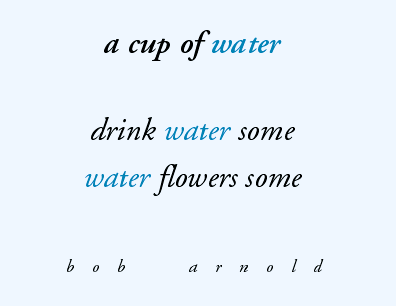
WOODBURNERS WE RECOMMEND — APRIL SHOWERS
Chaos is the first condition. Order is the first law. Continuity is the first reflection.
Quietude is the first happiness.— James Stephens / The Crock of Gold Just to let you know — the sidewalk readings for New Orleans hasn't missed a week in our Vermont in-town spontaneous combustion vigils ever since the southern belle city was drowned last September. We've been there, sometimes for a short spell on the mean winter days, but an opportune time to pull out one of the small Longhouse booklets issued for poets John Martone, Jeffery Beam, Henri Michaux, Kim Dorman, Jonathan Greene and now Catherine Walsh and Thomas A. Clark and read each poet on the icy turf. For a few sessions it was just too cold for anyone on the sidewalk to give a damn. Now with Spring coming on, it's easy street and we'll be reading forever. I've invited poets, musicians and other literate hustlers to take part or come keep us company. Don't be shy.
~
In the early 1870s, a journalist-adventurer named Stephen Powers, who had recently crossed the United States on foot, took two summers to visit California Indian settlements. ... One man who appreciated Powers's early picture of California Indian ecology was University of California archaeologist and anthropologist Robert F. Heizer. At Berkeley he enthralled students with re-creations of native existence on the eve of white contact. Before Sir Francis Drake's brief visit in 1579 among the Miwok of Marin County, he told them, California "held between 500 and 600...independent and separate definable groups," making it the most linguistically and ethnically diverse area in the world. -Peter Nabokov ,Where the Lightning Strikes: the lives of American Indian sacred places (Viking) : wise and very telling, spans the US from the western Sur across the Plains and up to the canoe edges of Maine — and then again: all places are sacred, and all of us are native. To lose that thread is to lose everything. In north-central California, Wintu women took their names from wildflowers
.~
Wish
I am
transformed into a clam.I will
be very, very still.So natural be,
and never 'me'alone so far from home
a stonewould end it all but for this tall
enduring tree,
the sea,the sky
and I.— Robert Creeley, On Earth (U/Cal) : Creeley's last book (so far) On Earth has been read and enjoyed. Not his greatest work certainly, but a continuance, with a well measured sincerity. Some of the rhyme is forced and terribly awkward, and then one or two glide by with such pleasure that he pulled it through. An older man's book in theme, buttoned up with a valentine at the end. My kinda guy. The Whitman essay is one more to add to essential reading. A tiny book in size but made with dovetail and mortice corners. One should take a lesson of how a craftsman showed such care for old poet friends (Blackburn, Dorn, Wieners), ever experimenting with form and cadence, and remaining highly readable. The secret message is the degree of love in the poet's heart...after years and years of a professional life, tussles, losses, fame and countries been to...it ends up in the wisdom of the heart. Almost where the first fine book of poems Creeley gave to us began. Draw a circle.
Valentine For You
Where from, where to
the thought to do -Where with, whereby
the means themselves now lie -Wherefor, wherein
such hopes of reconciling heaven -Even the way is changed
without you, even the day.— Robert Creeley
~
Those U.S. Evil-Doers (Rep/Dem same thing) taking us further up the ass of Iraq and into a state of mind paralyzed for any good news for America, so I took down without even thinking for St. Patrick's Day (call it my Irish blood) a copy of James Stephens royal bonus of Irish literature, The Crock of Gold and immediately disappeared into the pine wood as I read aloud to Susan in the pickup as we rammed our bodies and truck suspension over frozen mud rutted roads and gleaned what form of sanity we could find from Leprechauns, a fixed philosopher, a grumpy mother or two and some enchanted children. Pick your poison and keep a smile on your face.~
Poetry is communication, and every word I've written here subscribes to that belief. Poetry's purpose is to reach other people and to touch their hearts. If a poem doesn't make sense to anybody but its author, nobody but its author will care a whit about it. That doesn't mean that your poems can't be cryptic, or elusive, or ambiguous if that's how you want to write, as long as you keep in mind that there's somebody on the other end of the communication — Ted Kooser, The Poetry Home Repair Manual (U/Nebraska) a very practical guide, almost obligatory, by the Poet Laureate of the United States, who often infuriates the Lang Gang enthusiasts. But it's a big old world out there, so there is plenty of room to think poetry through. Kooser offers his own queries, solutions and mysteries, with many poets aboard as example and not one ambiguous poem in the lot. For those who like their roads straight and true. I mean, we are talking about a Nebraskan here.
~
Like fresh sheets on the bed, or finally a Spring day ! or even clean underwear, comes The Selected Poems of Wang Wei, translated by David Hinton (New Directions) who has become known already with his travels through Li Po and Tu Fu as one of the translators one waits patiently for. And no better than having one of the finest of the mountain dwelling hermits, Wang Wei (701-761 CE) and his spit-in-your-eye condensery line
For Wei Mu
We're both travelers dark-eyed with love
and both possessed of white-cloud mind.Why set out for East Mountain, when here
spring grasses grow deeper day by day?
— Wang Wei (trans. Hinton)
~
Chiwid, Sage Birchwater (New Star) Chiwid is said to be the Indian name for chickadee. Her mother was of the Tsilhqot'in people, and deaf, and her father was a whiteman who herded horses, all at the turn of the 20th century in the Chilcotin region of British Columbia. Sage Birchwater was hitchhiking in the early 70s in that rugged country about the same time we were in Vermont dreaming of taking a train to the same parts, and then ramble up to Prince Rupert. But there was no train anywhere close. So we settled on an overnight journey from Vancouver, through Kamloops, where we saw a large building burning out of control somewhere past the rail line, forest and town and drifted back to sleep awakening in time for daybreak, deep mountains and Roger's Pass. Where Birchwater was traveling, she was hearing stories about Chiwid, a woman who lived out in the bush of the west Chilcotin plateau carrying the tradition of spiritual powers, dressed in a miscellany of rags, blankets, tugging at one horse and keeping fed with a single shot .22 rifle that gave her squirrels, rabbit, and even at one time a moose. 50 below zero she slept outdoors, often beside the horse. She was the mother of at least three children, all taken from her wayward ways, and the wife to a brute that beat her with a log chain. Somehow she survived all of it. Hardly a bum. One with the land. At one time she raised cattle and horses just like her father. Would be seen everywhere on-foot. Her grandchildren seemed to love her. So does Sage Birchwater: she came to Chiwid's region and made an album of photographs and an oral history taken from the sawed-up reminisces of old timers recalling Chiwid and their own passing of the old ways — Dream like a coyote all the time. Then you make some noise like a coyote.
~
American Movie Critics, edited Phillip Lopate (The Library of America): an anthology from the silents until now — "now" meaning: The Cat in the Hat, The Royal Tenenbaums, A History of Violence, The Passion of Christ, Sideways — with a deep bedded contrast of classic film companions in the Stanley Cavell use of that word: "the writing about film which has meant something to me has the power of the missing companion", and so to H.D., James Agee, Otis Ferguson, Robert Warshow, Manny Farber, Parker Tyler, Jonas Mekas, J. Hoberman to sit with you while you read and watch at once. Their film writing magic does set your mind to panoramic screen lushness. When buying a vehicle, of course, forget the salesman up in the showroom and wander into the garage and try to pick up a conversation with one of the mechanics ducking in and out from under a chassis to find out what makes what you want to drive tick. Same here with this book. Editor Lopate is long in the tooth with film writing and appreciation, never mind knowing the essay form. One of the brainstorms behind The Library of America, Geoffrey O'Brien, is one of the Lopate's editors here and also a film and general jukebox mind for twentieth century culture. You're looking at mechanics who made this collection of wholesome cinema thinking. Remove the dust jacket and the underbelly is sleek black celluloid cloth/the polar opposite of print. Not bad for the publishing elite at The Library of America, a nonprofit outfit that for the last 25 years has made inroads to preserving America's literary heritage in stylish authoritative editions. Count this as one more.
~
While at the cinema, don't forget the comedians — many show up for us now on film — Seriously Funny, Gerald Nachman (Pantheon): the rebel comedians of the 1950s & 60s, so in other words: those who grew up before and after but definitely under Lenny Bruce. Not to be missed. Portraits spanning from Mort Sahl, Lenny Bruce, Jonathan Winters to Dick Gregory, Woody Allen, Joan Rivers and the portraits are admirable for their research and length, which is an accomplishment considering how difficult jokers can be. Vendettas and gripes seem to run deepest with impressionists, who feel ripped off by everyone, as they make their living as mimics! Longtime guru Jack Rollins sums it up one of the best, "It's not what you do onstage, it's what's left onstage afterwards." If you think today's standup comedians are great; you should have experienced them when they knew how to think.
~
And for one of the best at combining the screen of film venue as cartoon and satire, go to Harvey Pekar, Quitter, w/art by Dean Haspiel (Vertigo) this is but one of the latest in the continued career of Pekar to stitch along with American Splendor (the book and film), Our Cancer Year and other tales of a victorious loser. Ordinary life is pretty complex stuff. Ideal to pick up, put down, throw around. He fought his way out of the neighborhood and at age 65 is still fighting the inner demons.
~
Just slipped under the door — one of the great performer's lost to us (nearly: dead at 56 in 2002, but wait until you hear the voice) and one of god's creatures (take me literally here) Arthur Joseph Kushner, Stroking the Sparrow's Tail, publisher contact: http://www.arthurjoseph.org both the book of poems and double packed CD manages to manage the wild storytelling poetry passion of Kushner, with a little help from his friends on the CD from Mikhail Horowitz and Carl Welden. It's not great poetry, it's back-to-the-land great living, a higher art form from the page since The effect is accumulative. Here's one who practiced. I took a hike this afternoon in fast melting woods and had the Kushner playing before I left and just kept it playing, for all of the empty house. You'll see what I mean when you get there.
~
Even though my last trip into Yosemite Valley was like a trip to WalMart, though I go there very rarely, but once is enough. And even though reading back through John Muir's writings recently gave me the physical punch and activism that I love from wilderness writers, compared to today's supreme being degree of equipment and achievements — the Muir now reads foibled with his Victorian descriptions and boxy language — but there is nothing quite like a youngster set loose when Yosemite was cared for by Miwok Indians that Muir pooh-poohed as he scrambled heights with barely a rope in his harness. Those were the days. Now we have books aplenty celebrating chosen places. With computers we actually think we are getting someplace! as if blog-land and a million more emails isn't going to be a load of junk after awhile, but that would ask for pause and reflection, and I'm afraid nothing is being manufactured or taught in that direction. The hardbolt chickadees' come March have stuck around with me all winter just asking for a little more seed, and we're each a little more tamer in each others wild. The red squirrels living like rats in the woodshed are just begging to be shot. You see, they eventually invade a house. One learns to be practical out in the cold, or die. Any of us. And the more I read about, and of, American literature of the last 60 years — whether a new age writer putting us into a socially groovy hotspot, or an old Beat writer being lauded as one more grand wizard of loudmouth, eventually it's just playing a part. It's such a sad state of affairs reading through all the brilliant and young lives of the recent Wallace Berman fetishist (see the previous Woodburners) surveying one after another each of their early and often destructive lives & deaths. I want them all back! There is a better world out there, somewhere. Even as new readers miss the very point about Jack Kerouac — thinking he cared a hoot for this Beat thing. He was too sensitive, too small town, so much the loner boy dreamer, and only when you read his On the Road aloud will you even begin to steer by the cadence and body rhythms of his living art. Sal Paradise is all the early roles of Brando, Dean and Gloria Graheme...with nut'much to do with this Beat-thing after awhile, or certainly hippies and punk and foul mouthed brats, despite their relishing contributions — straight up to the Sex Pistols refusing any recognition from some rock and roll hall of fame. Fame is not, is what Kerouac really was saying after his turn with it. He was more in the bedrock tradition of Woody Guthrie, songs a mile a minute, lasting longer than any governments, how exactly to live the story. Better dead than alive is all we have ever given to both of these landmarks. And shame on us. So when I sit down with two more grand books, sweepingly illustrated and produced: Yosemite in Time, Mark Klett, Rebecca Solnit, Byron Wolfe (Trinity) I know I am being nurtured by a jam packed environmental and photographic appreciation, intelligent and duly informed. But with all our awareness I believe we'd be better informed if we finally shut Yosemite down. Just knock a few of the old deadwood timbers down across the road-in, and walk away. Give it at least ten years to rekindle — merely a sniffle in Earth time, but maybe a foothold on regaining what wild was once there. Backpackers and truants sloshing into the valley on-foot are recognized as taking their lives into their own hands. Perfect visitors. We have plenty of books and films and photographs to keep us company for the 10 year renewal. Explorers, Andrea De Porti (Firefly) is yet another: this time from people and lands pretty well gone. You can be a tourist, but exploration is now a disciplined frame of mind. The book opens its arms very wide from Sir Richard Burton on the Nile to out-of-this-world Apollo 13. I personally can't make the jump from Earth exploration — for instance, Thor Heyerdahl on his handmade raft of bamboo and balsa trunks on the high Pacific, to the next chapter gone nuclear with the war machine Nautilus. Sorry. Nevermind space travel taking us away from Earth. Really dip into these luxurious pages that fold out like maps and pull the reader into the worlds and places found by Theodore Monod, Isabella Bird Bishop, Vittorio Sella and many more — you are in the company of mountaineering photographers, mapmakers & intrepids, peaceful colonialists, desert rats. Turn the tv off for awhile, you're reaching for the middle kingdom.
© Bob Arnold
23 March 2006
WOODBURNERS WE RECOMMEND: DENNIS WEAVER Went into the music store where my son works this afternoon, March blowing the streets wild. All sorts of critters blown into the store like old leaves and piled up over used music bins. The Byrds singing Dylan for one more 40 year deja-vu, and some spaced-out film ending up on the tv monitor attached high on the wall. I mentioned to Carson that Dennis Weaver just passed away. He's enjoyed the film Duel ever since I showed it to him as a tike....so without a moment's hesitation the other film concludes and he pops out the dvd and slips on Duel . Soon Dennis Weaver shows up. The world at a Presto! touch.
A few facts to cherish about Dennis Weaver: if you're old enough to remember "Chester" and the television western Gunsmoke, well then there is one. McCloud followed, but I went some decades without a tv so missed all of that.
Look closely, Weaver is in Orson Welles's Touch of Evil.
Weaver ended up his television life hosting the Westerns channel for Starz Entertainment. A noticeable hole in the wall without him when I was sitting down to watch Randolph Scott in Budd Boetticher's Comanche Station last weekend.
In 1982, Weaver, with his wife Gerry and other friends founded "Love Is Feeding Everyone" which fed 100,000 people every week in Los Angeles. Unfortunately, Dennis Weaver never garnered a "Sexiest Man Alive" award, so few of us ever knew how the starving were being helped along.
Again, with Gerry Weaver, Mr. Weaver founded the Institute of Ecolonomics — a made up word by the Weavers that meant to find solutions to environmental headaches. In 2003 the same institute formed a "Drive to Survive" fleet, of which Weaver personally wagon-mastered a campaign of alternative-fuel vehicles across the country to Washington DC., raising awareness to the country's dependence on oil. Three years ahead of some little squirt stuck in place announcing the same from his bully pulpit. Weaver much in the Bucky Fuller tradition...
...and thensome, since the Weavers from 1990 have lived in what they termed an "earthship" : a solar powered, 10,000 sq. ft. home, fitted together from 3,000 old tires and 300,000 tin and aluminum cans.
Dennis Weaver died at 81. His star is on the Hollywood Walk of Fame. Like many other good outlaws, he hailed from Missouri.
© Bob Arnold
15 March 2006
WOODBURNERS CELEBRATES A FEW RECENT FILMS DURING AN OSCAR SUPERBOWL WEEKEND, RAH! RAH! RAH! remembering Don Knotts A clutch of excellent films now on dvd: The Story of the Weeping Camel — a graduation project of film students Byambasureu Davaa & Luigi Falorni seen through the eyes of a many generation family of nomadic shepherds in the Gobi desert and how one of their mother camels from the herd rejects the delivery of a rare white colt. The family fetches a musician friend to perform the "hoos ritual," joining along with one of the family's woman singers, and a small miracle happens. The relationship of man/animal is patient and engrossing, shot with a likewise rhythm of the desert and the old ways life in documentary/storytelling style. Sit with and as a child and enjoy.
Then, shoo the child away for In Cold Blood. A film that shivered me to my timbres as a teenager when it was released in the 60s, about the massacre of the Clutter family in their ranch house outside Holcomb, Kansas. The film hasn't lost any of its fearsome drive and getup, thanks to the cinematography stamp of Conrad Hall, edged with equable direction by Richard Brooks. Steve McQueen and Paul Newman were slated to be the killers, much the same mistake Hollywood makes these days glamorizing roles and spoiling film after film. Fortunately, Robert Blake and Scott Wilson were found, two unknowns, striking uncertainty and eventual terror throughout the audience. "Who are these guys?" we all cautiously wondered, and we're still wondering. The terror would have been ratcheted up another notch if we knew some of the scenes in the film were actually shot in the real-life Clutter family home. Talk about returning to the scene of the crime! The film sparked renewed attention in 2002 when Robert Blake was arrested, and later released, for the murder of his wife. This was the same Robert Blake from Our Gang comedies, and as the standout Mexican boy who sells Humphrey Bogart his lottery ticket in The Treasure of the Sierra Madre. Further recognition will come for the film if Philip Seymour Hoffman pulls in an Oscar award for his portrayal of Truman Capote in the film Capote, being the author who rose to fame with the publication of the best-selling book In Cold Blood. All part of the killer's kiss.
One also shouldn't miss an elder Jeanne Moreau showing actors everywhere just how to continue in cinema for 60 years by playing the quite demanding role and late loves of Marguerite Duras in the film Cet Amour-La. For double-feature Francais be lucky enough to find Jean Renoir's newly released and polished up to dvd standards La Bete Humaine with champ Jean Gabin and a very feline Simone Simon paired up in a murder triad. Where Simon sets the tone for femme fatales ever to swarm the silver screens of film noir since 1938, never mind Renoir's compositional visual/thematic essay. The swashbuckling train scenes are real stuff and Gabin actually mans a train where the real-life passengers aboard have no idea they are being engineered by the top romantic screen idol of their time.
Another instant treasure not to be missed on dvd, through Criterion, is John Ford's Young Mr. Lincoln, with young Henry Fonda as Abe Lincoln. The Japanese film director Akira Kurosawa always spoke glowingly of his mentor John Ford — watch in this film small details such as Fonda picking up a stick and letting it fall, as a stick will, to make a decision in which direction he should go in his life...much as years later Toshiro Mifune will do the same, but more wildly, with a stick found in the road of Kurosawa's classic Yojimbo. East meets west. Lots of Ford and Fonda memorable extras to go along with this double-disc set.
One more to hunt up, for part Circle Jerks music, more alien rites, and the time is just ripe for it — is a new watching of Alex Cox's Repo Man. And be sure to watch the film twice, unless your mind is ambidextrous, for the follow along commentary by a cackling crowd of old friends, actors, director Cox, producer Michael Nesmith hashing over the early 80s cult-film favorite and letting you in on a few trade secrets. It's not quite up there with the single commentary knockout that comes with trash like Showgirls, or Donald Richie on Japanese cinema...but then you do get extra features with Repo Man, like an in-house interview from 2005 with Harry Dean Stanton — where the prince of character actors quotes Zapata, Jung and sings in two-part harmony with the interviewer "Row, Row, Row, Your Boat", while strumming his guitar. Easily worth the price of admission. The day the Academy Awards recognizes Stanton for a Lifetime Achievement Award, will be the day hell freezes over, and the whole Tinseltown big-show farce makes sense.
I'd rather die on my feet than live on my knees — Emiliano Zapata ~
Sketches, jottings, notes, celebrations, finger-pointing excitement about some books of recent weeks. Briefly (since I'm reading!) -
It's been a long time since I heard the voice in my head of those practical and sturdy footed women of my childhood neighborhood in the Berkshire hills when my buddies and I came to play baseball and sometimes could use their yard, and sometimes we couldn't. The good women had their reasons. So don't pester. Now in the morning's mail comes the latest issue of Hummingbird edited by Phyllis Walsh (PO Box 96, Richland Center, WI. 53581) often with a haiku/short poem bent. Here's what Phyllis has to say within the March 2006 issue: "With the coming of spring, we tend to be more helpful and more positive toward each other. May I use this period to urge patience upon contributors whose poems have waited to be published too long in the large backlog. I shall not be reading submissions, as usual, during the spring and summer in hopes of catching up with old acceptances. Unless invited, submissions will be returned unread then. I am grateful to all who are part of this community of poets, but I cannot always accommodate everyone's wishes to be published. Thank you for your patience." Smart neighbor. In other words — if things aren't working for you at that moment (you fucking poet you) why not help, read, publish, support another poet? It works wonders. Hummingbird is 4 issues / $15
Music playing at the moment — some compilations picked up yesterday on a trip to the big city, out of a sale bin — 50 cent to $1 cd promos from Fat Possum, Ruff, world music rolling along. I'm still not able to stir out of my head the menacingly fine Iggy Pop blues side of a compilation playing in another store when I walked up the sidewalk rumbled with students, backpacks, that still very cold but lasting longer into the day sunshine and a young friend and owner of the used music store shot me his hi-sign ala Paul Muni as I strolled in and a gift of GladtreeJournal(www.gladtree.com) an immaculately simple and twice sewn designed wonder of a package of poetry, art, interviews and prose that leans toward the music side of life was put into my hands: a rabble-rousing interview that Thurston Moore does with the Magik Markers, a chapter from Byron Coley's "Dominoes", art by Caitlin Bailey, writings by Joshua Burkett, Scott Foust and a tribe of others. I received the booklet as a doorway gift and greeting, which beats capitalism every time.
Street-hug greetings & welcome to Michael Farmer (email Michael at : [email protected] ) who sent us his hand tooled flutes to play turned from red cedar, poplar, even PVC pipe for our readings and music on the streets for New Orleans. Hallelujah! between Wisconsin~Vermont woodlands. Hey, the PVC pipe has a lasting, resonant sound. White-wood poplar and cedar melts into your hands.
Michael S. Bengal, Mercury, the Dime (Six Gallery www.sixgallerypress.com): a highly attractive, pocket-size glossy marvel of a book, with poems to sweep you up from a San Francisco early 90s feeling in an era more Sandburg than anything Beat. A sure footed Americana celebration Past the Western frontier / lay the Great Plains / multitudes of Americans — I always love a poet who loves his country in Whitmanesque multitudes.
I DON'T KNOW MUCH ANYMORE
my heart can take of sorrow, and of the trouble of others,
especially the trouble, and heartache, and suffering,
and the loneliness of others
who have always been drawn to my life.
Just last night I watched a starving child
try to spoon boiled rice into her mouth,
only her arms were too weak to lift the spoon.
I don't want the weight of anybody on my back anymore
is how I feel when I look around these days. I don't want to watch
the sky move past everyday, but I do, and I don't want to love
words so much, but I do, and I don't want to know
why it is that your heart is broken, but you'll tell me.
That's the way it goes on a good day.
Nothing but blue skies.— Bruce Weigl from Declension in the Village of Chung Luong
(Ausable Press / www.ausablepress.org): Ausable Press, one of the finer independent presses still surviving and rigged together by the poet Chase Twichell and her merry band. Go delve into their catalog of sweets.
Then go head-spinning with Ray Bradbury, Bradbury Speaks (Morrow) in full glory ugly book design — I even have stains in the text of my new copy — and it fits perfectly with the presence Bradbury has always brought to his literature: larger than life. Subtitled "too soon from the cave, too far from the stars: essays on the past, the future, and everything in between" taking a bit from one of Bradbury's favorite poets — Yeats, and the last line from "Sailing to Byzantium". Not quite the cosmic headwaters force of Bucky Fuller, Bradbury has always played by his own rules from cinema, television, rewriting countless treatments, savior, a few wicked masterpieces, and a span from Bertrand Russell to Sergei Bonderchuk seemed to like the guy. The book is a mess of oft repeated themes but I didn't care in the least, as if lost awhile in a loop of space travel. A writer who doesn't at all mind standing or walking out in the rain, plus he loves trains, so he's just my kind of guy. He nails the facet of what a computer is. He's also seen the future, returned, and is now old, white-haired and wise. Read him.
moving right along (into a Ryko compilation, another 50 center. I better take the clicker with me to jump out of Sugar to get to Nick Drake)
Speaking of the future. She was there before we were: Essential Deren, collected writings on film by Maya Deren (McPherson & Co www.mcpherson.com). McPherson has kept the magisterial writings of Deren and Stan Brakhage in print as proof positive poetry can be seen in all of their films and writings. And Deren, from the 40s onward, published everywhere from Film Culture to Mademoiselle. No one loves poetry or the cinema and misses Deren. Scribble on your hand: go find: Meshes of the Afternoon, Deren's first film from 1943. This book will nicely amplify it all.
While I'm still in the Big Apple, with Deren in mind, I've dug up to read two recent books on the art scene of the mid-twentieth century. Each highly readable and centering around artists De Kooning, Pollock, Hans Hoffman, Joan Mitchell, Fairfield Porter, the many poets, social districts and very nicely surveyed with illustrations throughout. Jed Perl, New Art City (Knopf) is the exploring marvel of the era, and I'm as sure as he is sure at his portraiture and a critical eye. Robert Long, De Kooning's Bicycle (Farrar) is quite the opposite — a dressed out storyteller's tale from the East End of Long Island. Where the artists, writers and the landscape are as one. Absolutely skinned of glitz, the city lights, and more a town meeting parlor feel. I even learned a little of my own Green River locale from this locale.
Mark Kuniya & Ed Baker have put their downy heads together to make a splendid gold sheen wrapped, Japanese four-holed stitched book of poems, translation and drawings by Ed Baker, things just come thru (country/valley, Red Ochre Press http://edbaker.maikosoft.com/) set to the memory of Cid Corman and following thru to a tee Cid's own discipline of small books made beautifully and given so. Purple / blossom / just / here / just / hear / just her
Hands-down I simply read every book Nicholas A. Basbanes writes on his equal historical and lover's range of book adoration — the latest being Every Book Its Reader (Harper), profiling Milton to even Hitler and de Sade, and a readers culture from Daniel Aaron to Breon Mitchell, Perri Klass and other notables. I'd like to see Basbanes get a little more dirt on his knees and scrabble into book lover street vendors, small press tree huts, rafts of Huck Finn quality explorers with books in hand now that he has covered quite nicely the renown ivory towers. Even Montaigne came down out of his. Nonetheless, this is scholarly rejoicing.
there's a gassy cut from Bootsy's New Rubber Band on this compilation. Only clicked past one, otherwise...while reaching for yet another well-balanced Thomas Merton book...
...in the ceremoniously continuance of books that seem never-ending from Thomas Merton: Survival or Prophecy? the letters of Thomas Merton & Jean Leclercq (Farrar) the Trappist monk (dead almost 40 years ago and seemingly forever young and writing to this day) and the French Benedictine monk putting their heads together over a twenty year correspondence, and extensive worldwide travels to and from monasteries, for the greater good at rallying Catholic religious life. Has it worked? Sift out the neocon politicians, evangelical despots, new age saps, and maybe so. Merton remains ageless as ever, bright-eyed and bushytailed when visiting with an equally divine mind.
Update reading aloud in the pickup truck between far towns with Bob & Susan: John Steinbeck, The Red Pony — was it that sober and violent of a tale when we read the book as kids? Ah, but the boy's eyes looking from the valley to the mountains and o'er was Monterey and dreams... we were there once one early dawn in Priest Valley. Kerouac, Satori In Paris: such an old man's book and little of the Duoloz skip & cadence. Much finer to go headlong back into Lonesome Traveler: the era of the hobo song as heralded by JK. Haven't touched Richard Brautigan, A Confederate General From Big Sur for almost 30 years. It will always be the book we sent to Franco in Switzerland needing a copy...I began to read to Susan on one drive one morning ala Jesse and Lee Mellon antics and by only page 25 she turns to me, listening patiently, raised in California and evenso leers over a look at the book with a laugh and asks, "Where are we!?"William Gass, A Temple of Texts (Knopf) my prejudice: I've read everything he has written. I also attended his reading a year or so ago in Brattleboro in the center of town at the Congregational church. Small towns can still get away at holding a session, pie sale, booksale in a church and it doesn't end up at being a religious statement. Or any statement. The church in town was the largest seating available at the moment for the crowd expected, and the crowd came. The next day, too, for Julia Alvarez. Heck, I can remember decades earlier listening to Joseph Brodsky read, with his Russian translator, in yet another church in town. And Bernard Malamud followed him. Gass arrived to his reading at 80 years of age looking with no tarnish of celebrity, and he read for the next hour, at least, without the slightest hint of losing his place or slowing down. Real campfire story gusto. And it was one of his plain celestial stories with a bottomless floor. I'm still falling into it. Don't even remember the title. It slipped from my hands when I was silly enough to grab for it. Of course Gass — one of our last literary lions: fiction, essays, galaxy mind — is portrayed in the Basbanes book mentioned above. Do you want me to say something about this new book? Isn't the title enough? Isn't a writer grand when the title says it all? All serious readers have Gass in their trunk like a tire iron.
too much Elvis Costello on this compilation but ending up with an old favorite from The Incredible String Band. Stop whining, get up and put on another compilation disc from your cheap horde and tell the folks which one it is...
...well, I wanted to go with some ancient Jamaican outlaws on the Ras label, but I'm holding to the order as it's coming in the pile...which means some slouchy freebee from Mojo is next and each band sounding quite a bit like Ramones spinoffs, which seems an oxymoron
An individual is as superb as a nation when he has the qualities which make a superb nation. The soul of the largest and wealthiest and proudest nation may well go halfway to meet that of its poets. The signs are effectual. There is no fear of mistake. If the one is true the other is true. The proof of a poet is that his country absorbs him as affectionately as he has absorbed it — Walt Whitman. Brother Walt from the 150th Anniversary Edition of Leaves of Grass (Oxford) newly released, sporting the original edition dress code of layout, typeface, design — before Whitman returned his hand for revisions all around (a carpenter never quite done with his work). Also included is Emerson's welcoming letter to Whitman (the Nike endorsement of its time), and Whitman's own three self-reviews of his own book. What a card! I was shown this book a week earlier by the bookseller Mark Wooton at his book haven, with a mighty strong poetry nook at the center of the shop, in Amherst Books of Amherst, Ma. Mark appearing nearly priestly as he reverently lifted the book up for my inspection, with an expression asking for a communal respect of a weathered treasure. I follow you whoever you are from the present hour
While I'm still minded in western Massachusetts, James Salter has a great true story about the time he crashed an airplane into a house in Great Barrington. That's all. Writers do it all the time, right? This was 1945 and some years before Salter would go on to Paris Review fame, sexy jeune fille stories from ski-slopes and Europe, and write fighter-pilot classics like The Hunters, which is excerpted some, along with other flying-years writings from the author's compendium, in Gods of Tin (Shoemaker&Hoard): a gleaned down memoir of fiction and journals. Imagine if Chuck Yaeger could really write.
The Mojo set of songs was only 8 tunes in and out. But remember, a bargain at 50 cents. Nothing to add to my jukebox, which is now stuffed with music to last 7 days, nonstop — or else enough music to drive to California and back with a classic steward at the wheel. You bring the music just so you can end up playing very little of it, and instead drive through the night with the windows open
For years I used to walk Ulysses in our neighborhood, so we ended up knowing a lot of people. Dogs are like Emmanuel Kant, who always wanted to take the same walk. The less it changes, the happier they are -Roger Grenier. You see, this is just the writer Nicholas Basbanes should be drumming up for his books on literary love and lust — a writer that can combine dog story after dog story with all things philosophical, territorial, common, and touchingly so. See more in The Difficulty of Being A Dog (Chicago) which I found for about the same price as these music compilations playing the afternoon away. It was a UK poet friend who first told me about the book, and enough said, I was off and running. Gorgeous vignettes which are splendidly human, and nothing at all like Vicki Hearne or William Wegman who boasts such on a book blurb.
stop judging me! a little Lalo Schifrin film scores never hurt anyone ($1)
Gone lookin' (like gone fishin') and wishing to remember the bold strokes and activism heart of the artist Rini Templeton. See The Art of Rini Templeton (The Real Comet Press) compiled in this excellent retrospective spanning those 20 years of the artist's life when she sojourned with sketchbook, drawing out the struggles of people from the USA, Mexico and Central America. Many times offering her art work for free for the cause, and her faith for a better world. A one part biography of Templeton through the eyes and memories of friends and co-workers that travels the text, along with a cache of sketches, silkscreen prints and sculptures. The artist died far too young. One more reason to pick the book up again, and again.
Some of the artists and characters in this excellent collection may go on to be famous, and then we can hate them. Ha! But for now, Beautiful Losers, contemporary art and street culture, edited by Aaron Rose and Christian Strike (Iconoclast) and I have to believe a whole bunch of unsung heroes and contributors have a hand in here, but that's just the point in a retrospective like this: the angels are never seen doing their job — pure 90s street life pranks and art work made on the spot, danced there and vanished, chalk art washed away by the rain (another art form), mucho influenced by graffiti, skateboard gangs, street players and independent music impresarios featured in this gangbang all its own of paintings, sculptures, portraits, photographs, videos, collages and the ever tour of skateboard collections and you-name-it-limited-edition wonders. I liked the looks of the whole thing right off the bat. And gosh darn I don't even own my own copy of the book. I'm borrowing this one. Apropos.
But. Own this one. Own this one. Own this one. I'm trying to reason with brassy Lalo's music while I reach for, of all people, Wallace Berman : Semina Culture, Wallace Berman & His Circle, by Michael Duncan & Kristine McKenna (DAP/Santa Monica Museum of Art) I saw this book on display in some bookshop and my heart sank because one corner was badly bumped, and in the meantime the whole bookstore dissolved around me in a friendly vanishing act that hardly ever happens anymore when one great book is left standing with magnificence. Glistening. Stunning. You don't eat that week so you can own this book. Like some of the great Californians, such as Clarence King, Berman was born on the east coast and went west young man, to become at least to mine-eyes, the greatest of the Beat, visionary, Outsider minds of the Twentieth Century. And that includes both dudes Kerouac and Ginsberg, and I really love the first one. With Berman, every critter from the Beat pantheon, and even those that thought they got-away, are caught in his vortex of friendship, association, art work, printings, photography, paintings, culture, religion, neighborhood, contributions, collages, publications and civic duty. Lots of the famous, not yet famous, never-to-be famous, all are miraculously here. What a labor of love! The book is one of the more glorified dreamboat hero sandwiches of those gallant years, with so many of the participants affectionately remembered and held to. A must to own. Don't tell me you're bored with life after this one...except to go further. Young Berman sort of stoops down cellar-window style to get into the self-portrait book cover photograph, with a small ink press ready at his side, and some mystic sorts staring out at us from a photograph behind him on the wall. I believe Rimbaud is in that group photograph, with an out of focus framed portrait on the wall behind the group...so it's frame into frame into frame...perfect. You don't need to know Berman was killed in 1976 on the eve of his 50th birthday in California by a drunk driver by the name of Spike, who got off the rap using one of the same lawyers who sprung OJ many years later. No one this beautiful ever dies.
~ © Bob Arnold
March 5, 2006
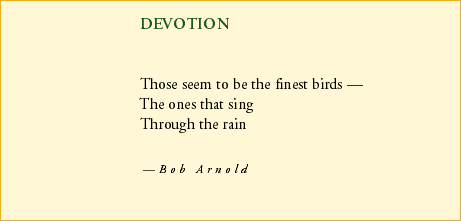
Bob's poem is from his book Devotion forthcoming from Longhouse in late February. We share one poem here for Valentine' Day.
Also forthcoming: Jonathan Greene: The Death of a Kentucky Coffee-Tree & Other Poems
Bob Arnold & Greg Joly will read at their spot on Elliot Street in Brattleboro on Valentine's Day
— love poems for the occasion. Both poets believe they have plenty on hand, and it won't hurt in the least to send such a bouquet toward New Orleans. The guys are usually there, in snow, when the sun is acting the warmest, between the hours of 1-3 in the afternoon. Come and blush.If you are nearby Northampton, Ma., the next few weeks, be sure to drop in at The Forbes Library and spend awhile with Julius Lester's photography exhibit Do Lord Remember Me, a stunning retrospective of the years 1966-68 when the Newport Folk Foundation sent Lester to Mississippi to scout up and record black traditional music. He had a Nikon camera and two lenses with him, and lucky for us. As Julius Lester explains, "There are many ways to think about photography. During those two years photographing throughout the south, I was conscious of using my camera as a medium of historical memory. But a photograph is never totally about the subject. A photograph is also the visual record of the relationship between the photographer and subject. In that sense, then, these photographs are autobiographical, though I do not appear in any of them.But my love for the black south of my parents, grandparents, great-grandparents, and my adolescence does. It is that love I offer you." The exhibit is free.
This tragic news just in from Thomas Rain Crowe in North Carolina about the loss of his good friend Ken Wainio. Since Ken had the spirit to hear things, let it sing:
photo by Russ Thomas
from Thomas Rain Crowe
— Ken Wainio (1952 — 2006) was born in Ukiah, California about two hours north of San Francisco in 1952. The Rimbaud of the Baby Beats cadre from the San Francisco 1970s and one of the foremost surrealist poets and writers in the U.S., he began to write at the age of fifteen--having been influenced by the writing of the French poets Lautremont, Rimbaud and Nerval. He moved to San Francisco at the beginning of the 1970s to study at San Francisco State University with the Greek surrealist poet Nanos Valaoritis, and met the American surrealist poets Philip Lamantia and Stephen Schwartz. It was a couple years later, in an informal "poetry class being conducted in the home of Harold Norse that he met Thomas Crowe, Neeli Cherkovski and Luke Breit--along with whom he would later help to resurrect Beatitude magazine, and was co-editor of issue # 26 which appeared in 1977. During the 1970s, his poems were published in most all of the important literary magazines being produced in the Bay Area: the City Lights Review, Beatitude, LoveLights, and Bastard Angel. With Jerry Estrin, he was a founding editor of the pan-surrealist publication Vanishing Cab. After driving a taxicab for the entire decade of the 1980s, and after living for more than twenty-five years in San Francisco, he moved to Glenhaven, California where he resided until his untimely death on January 26, 2006. His travels have taken him to Greece, Turkey and Egypt, where he has spent considerable time in the past two decades. His poems and fiction continue to be published both here and abroad in such journals as Nexus, Asheville Poetry Review, Litterature en Marche and Greges in Montpellier, France. His books include Crossroads of the Other, which was written during the 1970s, Letters to Al-Kemi (an Egyptian travel memoir), Starfuck (a novel published in 1996) and Automatic Antiquity (poems, published in 2004). Forthcoming books include a book of autobiographical fiction from New Native Press titled Scene of the Crime: Confessions of a Baby Beat and Slab Window, a collection of his most recent poems from Beatitude Press..
© 14 February 2006 Bob Arnold
WOODBURNERS WE RECOMMEND — FAREWELLS Hey! Hey! Stew Albert 1939-2006 — one of those: "a strolling farce of lost and forlorn people" — Theodore H. White Dear TB -
I am tougher than you are on the funeral for Coretta Scott King: as speakers, I found both Connecticut oil men worthless — in fact, so rattled was the father within a swelling procession of benevolence and charity, he lost part of his speech and went to speakeasy talk about young black youth and basketball in Houston...a usual white, Wasp professional response to the black community: 'They play sports/they dance.' Both of these men are exemplary models of oppression in this country. Bill Clinton is well loved by the Atlanta community, as he should be. He just personally turns me off by his relentless need for adulation. His wife is a bore. Ted Kennedy was just the right touch of humility and ages of experience, and for once in a great long while, he brought it home. And Jimmy Carter was just the way you like to hear a man who knows something and has grown wise enough to share it. Most pastors, like The Rev. Joseph Lowery, were in their element and electrified moments of the ceremony. I could have done without the scary Mr, Schuller, as I believe Martin Luther King would have. The eulogy for Coretta Scott King by her daughter Bernice was a wonder, I agree, and shimmered reflections of her father — tone, style, presence, timing, ardor. She sent chills up my arm. Malcolm X's daughter, Malaal Shabazz also showed a passion I adored. To top it off, under her great hot pink hat! We may not have buried the Civil Rights movement, quite yet.
Today we read on the sidewalk for New Orleans. 28 degrees. Greg in warm bundled clothes, half-gloves with the fingers free. A woman stopped and left a dollar bill but not before telling us a little story and her hopes for the future.It was about her father, and how once upon a time he gave the great jazzman Louis Armstrong a ride in his car down in Washington DC., but the car had no door. I liked that part of the tale. Her silver hair still long and in a ponytail. Telling us the story as much for her warm paternal memory, and just what could she do in our own time of deplorable neglect by all leadership, whereas people like herself were walking around with broken hearts. "Where are the heroes?" she moaned. "Be one", I offered. She nodded, smiled, and with a little wave she was off.
And also, farewell to Mary Blair — on a personal note, a woman I worked for on her Vermont farm, in marriage with her husband Bill. Not a working farm — though local farmers drove their cows to their ample fields and pastures, and a sugarman loved their stand of maple trees. Bill picked me up one day while I was hitchhiking my usual routine the long, winding backroads twelve miles into town. We got talking and it eventually got to books, writing and the great outdoors. Bill had been publisher at Harper's Magazine and was now hatching a new magazine in the hinterlands called Country Journal. He was also looking for a handyman for his farm: gardening, snow shoveling, firewood work, you name it, and I was hired on. For the next twenty years. It was Mary who usually paid me with a check under the teacups in the kitchen, on her way out the door in a flurry to the Brattleboro Museum & Art Center where she was one of the guiding lights, to Planned Parenthood locales, or on a buzz about her wonderful cookbook Mary Blair's Hors d'Oeuvre Cookbook: A Complete Guide to Hors d'Oeuvre Cookery and Festive Menus that often brought on a rush for special foods catering. A Canadian through and through, with a tough love attitude and a passion for her homegrown crab apples, grapes, raspberries, bluebirds, and circles of flower gardens that I worked on for her each week — when not right alongside Mary and Bill. There's no better place to make friends than finding the hands and knees getting dirty all together. I remember Mary liking the books of Laurie Lee.
© 09 February 2006 Bob Arnold
WOODBURNERS WE RECOMMEND — VALENTINE And because they had mass, they became simpler, said Beatty. Once, books appealed to a few people, here, there, everywhere. They could afford to be different. The world was roomy. But then the world got full of eyes and elbows and mouths. Double, triple, quadruple population. Films and radios, magazines, books leveled down to a sort of paste-pudding norm, do you follow me? — from Ray Bradbury's Fahrenheit 451, as spoken by fireman Captain Beatty to fellow fireman Guy Montag. A deserved classic these days dismissed out of hand as a book "read (and forgotten) since high-school". You might be up for a rereading in these times of full wall size monitors talking to us , antibook leadership, souls disappearing under the wheel's 'progress' whether to outrageous penal colonies, personal assassination, or into the homeless drifting islands of one gone mad and out of their minds. Be Ware. "Second guessing is not a strategy" — that's the line of talk from the latest State of the Union Speech. Imagine more power to them because it ain't just talk — like the Democrats who are ash — but something that has already killed many many thousands. On our watch. One of the quietest Spanish poets of the modern era dashes but two lines as the vision for the Bradbury book: If they give you ruled paper, / write the other way — Juan Ramon Jimenez. May you have a "Faber" whispering into your ear.
no one part any the less than the /sum of all my parts — CW Where is America? In this morning's mail (picked up the next day/hard rain all day Saturday: never got out to hike to the mailbox up river) comes this little secret I know from Ireland. Maybe you know the secret as well? : Catherine Walsh & Billy Mills. Ring a bell? Their fresh baked bread of books: Logical Fallacies, Billy Mills. Email hardPressed Poetry at : [email protected]
this song is not
the world isthis song is not
the world— Billy Mills
I've just read books before breakfast and can't help myself but to share. Billy may also be found in earlier Longhouse issues and titles so scan the horizon of our website bookshop for others to peruse or purchase, and more is to come from our press from both these poets who have remained in itinerant contact with us for well over a decade through travels and living quarters from Dublin to Barcelona to back in the Irish Limerick. For Catherine Walsh there comes from Shearsman (www.shearsman.com) City West, book cover design taken, it seems, from the plaid fabric of the long dress Catherine is wearing in her cover photograph, just as her poetry is her motion of living, or let the poet tell you the physical quality of life, that's/ living, and not the analysis / afterwards or the moments of / discord or premonition — . This is poetry that sways the page no / more / than / breathing. It absolutely refuses to be pinned down, categorized, labeled as a such so you are prepared before getting here. I dare try to snatch one like a firefly and set it a moment in a glass jar to light this page -
(bodies in darkness)
upreared one
cat
terrible one
fat face
turned face
the one belonging to cobrasalutations
the cat
the gory one
the swallower of millionsfrom the the
from the the from the the from
the the from the the— Catherine Walsh
Catherine's earlier model of City West ( a selection of poems) was first published by Longhouse and may be found down the well-lighted clean place of our bookshop on-line. Billy Mills' Alba may also be found there. Since I'm a fan, one more from Billy:
if a tree
yes the
question isair compressed
expanding
earth isthere yes
the air
unfolding is— Billy Mills
Cockles are common, still cheap, and in season all year round. They don't attract much culinary attention. They're small and fiddly to deal with. Shelling them is tedious and can upset delicate skin. When bought from shellfish stalls they're often a gritty mouthful.
-from A Little Book of Cockles, Carla Phillips (Coracle / Tipperary, Ireland). Yes in the very same mail this morning. As if planned, and impossible to plan! Hearts align. All from the British Isles and this the sweetest cookbook all its own on all dishes made from cockles: Cockle Pie, Cockles with Lemons, Cockle and Artichoke Soup, Normandy Cockle Soup, Tagliatelle with Cockles a tell-tale crunch of footsteps upon the shells w/drawings throughout by Laurie Clark. Hold this treat.All reviews so far written this morning while listening to Rosanne Cash, Black Cadillac (CD) each song written by Cash taken from her Johnny Cash blood stream, never forget that. She won't. now one of us gets to go to heaven / one has to stay here in hell . Graceful touch, the last song runs out with a reverent full moment of silence before the cd ends.
Film — Gadjo Dilo (The Crazy Stranger) by the Romanian director Tony Gatlif who also brought to the world Lacho Drom, more of gypsy culture through the story of a young Parisian traveling by-foot as we first see him in search of a gypsy singer — bold, lusty and uniquely passionate, as if the camera has been allowed to stray into a Romany thicket of thieves, musicians, celebrators with an immaculate seductive touch. The love scenes, like the music throughout, is sincere, crazed and uninhibited.
No matter the politics and backroom cutting (of throats) that went on during the long reign of white-bred but black culture enduced John and son Alan Lomax musicologist lifetimes, much of their field recordings that would span the world, trailblazing into our rural south, is of high merit. Long suspect in music scholar quarters that others must have been involved with the Lomax team, and later with tireless Alan Lomax, we now have the proof in the pudding with Lost Delta Found, ed. Robert Gordon and Bruce Nemerov (Vanderbilt) rediscovering the 1941-42 fieldwork of African American scholars from Fisk University: John W. Work, Lewis Wade and Samuel C. Adams, Jr., who, with Lomax, recorded some of the earliest recordings of then field hand Muddy Waters. Waters reveals a hint of how things were going down in a recorded interview at the time. Somewhere along the line between the field work, massive notes and manuscripts gleaned and a final joint book publication in the works between Fisk University and The Library of Congress from Lomax and his Fisk researchers, all was "lost" from the Fisk team chronicles... for decades...like all lost Blues....hmm, what do you know. Lomax published his own book a half-century later drawing from this time, riddled with inaccuracies. This new book, showcasing the Fisk gang's findings, has immediately sparked controversy and opened a whole new can of worms as to the real irony of racism whether from Coahoma County, Mississippi, straight through the alluvial deposits of scholarship. Place the writings of Alan Lomax side by side with John W. Work and blend a history, since mysteries will remain always part of it. The transcripts and mud on the boots reportage here is invaluable.
There seems to be some faux-pas between Jim Marshall and his publisher Chronicle Books. The book's back cover blurb in 20 point type states "From legendary rock photographer Jim Marshall", and inside Marshall in lesser size type has his own last word, "I've said it before and I'll say it again — I'm not a rock photographer." Make your own decision, the book is titled Jazz, Jim Marshall (Chronicle Books). The cover photograph is Thelonius Monk and it stopped me in my tracks. Turn the book over and there is John Coltrane, in reverie, one finger touching his divine lip. Inside is a double page photograph spread of John Handy in cowboy hat, pipe, beads, striped pants, sandals, his sax in one hand. Oh, he's sitting in a wheelchair...and there's a rifle spanning the arm rests. Quite the beaming smile. I never thought he got his due. A compact one-shot wonder of Paul Gonsalves. There's always a crotchety and hard-earned been-there quality to Marshall's commentary. I like those guys, if they deliver as well as this.Since last sharing books read aloud to and with Susan we have added a few more: Car /Harry Crews (what the modern era may do for you), Indians In Overalls /Jaime de Angulo (what the Old Ways may do for you), Fahrenheit 451 / Ray Bradbury (found in a library cellar sale rack of the discarded in rebound cloth, brittle pages, and with a riveting opening first line that Wright Morris once taught me to look out for, "It was a pleasure to burn") — read 40 more pages aloud to Susan last night coming home from a long day of many town rounds and errands and one more stop at a favorite laundromat in western Massachusetts, and even with a washing machine back home I can't give up my old habit of washing my work clothes in the crummy all-night-open lighting of this place. And still a four quarters machine! We never use the dryer, waste of money. Hang the wash around the woodstove back home or out on the long clothesline in the snow. Smell the surroundings. While waiting for the wash, read another section in the truck and under a street lamp of the Bradbury aloud. A book first circulating when Kerouac was writing all his books as a complete unknown (on the cusp of 1950) and first seen in Galaxy Science Fiction. Truffaut would go on to make the French film version of the glamorously American model. Love your Mother country like you should you sniveling whiners or else it will be taken from you by impostors never adapt at doing anything but mauling and killing and living on a trust fund of evil-doing.What's around you was made by hand — timbered songs and literature and cinema and whole communities and well socketed homes built by small crews hewn off a cloth nail apron and still standing strong and with a street long elegance under Spanish tiles or durable gray slate. Ask for this from yourselves.
Then go find The Collected Poems of Ted Berrigan (Univ. of California) — one of the very last of the high minded streetwise poets, and so expect many of the poems to be pure silly throw away culture (we throw planting seeds, too) mined under a matrix of holy soul poetry goodness. The first three or four books are absolute keepers and go as important as any music or film or poetry that occurred during the same era of the USA 60s. Berrigan captures both equal anarchy and log cabin Lincoln discipline in these first few books and none of it really leaves him through his shortened life (gone by age 48: I remember the day, standing in a book sale line and reading the obituary and I was as far away from being a friend but through the poetry I lost a dear friend). His family of Alice Notley, Anselm and Edmund Berrigan do all the honors making a complete gathering and editing and preamble introduction thoroughness, plus a massive gossip corner of the hows and sometimes whys of each poem, which goes completely with the behavior of a Berrigan poem. The author's photograph for the book jacket is just how I first saw him: part geek Buddy Holly genius caliber in a head cocked Waylon Jennings know-how. Add the Thoreauvian chin hairs and you have the wooly bear. I don't know any other poetry when reading Ted Berrigan.
My girl, Susan, has always loved Sam Cooke. That sort of woman love for the songs is what keeps her from even looking at Peter Gurlanick's masterpiece biography of Cooke Dream Boogie (title taken from Langston Hughes, Little, Brown). Not even a peek. She doesn't want to know about all the other women and children out of wedlock born and the revealed down to a stitch what made the dream voice sing. She has his songs. For any of you others, like me, do not hesitate a moment from reading this book. The book held in the hand and the weight already is a dead giveaway for what dynamite is pressed between cloth covers. Photographs lace the text that river roam loam the subject and every influence that will come. There is barely another text to ever qualify a Gurlanick text — he is often the authority, whether on Elvis and those others he has well written about from the Hard Worn Highways. One more of the Americana wonders who brings to us a storytelling gift right out of the pastures of plenty. We're so rich we can just take it for granted. Cooke was killed by the diamond edge of legend: another woman's hand. From gospel to a motel room floor. His flammable voice rising out of Spike Lee's Malcolm X will always be the very best moment in that film. Go read this book and die a million times over, or, like the girl, stick with the imperial songs.
What a marvelous book — looks, talk, size, well over 300 illustrations and spanning the globe. Sit in place and squeal! Puppetry, Eileen Blumenthal (Abrams). I really like the author's looks because it matches her writing verve and style, blithely running to a performance through the rain. A world history of puppet masters and of course she can't even begin to attach to each and every corner, school, village, big city event but she certainly inspires you to believe in them. My father, when I was a boy, introduced me to the puppet hand — back in his era it was Charlie McCarthy, and any father could treat his children with his own kitchen antics by a curved hand and just the right ingredients of marvel. My older sister and I were enthralled. I was reminded of this when falling onto a photograph in the book of London cabbie Charles Tebbutt, providing entertainment to grown men from behind one of his cab doors with the window open. It just takes imagination. This book is soaked through with it — from childhood delights to the masked erotic. Be brave, hold a hand.
There are a bunch of new books released through Universe Books — Thurston Moore has one on cassette tape recordings Mix Tape : The Art of Cassette Culture, a specialty all its own. My son Carson was archiving his own world of this sort since age 14 with home recordings, sharing, reviewing others, threading a community of like minded ragged dreamers. There are also books to give you a headache: 1001 Films to watch, or 1001 music albums to own — again, in our new culture world of bonanza, where never enough is quite enough. Cover shot of the 1001 Films book ruined with that The Shining murderous mug of Jack Nicholson, already over-used but familiarity is the market's pulse. One hour with either of these dynamo books, splattered with illustrations (Thurston's is a gleaned down cache of less than a 100 pages but I haven't seen a copy to hold yet) and you'll need to step out the window onto the fire escape, or out the backdoor to whiff the woodsmoke, or just close your eyes and rest. Dear ones rest. But compilations still have us, somewhat, covered.
James Koller has always said he met Susan and me when we were children (just about). The longest riding editor in the history of Coyote's Journal — a publication that began in the Pacific Northwest with a bunch of fellows (one being Koller's future father in law, a legend in his own time, Bill Brown) the journal rose up in the earth household running days of the organic mindset, whether you were willing to pack off long ago to ancient myths & texts, Genghis Khan, Olsonian, Snyder and 60s radical troupe, while having that de Angolo two to four-legged trickster playing a teasing flute all around your head. Many other editors borrowed handfuls from the Coyote's magic and started their own magazines — many of the same poets drawn, and added in their own good ingredients, but most of these journals ran one to two and maybe many more issues but almost all of these publications are now gone. Coyote is a slippery varmint, it never leaves, and neither has James Koller. Threatening its next issue since its last (number 12 was it? ) no more than a mere two decades ago, Koller in the meantime has continued publishing small in-house books, pamphlets etc and for most of those last two decades has found himself touring about on a shoestring and a song throughout old Europe reading with other poets and musicians, entertaining local villages, school children, sampling wines and fine food and self sustained lifestyles, and keeping the Coyote grin good and toothy. New books from Coyote may be purchased through Longhouse, or from Coyote Books, PO Box 629, Brunswick, Maine 04011: The Distressed Look, Joanne Kyger / Watersheds of the Mind, Giuseppe Moretti
We are part of the natural, and in our deep self, inalienably wild, but we aren't aware of it any more. We are so disconnected that even the meaning of the word "wild" itself has been upset. In our dictionary it becomes: uncultivated, furious, crazy, incoherent, uncontrolled.
In the wilderness, uncultivated is the uncontaminated barn that nourishes life...
— Giuseppe Moretti
Speaking of Wild. Today is the Super Bowl. Of course by kick-off, the game is already over; it's been two weeks of media circus hades — every reporter and camera angle has punched one another out, all predictions are the game will be a washout, a well-fed giant by the name of Bettis has captured the hearts of nearly everyone with his parents in the stands. Not much more of that military straight-up uniformed Tom Landry years with a top hatted coach and an armada fleet eye coaching a team without a headset clamped over his head wired to a skybox of brains somewhere telling him what to do next; nor a Broadway Joe limbering up with a hangover sexy smile. Howabout Walter Payton's Miles Davis sureness? Poof! It's over before it begins. The Rolling Stones are being limo'ed into Motown to make sure they do the halftime show because lord knows we have no local talent in Detroit that can entertain during that primo time slot. The Rolling Stones have lived long enough to be the chagrined white kings of Chicago Blues, and now Motown soul. At least Mick Jagger got in one unscripted "fuck" during a news conference to make it seem radical and dicey and rock'n roll, but I didn't hear it or care much about it because I just want to enjoy a game. See the ball sail. Watch an underdog win. But then again that won't happen since the officials have fixed the game (go ahead, watch the replays). So join in lustfully chomping down some of the 27 billion calories predicted to be consumed by Super Bowl fans. Next stop, St. Valentine's Day.
© 06 February 2006 Bob Arnold
WOODBURNERS WE RECOMMEND : WHAT YOU WILL NOT HEAR DURING THE STATE OF THE UNION SPEECH
There is no war with any other nation...yet. There
is no state called terror, an abstract noun like liar. — Gore VidalVeterans for Peace
.... "Veterans For Peace is actively protesting the US war of aggression in Iraq in numerous ways. Besides circulating a letter for the impeachment of the President and Vice-President (see the Veterans for Peace website) for their violations of Article VI of the US Constitution as well as the War Crimes Act of 1996 (18 USC para. 2441), the chapters of this veterans' group around the country are conducting a counter-recruitment campaign to educate American youth and help them better see through the distortions and falsehoods of the US military recruitment programs. That task may be a daunting one given that the Pentagon's budget for recruitment is a record three billion dollars this year, but these veterans are undeterred.
"In addition to these grassroots activities and others, Veterans For Peace wants to publicize the many tragic human connections between the war in Vietnam and the war in Iraq today. Toxic chemical weapons were and are horrendous features of both wars and share the characteristic of causing chronic suffering and death long after the conflicts end. In Vietnam, it was and is the chemical defoliant, Agent Orange, with its extremely toxic containment, dioxin. In Iraq, it is depleted uranium, an armor-piercing heavy metal which can also be toxic to human beings. Depleted uranium has been implicated in Gulf War Syndrome.
"Long after the end of the Vietnam War, dioxin is still injuring and deforming the Vietnamese people. The slide show presented by the Vietnamese Agent Orange Victims Organization was graphic and estimated the number of sufferers in Vietnam today to be as many as four million, among whom there are 500,000 disabled and deformed children. Fifty thousand American Vietnam war veterans and their offspring suffering from exposure to Agent Orange won their lawsuit in 1984 against the chemical corporations, including Dow and Monsanto, that had profited from manufacturing the defoliant during the war. Today, Veterans For Peace is supporting the ongoing litigation of the Vietnamese. In order to give support and for more information contact: Veterans For Peace, 216 S. Meramec Avenue, Saint Louis, MO 63105, and/or, Vietnam Agent Orange Relief and Responsibility Campaign, PO Box 303, Prince Street Station, New York, NY 10012."-— Bill Griffin from The Catholic Worker January-February, 2006. Please send your support to one of the oldest and wisest humanitarian publications in the USA: Dorothy Day's — The Catholic Worker, 36 East First St. NYC. 10003. Don't confuse the publication title with present day Bible thumping Warlords. Subscription rate is 25 cents yearly! What heart! send them one in kind.
© 31 January 2006 Bob Arnold
WOODBURNERS WE RECOMMEND : WINTER NEWS
Despite the fact his New York Times obituary listed both Cid Corman and Jonathan Williams as "Canadian writers" associated with the late and great Irving Layton — plus no mention at all of Leonard Cohen from his early years in Canada with Layton — we pay tribute to one of the highbrows of earthy poetry, now gone at age 93. As we destroy more of the Earth each day, including its culture, voices, poetries, outposts (homes cleared and made by hand, no matter their size: squat huts to magical home-brewed masterpieces) it's important to recall the earth in hand. Poets like Irving Layton. The painter/collagist aura of Mary Beach.
A little snow blizzard occurring since last night. A wind blast half foot of snow right at the back door and drifting. Going to be cold and wind chill of 15 below 0 the next two days...this after a near January thaw on Friday, where Greg and I read on the sidewalk crawling with come out from under a rock melting figures. Lots of noise, lots of bustle, people shaking their oats. We had a true blue scam artist "Native American" from Oklahoma . I asked, "What tribe?" "Cherokee". Then lots of mumbo jumbo about a herbal book her brother is writing and peddling, hustle gleam to her face as she speaks of "elders" as if we wouldn't have any...very plump, dressed in mens clothes, a basic wreck and not an inch of humility. Like crazy fools we gave her a few leads as to possible publishers for this book. "Do you have a pen?" she asked. Greg had a pen. "Paper?" Handed her paper. We mentioned that we were reading for folks in New Orleans. So What? look. As soon as her brother sidewinds up to the curve out of nowhere in his ratty pickup truck she turns from us like a lifted leg dog to a post and is gone. Not a word! No goodbye, no glint of existence. Elders.
With the Injun in mind, I pulled out J.P. Seaton's glorious translations of nasty Zen / Wang Fan Chih and let Wang take over the space. Boy, did he! One short poem read aloud in the shadow of her leaving, and the spot was cleansed with real dirt.
Of course the bad with the good, like any sidewalk, we invite it all. A young mother climbs the stairs from a nearby day care facility and would like to hear some poems as they go along but we are just bustin' up camp. One short one is on the tip of our tongues. Besides, we'll be back next week and the week after that and the week after that.
How things cross-paths nicely. In the day's mailbox comes from Andrew Hughes, co-editor with Whit Griffin of Tight, a fine fiddle of a small press journal. Neat as a pin and sized handsomely in type and writers selected: spanning from Billy Collins to Jonathan Williams (and that is a span!), mainly poetry, some prose and one interview over the first two issues (a third issue hasn't been seen as of yet) where the poet John Yau makes note to the late and about forgotten John Cowper Powys: "I like John Cowper Powys's ornate writing. Or other early twentieth century writing. It's not flowery, it's dense and ornate. I suppose I wanted to figure out how this could be brought into poetry without writing ornate poems." Flash ahead a few years from that first issue of Tight to number 97 in the Backwoods Broadsides Chaplet Series and into the lap of luxury of Robert Kelley's Samphire and I see no better run of poems to a Powys homage: an endless falling /into the particulars /of being apart: find out more about the Kelly and 96 other excellent booklets (the elegance of Joanne Kyger is #96 Night Palace for a kick in the pants) write to Sylvester Pollet, 963 Winkumpaugh Rd., Ellsworth, Me. 04605-9529. As for Tight — the editors are young and thriving and there is a bit of that ornate goodness detected between issues in typeface and all assembled. They're either a flash in the pan grand, or just begun to fight. I hear they are putting heads together to start another publication. Keep an ear to the ground.
I'd also like to advocate once again — don't know the guy, never met, far away in Utah, but I much like his zest and absolute care and belief in churning out very small press books in these worse than lean times (that means it isn't just the usual money problems but a doomsday shadow): Andy Hoffman reports that he prints his Elik Press books in a shed behind his house in Salt Lake City. Salute him just for that! And his order of business are poets: Randy Roark, Hector Ahumada, KW Brewer, Joel Long, Louise Landis Levi, the great Ira Cohen, and of course Alex Caldiero. email Elik Press at — [email protected]
Likewise from the ever champ Roger Snell in San Francisco at Sardines Press: [email protected]: latest publication, the exquisite John Phillips Language Is. John — long a Longhouse contributor — may be found in our on-line bookshop with this and other titles.
the time
it takes
to read
a poem
is it
— John Phillips
Film / imagine it's 1964, twilight years of Hollywood cinema glitz, five years before the stormy guts of Bonnie & Clyde and The Wild Bunch, and two years after the director J. Lee Thompson scared the pants off viewers with the original Cape Fear, and in the same director's hands comes a Shirley MacLaine tour de force (recently seen scurrying into the The Golden Globe Awards on a cane, age 71) with a not to be missed spectacle What A Way to Go! now on dvd, and one of the only films crazy enough to mine Henry David Thoreau against capitalism, and the hermit wins! Someone by the name of Gene Kelly choreographs the film and I don't care what Coen brothers film you pick, the dreamscape sequences in this film tops theirs hands down (and they might agree). Guys: Kelly, Van Dyke, Cummings, Newman, Dean Martin tangle with Shirley and it may be the only film where you will see Robert Mitchum in bib-overalls. What's it about? Who cares! Go swing.
So Far — the reasons for not wanting to see Brokeback Mountain sound far sillier than the reasons to see it. Remember: the two young fellas aren't cowboys but sheepherding ranch hands, and the moment is love by man, woman and child. Not one actor is untouched in this film. The quiet revelation of prejudice is palpitating in the cavern darkness where the audience sits.
Sam Peckinpah: now reissued in sterling four film boxset "The Legendary Westerns Collection" is the California Sierra foothills native's four classic westerns: spanning from the traditional masterpiece Ride the High Country to the western that killed the genre or else punched it to greater heights The Wild Bunch. Sandwiched in-between are two genius portraits of the old west Pat Garret and Billy the Kid, and Jason only-could-do-it Robards in The Ballad of Cable Hogue. That's the masterpiece Peckinpah set. Still to come, in some marauding hands, has to be the Forgotten Years: four films: The Getaway (McQueen), Bring Me the Head of Alfredo Garcia (Oates), Straw Dogs (Hoffman) and the elegiac and almost forgotten Junior Bonner (McQueen, again). If Peckinpah is now, ground-breaker Budd Boetticher's immortal westerns best not be far behind.
How in the new world could I not like the man who named "New England" — John Smith, colonizer (Jamestown), publicist, and as a young dude warrior at the dawn of the 17th c. had grand escapades in a Christian army against the Turks in Hungary, a trio of dueling victories under his belt, with more wanderings through eastern Europe and Morocco and all before the 12 year old Pocahontas (a nickname, her proper name was "Matoaka") is met and saves his life at a tomahawk's edge from her brethren Algonquin. By this time John Smith is 27 years old. One would think, by watching the film The New World, directed by Terence Malick it is all because Colin Farrell, who plays John Smith, looks just like a glam brunette from the rock group Duran Duran. Despite the absolutely gorgeous cinematography, patience of all involved breezing with the new world landscape of grasses and waterways and tribal sunlit confederacy, the doom of the mud diseased fort, the brilliance of the native behavior and appearance...with a surround soundtrack that can't shake away from the crow's call in the far back speakers where we sit, amongst twittering teenage girls come for Colin, this film ain't making it as neither a love story or any story much since it is so hopelessly over bored, labored. Think of a majestic cake sunk in the middle. Bread that doesn't rise. A flat tire. The critics mainly give Malick coasting great grades since he is the untouchable art director, with a reputation for going at his own stride: only four films over scores of years. Me thinks he has become quite constipated. The same pioneer diary narration that beguiles his second film Days of Heaven, and is used in each of his films with riveting presence, sounds like letters to the editor of Rolling Stone Magazine here. In his first film, Badlands we see the hallmark of Malick with young Hollywood actors and oldsaw mythic wunderkinds (Warren Oates) bust open the legend of cinematic desperadoes — nothing much to this day touches it. By his third film, The Thin Red Line, one begins to sense a director far too long away from the game and stuffing our mouths with every possible famous male actor in full testosterone play-acting; fortunately the day is saved with Jim Caviezel's performance as a warm water trickling stream of consciousness running down our spines. Having Elias Koteas on board doesn't hurt either. The sway of nature in the film is particularly mesmerizing in this director's hand. There is no Jim Caviezel to save The New World. The opening shot of a Christopher Plummer profile and you may be feeling in good hands. I'm sure Farrell could have eaten up and been John Smith but not in the lost ways of a self-conscious Malick. Are there no other male actors, unknown and starving out there, who could have filled Smith's strapping britches? And once you get a look at the chimerical Pocahontas, as played by debut actor Q'Orianka Kilcher, you know any semblance of Hollywood actors and cornball romance, unless nailed down with gravitas (Plummer/all the native tribes) is over.
Now with a world coming to the Best Of Everything — publishers competing with the Google — we have a feeding trough of Best of Poetry, Best of Essays, Best of Music, Best of Crime stories in print etc., and forever with the usual suspects that fabricate the selling market: no film will reach a high life — unless a fluke — without a selling star attached. We have become accustomed to our books this way, our poets (the new The Best American Poetry 2005 starts off with surprise! A.R. Ammons and you can just imagine who is at the end of the alphabet...Mr. Ed's (the talking horse) owner has the same name. Demand better. Walk with the nameless.
All things becoming organized — Buddhism no exception — level toward corruption. It is throughout centuries of history. New film of Jamestown by master Terrence Malick (The New World), fails miserably at understanding the lotion of love (Pocahontas etc) but gets almost all the scenery correct. It's the heartbeat that sustains. Most organized good intentions darken. One reason why the poet must remain free, and take its sacrifices. -private letter today from Bob to Louise L L)
Photography & Art / a bevy : The director Nicholas Ray introduced photographer Dennis Stock to actor James Dean and just imagine that momentary setting of three minds. Dean's cinema career was: East of Eden premiering in March 1955, Rebel Without A Cause ending its shooting in June, followed by Giant finishing up in September and James Dean was dead the same month on his way to Salinas, California to race his Porche. That's a seven month timetable career. Dean had invited his new friend Stock to join him and if he had said "yes" (like he did) and not reconsidered and said "no" (like he did) he might not be living in Connecticut today and quite alive with a great book of Dean photographs under his arm James Dean / Fifty Years Ago (Abrams) of which all of us have seen many times over by poster and multitude postcards of the very best shots of James Dean home in small town Indiana, New York City rain streets, catches of Hollywood. It's from a friend to a friend.
Sit awhile with Ken Elkins, Picture Taker (U of Alabama Press) "Picture Taker", Elkin's nickname by some — and tell me you haven't been somewhere else, specifically the rural south and stretched over a four decade career as photographer for Alabama's "Anniston Star". Vintage black and white portraits and journalism at its bravest and finest. Not one photograph — of a deep seated one-hundred photographs — denies.
Originally I was inspired by a guy like S. Clay Wilson, who tried to see how rude and bitchin' he could be in a comic book. That thrill I can't translate today. I think part of that is because we're in a time of complacency. Everything is what you can sell — nothing has a soul anymore. Even the thought of a soul is sort of old-fashioned and kitsch. That's a dead duck, the radical subversiveness of underground comix — Robert Williams one of the head honchos, deservedly, of the genre of pop surrealism & lowbrow art in Weirdo Deluxe (Chronicle). Scanning the Lowbrow influences since 1905 to present day with two-dozen heavy hitters showcasing their wares, location, working methods and their ultra revealing list of personal collections. You'd best be in the mood.
For the fans of documentary photographer Mary Ellen Mark, here is your gift: Exposure, Mary Ellen Mark (Phaidon): a best-of volume of the photographer's vast work from common to exotic locations hand-picked by her after 40 years of sojourns to India (brothels and circuses), gypsy camps and the homeless, streetwise children, state mental hospital wards, accommodating twins, and forever the unforgettable portraits — many of the finest from her earliest years with a camera in Turkey, all before age 25. This large scale layout is boiled down from many thousands of original shots to a final 134 photograph treasure trove, out of chronological sequence and all the better for spontaneity. Mark has taken a pile of her favorite portraits aside, in a glossary format, to comment at length as if letters to home.
All I'm saying is it should have been larger — tall and lustful and breaking apart at the seams — instead of this near pint-size volume on the life and cinema of Italian director Sergio Leone. Christopher Frayling, Once Upon A Time In Italy (Abrams) hog-tied together with interviews with many key players: Eastwood, Wallach, Bertolucci, Cardinale, Morricone onward, and 200 illustrations of packaged Italian western goods. Frayling knows his historical ground and also lets all the bad guys speak. We miss now bearlike Leone dead at 60 years of age, as kookie burns Eastwood sprints toward 80, and grizzled "Tuco" already has him beat by well over a decade. The story of how Henry Fonda was jittery about being cast as a heavy (of all heavies) in a Leone western and went at lengths to disguise his well known Hollywood face and baby blues, only to have Leone take one look at him on the set and bark off all the self-applied Fonda makeup to return to the very essence of Fondaesque. It took the European directors to show the Americans just what was beautiful about America. Leone learned deeply from John Ford. Clint Eastwood thought every Howard Hawks film was a John Wayne movie. Shoulda been a bigger book, hell to hold.
Tree, James Balog (Sterling) was issued large and flouncy, many pages foldouts and expansive, complementing the subject of just how to respectfully photograph and pay homage to the American forest. I've seen those editions posted for big bucks and instead found for myself the best buy of the season, at 5 cents under $20, the poor man's guide to this crazy tree rappelling photographer's art form. It is the 21st century afterall, and nothing is any longer done without a big bang, including kingdom size retrospective photographs of sequoia and redwoods as made through a myriad of tiny frame shots, later stitched together into a full timbered mosaic. Town trees also show up — birch, elm, beech, oak — often showcased with a carefully draped background tarp or sheet for grander resolution. Balog is relentless and of the age of extreme, nicely calming down in his own in-field commentary that rides along each photograph. He's aware intermountain bristlecone pine are 250 generations older than he is / he is also savvy enough not to reveal where they are. It's about as tree-like responsive as any photography book I've ever seen on forest splendor. The publisher even packs a disclaimer against any fools inspired to fly like a man in a tree with ropes. There is a steadiness and grace to Balog in visuals and writing that will endure.
From trees / to birds, and extremely readable, inviting, walk along friendly and scientifically stable in the form of printed sonograms and accompanying CD is Donald Kroodsma's Singing Life of Birds (Houghton), which is an excellent guide to the art and science of listening to birdsong. No matter where you be (if you are reading this) there are birds who sing. I'm dipping in and out of the grasses of this wonder book all winter, snow up to the back windows.
We've also come to this — as Jackson Mac Low has shown (and John Cage earlier) the merging of music, sound, writing and the kitchen sink; so too Cy Twombly, A Monograph by Richard Leeman (Editions Flammarion) is the artist for the age to come, and I'm just midway in this tremendously attractive volume — meshing painting, drawings, notations and writing onto canvas — so I'm not wanting to come out to play. Busy reading late into the night and going forward/backward to scan over so many more plates. A feast. Scholarly, detailed and unkempt all at once. The rhythm that Roland Barthes found present at the genesis of painting & writing: "In a unique area of physical practice, painting and writing will have started with the same gesture, one which was neither figurative nor semantic but simply rhythmic." I'll say more later if I'm not left speechless.
Gerard Malanga — from Chelsea issue number 79, a retrospective of Chelsea authors photographs : I first saw a few of these, I believe, in a gallery at Bennington College 1980, and Gil Williams at The Bellevue Press may have published some more as postcards that I immediately tacked up on a wall: of a sleep deprived Simic, rooster looking Ashbery, dreamy Anne Waldman, playful tiny tots and Kinnell, pantomime Cage, bold Rukeyser, faraway from home Wendell Berry, lion Mac Low, champion Rakosi, beaming Jonathan Williams, sized-up Corso, instant karma Eigner, sunlit Dorfles (34 photos in all) — they're classics by now.
Note: some readers wonder where I get the time to read. Make the time, period. Reading is its own discipline, like practicing the piano or learning to throw a pot, or boomerang. It takes patience and certainly inspiration. Many of the larger and expensive books I cull from libraries and then own in my fantasy world for a few weeks: how can I legitimately not share them with others? Others are bought as a feast ("must have/must have!"), others yet are gifted by lovers that know my weak spot, and even others yet are sent by publishers who still believe a book can be fully appreciated: read, groomed, reviewed, shared, lent, spoken-of, shelved, and a huge library of one's own is built. Believe, youngsters: you ain't nothin' without a book in hand (and in heart).
Buster Keaton: "I never drink — unless I'm alone, or with someone." Classic stone face logic, and lifted from Arthur Winfield Knight's entry "Swimming in Sand" selections from his imaginary autobiography of James Dean, and taken from In Pieces, edited by Olivia Dresher — a full blown anthology of fragmentary writing which is a specialty for Impassio Press / [email protected] and including William Pitt Root, Carlos Reyes, Yannis Ritsos, William and Kim Stafford, Helen Ruggieri and many more. Scatter yourself in thought.
Everything is right about the dedication to June Jordan's book of poems Passion (1980) it speaks to every June Jordan poem ever written: "Dedicated to Everybody scared as I used to be" : She knows you. She is you. She sings for and with you. That's ceremony — and the poet gone from breast cancer in 2002 is gifted back with the ultimate gift from many women hands: editors Jan Heller Levi and Sara Miles, and a gazing introduction by Adrienne Rich, Directed By Desire (Copper Canyon) is one more gorgeous collected poems (Jordan's ten books, many uncollected, and one posthumous collection left by this compassionate activist) served up bold and beautiful by this Pacifc Northwest Press. This is the way poetry should be celebrated — fearless and fully compassed, and it's our own loss when you find this unappreciated and soon long gone. Fight for it.
AS THE SUN SETS ALL THE WATER
LETS THE SKY SLIP AWAYWho never looked back
except (in fact) to see
me
and moved on
today
I know
however I may go from here
I move towards you
and so
I leave no
one
behind-June Jordan (1936-2002)
Any book or collection or artifact from the Walker Art Center of Minneapolis I covet, collect, buy, seek, borrow, melt within. The Bruce Conner collection is a no-brainer to embrace. Bits & Pieces Put Together to Present a Semblance of a Whole by Joan Rothfuss & Elizabeth Carpenter (Walker Art Center) is just the impossible idea that only those associated with Walker would attempt — a museum collection of over 11,000 objects and these trailblazers will attempt and succeed (don't dare drop the book on your foot; I hate to call it a brick, but it's heavy) to gather up archival footage as essays and illustrations on 350 artists working in the spectrum of the arts and under the broad roof and open sky gardens of the Minneapolis museum. Co-authored by the museum's curatorial staff, along with contributions by Charles Simic, Annie Proulx and more of your favorite authors. The point is, dig in now, it will take a lifetime to read. I've been steering on five-roads at once with a pretext bloodhound snout that is looking for what is fascinating.
Oh, by the way — white narcissus bulbs flowering upstairs in the east brow bedroom window — are presently 16 inches tall, just about. While we sleep, they don't.
GOING AWAY
I am supposed to go today,
but I won't, I'll go tomorrow.
You'll see me playing a flute
made of a fly's bone,
my flag will be a spider's web,
my drum the egg of an ant,
and my cap,
my cap will be a hummingbird's nest.trans. by Carlos Drummond de Andrade "Songs from the Quechua" and again trans. by Mark Strand for Looking For Poetry (Knopf) poems by the Brazilian poet and Rafael Alberti. A clean machine.
New Hampshire, Canterbury based, fiddler/poet Dudley Laufman has now written his long narrative poem The Stone Man (Canterbury Shaker Village), illustrated colorfully by Jacqueline Laufman, with present day photographs, devoted to the Shaker brother Peter Ayers who practiced what he preached "Thee must respect the stones." Copies available from Longhouse. Come westward from Canterbury, and at the big river (Connecticut) stop-in while at White River Junction at The Main Street Museum — an ever evolving living and breathing testament of what a museum can be: from showcasing a historic 19th c. fire station to how they themselves term their purposes: Preserving the infrastructure of a strange place..the public realm is also strange...being strange — then and now. Don't be a stranger. www.mainstreetmuseum.org
Either I read it somewhere, or someone told me, but it does seem a fine yarn how the UK poet Matthew Welton won some prize...shook himself, and threw all his poems away and started to write The Book of Matthew (Carcanet). I may stand corrected if anyone wishes but I'm sticking to this story since the whole book reads with such a flavor of new-day, rhyme done well, a looping weave I haven't enjoyed since discovering, in the unknown years, Ted Berrigan's The Sonnets. This is not the best example of this but one other I can resist sharing for its wholesome common providence -
SPRINGTIME
She only lives a street or two away.
Still, every day there's something in the mail -a picture-card without too much to say,
just where she's been and who she's seen, that's all.She never telephones or comes around.
This morning where the postman left his bikethe shadow that it spread along the ground
was hardly there, and no one was awake.— Matthew Welton
The cosmic force Madison Morrison strikes again, via a Taiwan packet of freshly issued books on the master of guise: MM, The Sentence Commuted by Various Hands (Sentence of the Gods Press, Norman, OK):essays, articles, translations, introductions, interviews, visual tributes and all in 20 languages. Plus: Frank W. Stevenson, Chaos and Cosmos in Morrison's "Sentence of the Gods" (St. Joseph's Press). Set Sail.
It's brutally difficult to track down the late Agnes Martin's paintings in book form through library, interlibrary and even Internet affordable titles. A unique publication would be Agnes Martin, Writings (Hatje Cantz) and the artist's writings, bilingual here (US/German), are as important as her paintings, represented throughout this text.
Advice to Young Artists
The life of an artist is inspired, self sufficient and independent (unrelated to society). The direction of attention of an artist is towards mind in order to be aware of inspiration. Following inspiration life unfolds free of influence. Finally the artist recognizes himself in the work and is happy and contended. Nothing else will satisfy him. An artist's life is an unconventional life. It leads away from the example of the past. It struggles painfully against its own conditioning. It appears to rebel but in reality it is an inspired way of life. -Agnes Martin
Honestly, the artist's writing and her own life example — much of the later years solitary in New Mexico — is as tremendous as her paintings.
The thing that appeals most to me about the study of medieval maps is that it explodes many of our common prejudices about the people of the Middle Ages. For example, it is currently fashionable to think of our medieval forebears as ignorant and simple-minded. The maps which they left behind seem to reinforce this reputation. After all who could take seriously a map of the world that shows the location of the Garden of Eden, the Tower of Babel, Noah's Ark and Jason's Golden Fleece? And yet, in mocking the simplicity of our ancestors it is often we who are betraying our own ignorance. As Evelyn Edson and Emilie Savage-Smith demonstrate in this book, the mappae mundi of the thirteenth and fourteenth centuries were not intended as geographical charts of the physical world. They were rather 'attempts to explore theological and historical aspects of space'. (see p. 118). — Terry Jones from the foreword to Medieval Views of the Cosmos (Bodleian): picturing the Universe in the Christian and Islamic Middle Ages.
When Billie Holiday died 10 years before Jack Kerouac (1959) they had just about the same amount of money to their name. Holiday's was a total of $1,345.36 and with a few hundred$ more hidden away. By that same year's end, the royalties from Billie Holiday's record sales garnered $100,000 and climbing like a rocket ever since. The dead live well. Julia Blackburn, With Billie (Pantheon) is a raggedy-ass biography and that's exactly why I like it. Almost every other page is crammed with a footnote — as if there isn't enough room in any book to catch Holiday (there isn't/play her music while reading) the real reason is that Blackburn is all heart & soul: writing both a biography of Billie Holiday and filtering through a second homage of a sort for the writer — and essentially a collaborator in spirit — Linda Kuehl, who worked through the 1970s on collecting interviews with more than 150 people, famous or not, who knew Billie Holiday...as long as they had a story to tell...plus rummaging up virtually anything about the singer's life. She sat down with her massive field notes and holdings and attempted to write the real story. She even had a publisher or two interested, and then not, which sent her life astray peddling the book and ever believing, until one night after attending a Count Basie concert in Washington DC, — through a wicked snowstorm and the train down from New York City — she dove from her third floor hotel window. It remains a mystery. All of Kuehl's papers and horse's mouth interviews went into an archive that Blackburn tried for awhile to make sense of, while seeking some order, finding it impossible, and so went ahead with her own book — drawing from Kuehl's treasury as she could and ended up writing a haunting, many-faced portrait (Holiday, Kuehl, Blackburn, strangers) of jazz, a singer, our relations and loves and losses and how memorable, in the right hands, it can finally be. Even the book jacket design is a smeared lipstick sort of thing.
The Downtown Book, the New York art scene 1974-1984 ed. Marvin J. Taylor (Princeton), scholarly adorned but grappling up the punch and hustle Punk rock to performance gala that stormed the Downtown art scene of the city. Detailed text and illustrated essays, plus many of the key players weighing in from Ann Magnuson, Lydia Lunch, Richard Hell, Eric Bogosian, Lynne Tillman and much more. And for all the anarchy and pissyness, there's balance here.
Now for you true book lovers — Javier Marias, Written Lives (New Directions), trans Margaret Jull Costa: biography vignettes from Faulkner on horseback to Mishima in death, with fugitive women like Violet Hunt, and a sequence of "perfect artists" (Thomas Bernhard being but one amongst a sleuth of others) Marias's stylist grace only takes one higher. Respectfully illustrated by a publisher that dominates in this genre. He (Faulkner) had not read Freud either; at least so he said on one occasion:"I have never read him. Neither did Shakespeare. I doubt if Melville did either and I'm sure Moby Dick didn't." He read Don Quixote every year. // Isak Dinesen made these words her own: "There is no mystery in art. Do the things you can see, they will show you what you cannot see." // Henry James "almost never spoke about his own works, but lavished great care on his library, which he himself dusted with a silk handkerchief. He did not understand why his books did not sell better than they did, although Daisy Miller was very nearly a best-seller. His friend Edith Wharton once asked their joint publisher to pay her far larger royalties into James's account. James never found out. // Life sells everything too dear, and we buy the most wretched of its secrets at a monstrous, infinite price — Oscar Wilde // Sometimes she (Djuana Barnes) would work three or four eight-hour days just to produce two or three lines of verse, and the slightest noise would ruin her concentration for the rest of the day and plunge her into despair. Whereas, a hard day in a writer's life for Oscar Wilde was summed up this way: This morning, I took out a comma, and this afternoon, I put it back again.
Drivers, start your engines.
— Bob Arnold
© 29 January 2006 Bob Arnold Back To Top
Earlier Woodburner Reviews — from 2002